Passover

The Hebrew and Greek pesach/pascha that is typically translated in English as “Passover” (see below) is translated in a variety of descriptive ways of various aspects of the Jewish festival. (Click or tap here to see the rest of this insight):

  • Ojitlán Chinantec: “the feast of the passing by of God’s angel”
  • Lalana Chinantec: “the day would come which is called Passover, when the Israel people remember how they went out of the land of Egypt”
  • Huehuetla Tepehua: “the celebration when they ate their sheep”
  • Umiray Dumaget Agta: “the celebration of the day of their being brought out of bondage”
    (source for this and above: M. Larson / B. Moore in Notes on Translation February 1970, p. 1-125.)
  • Obolo: ijọk Iraraka — “Festival of Passing” (source: Enene Enene)
  • Guhu-Samane: “special day of sparing” (source: Ernest Richert in The Bible Translator 1965, p. 198ff. )
  • Yakan: “The festival of the Isra’il tribe which they call For-Remembering” (source: Yakan Back Translation)
  • Wolof: “Festival of the day of Salvation” (“the term ‘pass over’ brings up the image of a person’s crossing over a chasm after death”) (source: Marilyn Escher)
  • Bura-Pabir: vir kucelir fəlɓəla kəi — “time-of happiness-of jumping-over house”
  • Berom: Nzem Gyilsit Nelɔ — “Festival-of jumping-of houses”
  • Nigerian Fulfulde: Humto Ƴaɓɓitaaki / Humto Sakkinki — “Festival-of passing-over”
  • Hausa: Bikin Ƙetarewa — “Festival-of going-over” (source for this and three above: Andy Warren-Rothlin)
  • Jula: “Feast of end of slavery” (source: Fritz Goerling)
  • Bafanji: laiŋzieʼ — “pass-jump over” (source: Cameron Hamm)
  • Tiéyaxo Bozo / Jenaama Bozo: “Salvation/Rescue (religious) feast” (source: Marko Hakkola)
  • Sabaot: Saakweetaab Keeytaayeet — “Festival of Passing-by” (source: Iver Larsen)
  • Language spoken in India and Bangladesh: “Festival of avoidance”
  • Vlax Romani: o ghes o baro le Nakhimasko — “the Day of the Passing”
  • Saint Lucian Creole: Fèt Délivwans — “Feast of Deliverance” (source: David Frank)
  • Finnish: pääsiäinen (“The term is very probably coined during the NT translation process around 1520-1530. It is connected to a multivalent verb päästä and as such refers either to the Exodus (päästä meaning “to get away [from Egypt]”) or to the end of the Lent [päästä referring to get relieved from the limitations in diet]. The later explanation being far more probable than the first.”)
  • Northern Sami: beas’sážat (“Coined following the model in Finnish. The Sami verb is beassat and behaves partly like the Finnish one. Many Christian key terms are either borrowed from Finnish or coined following the Finnish example.”)
  • Estonian: ülestõusmispüha — “holiday/Sunday of the resurrection” — or lihavõttepüha — “holiday/Sunday of returning of meat”
  • Karelian: äijüpäivü — “the great day” (“Here one can hear the influence of the Eastern Christianity, but not directly Russian as language, because the Russian term is Пасха/Pasha or Воскресение Христово/Voskresenie Hristovo, ‘[the day of] the resurrection of Christ,’ but the week before Easter is called as the great week.”) (Source for this and three above: Seppo Sipilä)
  • Russian (for Russian speaking Muslims): праздник Освобождения/prazdnik Osvobozhdeniya — “Festival of-liberation” (source: Andy Warren-Rothlin)
  • Kono: laaŋumɛ̃ɛ̃ or “skip over the person” (provisional term). Alesha Hagemeyer explains in this blog post that laaŋumɛ̃ɛ̃ is a play on the term laaɲámɛ̃ɛ̃ or “to skip over the water” which is traditionally used for the sacrifice of a sheep or a goat after the death of a family member. That term literally means “to skip over the water” so that “their loved one will pass over the water and enter the presence of God”
  • Spanish Sign Language: pass through + miracle (source: John Elwode in The Bible Translator 2008, p. 78ff. )


    “Passover” in Spanish Sign Language, source: Sociedad Bíblica de España

  • English: Passover (term coined by William Tyndale that both replicates the sound of the Hebrew original pesah — פסח as well as part of the meaning: “passing over” the houses of the Israelites in Egypt) — oddly, the English Authorized Version (King James Version) translates the occurrence in Acts 12:4 as Easter
  • Low German: Osterfest “Easter” (translation by Johannes Jessen, publ. 1933, republ. 2006)

Many Romance languages follow the tradition from Latin that has one term for both “Easter” and “Passover” (pascha). Portuguese uses Páscoa for both, Italian uses Pascha, and French has Pâque for “Passover” and the identically pronounced Pâques for “Easter.”

In languages in francophone and lusophone (Portuguese speaking) Africa, indigenous languages typically use the Romance word for “Easter” as a loanword and often transliterate pesach/pascha. In Kinyarwanda and Rundi Pasika is used, in Swahili and Congo Swahili Pasaka, and in Lingala Pasika. In some cases, the transliteration of “Passover” is derived from the European language, such as Umbundu’s Pascoa (from Portuguese) and Bulu’s Pak (from French).

As John Ellingworth (in The Bible Translator 1980, p 445f. ) points out “in most contexts only the presence or absence of the definite article distinguishes them [in French la pâque for Passover and Pâques for Easter]. Since most African languages do not have definite articles, there remains no way to distinguish between the two terms where the general population has borrowed the word for Easter and the Bible translators have borrowed the word for Passover to use in their translation. Some even consider the references to [Passover] before the death of Christ as prophetic!”

See also this devotion on YouVersion .

Learn more on Bible Odyssey: Passover .
complete verse (2 Chronicles 35:7)

Following are a number of back-translations as well as a sample translation for translators of 2 Chronicles 35:7:

  • Kupsabiny: “Then Josiah gave thirty thousand (30,000) lambs and three thousand (3,000) bullocks. He gave those animals to all the people who were there for the sacrifices of the Festival of Passover.” (Source: Kupsabiny Back Translation)
  • Newari: “Josiah gave 30,000 sheep and 3,000 oxen for all the Passover sacrifices of all the ordinary people who were there. He gave all that from his own property.” (Source: Newari Back Translation)
  • Hiligaynon: “Josia personally gave 30,000 sheep and goats, and 3,000 cattle, for the offerings of the people during the Feast of the Passing-by of the Angel.” (Source: Hiligaynon Back Translation)
  • English: “Josiah provided from his own flocks and herds 30,000 sheep and goats for the Passover sacrifices.” (Source: Translation for Translators)

king

Some languages do not have a concept of kingship and therefore no immediate equivalent for the Greek, Hebrew, Aramaic, and Latin that is translated as “king” in English. Here are some (back-) translations:

(Click or tap here to see details)

  • Piro: “a great one”
  • Highland Totonac: “the big boss”
  • Huichol: “the one who commanded” (source for this and above: Bratcher / Nida)
  • Ekari: “the one who holds the country” (source: Reiling / Swellengrebel)
  • Una: weik sienyi: “big headman” (source: Kroneman 2004, p. 407)
  • Pass Valley Yali: “Big Man” (source: Daud Soesilo)
  • Ninia Yali: “big brother with the uplifted name” (source: Daud Soesilio in Noss 2007, p. 175)
  • Nyamwezi: mutemi: generic word for ruler, by specifying the city or nation it becomes clear what kind of ruler (source: Pioneer Bible Translators, project-specific translation notes in Paratext)
  • Ghomála’: Fo (“The word Fo refers to the paramount ruler in the kingdoms of West Cameroon. He holds administrative, political, and religious power over his own people, who are divided into two categories: princes (descendants of royalty) and servants (everyone else).” (Source: Michel Kenmogne in Theologizing in Context: An Example from the Study of a Ghomala’ Christian Hymn))

Faye Edgerton retells how the term in Navajo (Dinė) was determined:

“[This term was] easily expressed in the language of Biblical culture, which had kings and noblemen with their brilliant trappings and their position of honor and praise. But leadership among the Navajos is not accompanied by any such titles or distinctions of dress. Those most respected, especially in earlier days, were their headmen, who were the leaders in raids, and the shaman, who was able to serve the people by appealing for them to the gods, or by exorcising evil spirits. Neither of these made any outward show. Neither held his position by political intrigue or heredity. If the headman failed consistently in raids, he was superceded by a better warrior. If the shaman failed many times in his healing ceremonies, it was considered that he was making mistakes in the chants, or had lost favor with the gods, and another was sought. The term Navajos use for headman is derived from a verb meaning ‘to move the head from side to side as in making an oration.’ The headman must be a good orator, able to move the people to go to war, or to follow him in any important decision. This word is naat’áanii which now means ‘one who rules or bosses.’ It is employed now for a foreman or boss of any kind of labor, as well as for the chairman of the tribal council. So in order to show that the king is not just a common boss but the highest ruler, the word ‘aláahgo, which expresses the superlative degree, was put before naat’áanii, and so ‘aláahgo naat’áanii ‘anyone-more-than-being around-he-moves-his-head-the-one-who’ means ‘the highest ruler.’ Naat’áanii was used for governor as the context usually shows that the person was a ruler of a country or associated with kings.”

(Source: Faye Edgerton in The Bible Translator 1962, p. 25ff. )

See also king (Japanese honorifics).

large numbers in Angguruk Yali

Many languages use a “body part tally system” where body parts function as numerals (see body part tally systems with a description). One such language is Angguruk Yali which uses a system that ends at the number 27. To circumvent this limitation, the Angguruk Yali translators adopted a strategy where a large number is first indicated with an approximation via the traditional system, followed by the exact number according to Arabic numerals. For example, where in 2 Samuel 6:1 it says “thirty thousand” in the English translation, the Angguruk Yali says teng-teng angge 30.000 or “so many rounds [following the body part tally system] 30,000,” likewise, in Acts 27:37 where the number “two hundred seventy-six” is used, the Angguruk Yali translation says teng-teng angge 276 or “so many rounds 276,” or in John 6:10 teng-teng angge 5.000 for “five thousand.”

This strategy is used in all the verses referenced here.

Source: Lourens de Vries in The Bible Translator 1998, p. 409ff.

See also numbers in Ngalum and numbers in Kombai.

sheep / lamb

Before the time of Abraham at least five breeds of sheep had already been developed in Mesopotamia. From mummified remains (that is, preserved dead bodies) and ancient art it is also known that at least two different breeds had reached Egypt by about 2000 B.C. Thus it is likely that the sheep mentioned in the Bible were of more than one breed.

The Hebrew word kar seems to be used of imported foreign sheep and may refer to a special breed but some scholars think it refers to a wether (castrated ram), since this word is never used in the context of sacrifice. This word is also used for a battering ram, that is, a heavy pole suspended on a rope, used in war for breaking down walls. ’Ayil is the word for a ram or adult male sheep, rachel is a breeding ewe or female sheep, and taleh is a very young lamb, probably still unweaned. The remaining Hebrew words refer to sheep in general.

The Greek word probaton is the general word for sheep, or flocks that may include goats. Krios is the Greek word for a ram or male sheep. Pascha is a technical name for the Passover lamb exclusively, and the remaining Greek words all mean lamb. Ovis is the Latin word for sheep.

Click or tap here for the rest of this entry in United Bible Societies’ All Creatures Great and Small: Living things in the Bible.

The early Hebrews were nomadic shepherds to whom sheep were the most important domestic animal. While goats eat almost any vegetation, sheep are much more selective about the grasses and plants they eat. This meant that suitable grazing for them was not always easy to find, and shepherds had to keep moving their flocks from place to place. This led to a nomadic lifestyle, with movable tents rather than houses being the normal household shelter. It was not until the occupation of Canaan after the Exodus that the lifestyle of the Israelites changed, and they became settled village-dwelling farmers and fruit growers.

However, even then, most households owned sheep, and some family members would function as shepherds, often living away from home for fairly long periods.

Sheep in the Bible were a source of meat, milk, wool, hides, and horns, and it seems likely that various strains were bred selectively to enhance production of these commodities. Wool is mentioned in the Bible as early as the Mosaic Law, which forbade the weaving of cloth containing both wool and plant fibers. The shearing of sheep is mentioned even earlier, in Genesis 31:19. Wool was in fact the most common and available fiber known to the people of Israel.

There was a very extensive wool trade in biblical times, stretching from Egypt to China. In the Middle East wool was cheaper than cotton or linen, which were the other common fibers. (Silk was known by the time of Solomon, but it was extremely expensive as it was produced in China and handled by numerous traders on its way west.) It would be a mistake to think of all wool at that time as being white, as Genesis 30 indicates quite clearly that there were also dark colored sheep and sheep that had dark and light patches, probably varying combinations of black, white, and brown.

We can be fairly sure that one breed of sheep known to the Israelites was the Fat-tailed Sheep Ovis laticaudata and that its fatty tail is referred to in Exodus 29:22, Leviticus 3:9 et al.

Rams’ horns had a variety of uses. Whole ram horns were used as drinking vessels, jars, and trumpets. But pieces of horn were used as handles for knives and other household implements, and for jewelry such as bracelets and beads. Needles too, and probably also arrow heads, were made from horn, as well as from bone and later from bronze and iron.

Sheep were also very important in Israelite religion. They were a very important element in the sacrificial system and in the traditional religious feasts, especially the Feast of Passover.

Sheep and goats belong to the same general family. They differ in that sheep produce wool, which is a special type of soft hair, among the ordinary hairs on their bodies. A ram’s horns too differ in shape from a goat’s horns, those of a ram curling down in a tight spiral beside its face, with those of a goat curving more gently back towards its shoulders. The sheep of biblical times produced much shorter wool than is common with wool-bearing breeds of today.

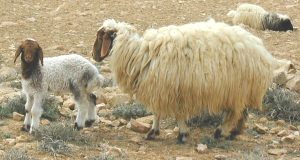
The fat-tailed or broad-tailed sheep is a smallish breed usually brown and white with a very broad tail. Like most other breeds of sheep in the Middle East it has large floppy ears.

Sheep are generally fairly timid animals, lacking the self-confidence and adaptability of goats. While goats will spread out in their search for food and then regroup without much difficulty, sheep become very insecure when they are separated from other sheep and tend to stay bunched together. They thus require a lot of shepherding. In the Middle East the method of shepherding involves training the dominant ram to follow the shepherd. The remaining sheep then follow this dominant ram, which often wears a wooden clapper or a bell. As they feed, the sheep usually keep within earshot of this sound. It is likely that this method is centuries old.

In most modern breeds only male sheep have horns, but in most ancient breeds female sheep had short horns too. This made separating sheep from goats in a single flock more difficult than it is today.

Of all animals the sheep was the most important for the Israelite nation. It had great religious, social, and economic importance.

In the Bible sheep are a common metaphor for the people of Israel and perhaps for people in general. Like sheep the people are seen as easily going astray (Psalms 119:176; Isaiah 53:6; Jeremiah 50:6; 1 Peter 2:25), as being in need of guidance and protection (1 Kings 22:17; 2 Chronicles 18:16; Matthew 9:36; Mark 6:34), as being very defenseless (Isaiah 52:7), and as being destined to an early death (Psalms 44:22; Jeremiah 12:3; Romans 8:36).

The metaphor of a lamb is used in the New Testament to refer to Christ, with an emphasis on his being a sacrifice for the sin of the world. This is especially the case in John’s gospel and Revelation. In the latter book the metaphor is introduced in a very striking way. In Revelation 5:5 as the writer is mourning the fact that no one can be found to open the scroll, he is comforted by one of the elders who tells him that “the Lion of the tribe of Judah” has triumphed and can thus open the scroll. Then the writer, expecting to see the Lion, sees instead a Lamb that looks as if it has been killed for sacrifice. The remainder of the book is then concerned with describing the triumph of this Lamb over the forces of evil.

In the gospels Jesus also refers to his disciples as “sheep” and “lambs” (Matthew 10:17; John 10:1 et al.).

The metaphor of the shepherd is extended to God himself who is the ultimate “Shepherd of Israel” (Psalms 23:1; 80:1). Then those who are responsible for the nurture, guidance, ruling, and protection of Israel, be it kings, prophets, or priests, are also likened to shepherds (Isaiah 56:11; Jeremiah 23:4; 49:19; Ezekiel 34:2; Zechariah 10:2).

The Messiah is also called a shepherd (Isaiah 40:11), and Jesus refers to himself as “the good shepherd” (John 10:11). In Hebrews 13:20 he is referred to as “the great shepherd of the sheep” and in 1 Peter 2:25 he is called “the Shepherd and Guardian of your lives”.

In languages that have a word for sheep, it is advisable to translate according to the meanings given above. If possible, the feminine forms should be translated as “female lamb” or “female sheep”. In languages in which sheep are not known, a word has usually been coined or borrowed by the time Bible translation begins, and this word should be used. It is not advisable to substitute another locally well-known animal in this case, since doing so negates the ritual and symbolic importance that sheep had for the biblical cultures.

In translating Psalms 23:1 it is extremely important to make sure that the phrase “my shepherd” preserves the relationship intended by the writer and reflects the psalmist’s theme that Yahweh is his benefactor, protector, and guide. There are really two metaphors involved in the opening verse-the caring shepherd (God) and by clear implication, the dependent sheep (the psalmist). In many languages the literal phrase “my shepherd” depicts a wrong relationship, meaning something like “the one who looks after my sheep” or “the one I employ to watch my sheep.” In many African languages unwary translators have produced a rendering that means “The Chief is (nothing more than) my herdsman.” It is often necessary to restructure the whole verse as something like “I am a sheep, and the lord is my shepherd.”

Sheep with lamb, photo by Ray Pritz

Source: All Creatures Great and Small: Living things in the Bible (UBS Helps for Translators)

See also sheep, lamb, and shepherd.

Translation commentary on 2 Chronicles 35:7

Then Josiah contributed to the lay people, as passover offerings for all that were present …: Like Hezekiah before him (2 Chr 31.3), King Josiah made a personal contribution to the celebration of the Passover. The Hebrew verb for contributed is literally “lifted up,” but its meaning here is “offered” or “gave” (New Century Version). For the lay people, see the comments on 2Chr 35.5.

Lambs and kids from the flock to the number of thirty thousand, and three thousand bulls: The Hebrew word for lambs refers to young rams (see the comments on 1 Chr 29.21), and the expression for kids (literally “sons of goats”) refers to young goats. But several versions omit any reference to the age of the animals and translate simply “sheep and goats” (Contemporary English Version, New International Version, New Century Version). Revised English Bible, on the other hand, translates explicitly “young rams and goats.”

According to Exo 12.3-11, the Passover offering must consist of sheep or goats, and the meat must be roasted, not boiled in water. However, according to Deut 16.2-8, cattle as well as sheep and goats could be offered, and the meat must be boiled in water. These two different traditions are combined in 2 Chronicles, with the result that the Passover offering consisted of sheep and goats, and the cattle were considered as a separate additional offering. Verse 13 calls the offering of cattle “the holy offerings.” The Hebrew text here in verse 7 indicates that the passover offerings consisted only of the lambs and kids. The bulls were not a part of the passover offerings but were additional offerings. By restructuring the wording of this verse, Good News Translation does not maintain this distinction.

The words to the number of thirty thousand follow the words all that were present in the Hebrew text, but the number 30,000 refers to the lambs and kids and not to the people. Revised Standard Version has changed the word order to avoid the ambiguity.

These were from the king’s possessions: This statement that makes it clear that what King Josiah contributed was taken from what he owned personally. This information may easily be incorporated in the earlier part of the verse to avoid a separate sentence here. Good News Translation does so with the words “from his own herds and flocks.”

Quoted with permission from Omanson, Roger L. and Ellington, John E. A Handbook on 1-2 Chronicles, Volume 1. (UBS Helps for Translators). Miami: UBS, 2014. For this and other handbooks for translators see here .