
Click here to see the image in higher resolution.
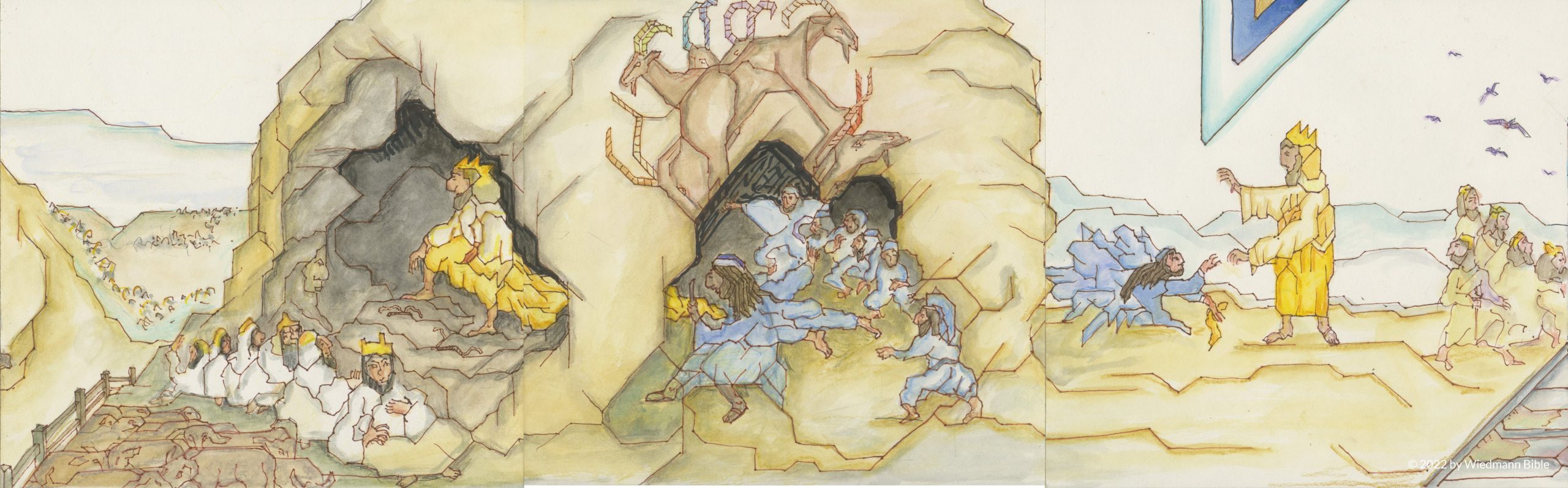
Image taken from the Wiedmann Bible. For more information about the images and ways to adopt them, see here .
For other images of Willy Wiedmann paintings in TIPs, see here.

וַיֹּ֨אמֶר֙ אֶל־דָּוִ֔ד צַדִּ֥יק אַתָּ֖ה מִמֶּ֑נִּי כִּ֤י אַתָּה֙ גְּמַלְתַּ֣נִי הַטּוֹבָ֔ה וַאֲנִ֖י גְּמַלְתִּ֥יךָ הָרָעָֽה׃
17He said to David, “You are more righteous than I, for you have repaid me good, whereas I have repaid you evil.
Following is a list of (back-) translations of various languages:
See also respectable, righteous, righteous (person), devout, and She is more in the right(eous) than I.
Following are a number of back-translations as well as a sample translation for translators of 1 Samuel 24:17:
The name that is transliterated as “David” in English is translated in Spanish Sign Language with the sign signifying king and a sling (referring to 1 Samuel 17:49 and 2 Samuel 5:4). (Source: John Elwode in The Bible Translator 2008, p. 78ff. )
“Elizabeth” in Spanish Sign Language, source: Sociedad Bíblica de España
In German Sign Language it is only the sling. (See here ).
“David” in German Sign Language (source )
For more information on translations of proper names with sign language see Sign Language Bible Translations Have Something to Say to Hearing Christians .
The (Protestant) Mandarin Chinese transliteration of “David” is 大卫 (衛) / Dàwèi which carries an additional meaning of “Great Protector.”
Learn more on Bible Odyssey: David .
Like a number of other East Asian languages, Japanese uses a complex system of honorifics, i.e. a system where a number of different levels of politeness are expressed in language via words, word forms or grammatical constructs. These can range from addressing someone or referring to someone with contempt (very informal) to expressing the highest level of reference (as used in addressing or referring to God) or any number of levels in-between. One way Japanese shows different degree of politeness is through the choice of a second person pronoun (“you” and its various forms) as shown here in the widely-used Japanese Shinkaiyaku (新改訳) Bible of 2017. The most commonly used anata (あなた) is typically used when the speaker is humbly addressing another person.
In these verses, however, omae (おまえ) is used, a cruder second person pronoun, that Jesus for instance chooses when chiding his disciples. (Source: S. E. Doi, see also S. E. Doi in Journal of Translation, 18/2022, p. 37ff. )
See also first person pronoun with low register and third person pronoun with low register.
Righteous renders a Hebrew term with a wide range of meanings. It may refer to that which is right in a legal sense. In some contexts the primary focus seems to be on right ethical behavior. It is, furthermore, sometimes used to indicate that someone has acted loyally or in the proper way within an established relationship. This latter sense seems to be in focus in this verse.
In languages where comparisons are difficult to translate, the more categorical wording of Good News Translation may provide a better model for the first part of the quotation.
For: the transition word between Saul’s admission of wrong and his reasons for doing so is important. It is possible to render it “because.” In some languages the two parts may be reversed, giving the reasons first and then the evaluation, and connecting the two with a “therefore.”
The verb repaid is not to be taken in the sense of repayment for something owed. So a literal rendering is not advised. The basic meaning of the verb is “deal with [someone or something].” It is translated in other versions as “treated” (Revised English Bible) and “done” (Moffatt). In some languages two different verbs will be required to convey the ideas “done good” and “done wrong.” The second person singular pronoun, you, is emphatic in Hebrew.
Whereas: literally “and I,” using the emphatic pronoun, which highlights the contrast between Saul’s actions and those of David.
Quoted with permission from Omanson, Roger L. and Ellington, John E. A Handbook on the First and Second Books of Samuel, Volume 1. (UBS Helps for Translators). New York: UBS, 2001. For this and other handbooks for translators see here .
No comments yet.
Leave a Reply
You must be logged in to post a comment.