Low German translation by Johannes Jessen, publ. 1933, republ. 2006: “steppe”
Yakan: “the lonely place” (source: Yakan Back Translation)
Western Bukidnon Manobo: “a land where no people lived” (source: Western Bukidnon Manobo Back Translation)
Kankanaey: “the place with no inhabitants” (source: Kankanaey Back Translation)
Matumbi uses various term: lubele (desert, sandy place without water) — used in John 11:54, lupu’ngu’ti (a place where no people live, can be a scrub land, a forest, or a savanna) — used in Mark 1:3 et al.), and mwitu (a forest, a place where wild animals live) — used in Mark 1:13 et al.) (Source: Pioneer Bible Translators, project-specific notes in Paratext)
Chichewa Contemporary translation (2002/2016): chipululu: a place uninhabited by people with thick forest and bush (source: Mawu a Mulungu mu Chichewa Chalero Back Translation)
Note that in Luke 15:4, usually a term is used that denotes pastoral land, such as “eating/grazing-place” in Tagbanwa (source: Tagbanwa Back Translation).
The term that is transliterated as “Philistines” in English is translated in American Sign Language with a sign that signifies the helmet the Philistine warriors wore was decorated with feather-like objects. (Source: Ruth Anna Spooner, Ron Lawer)
“Philistines” in American Sign Language, source: Deaf Harbor
Click or tap here to see a short video clip about Philistines (source: Bible Lands 2012)
The Hebrew and Greek that is transliterated as “Saul” in English is translated in Spanish Sign Language with the sign that depicts “sword in chest” (referring to 1 Samuel 31:4 and 1 Chronicles 10:4) and also “self-centered.” (Source: Steve Parkhurst)
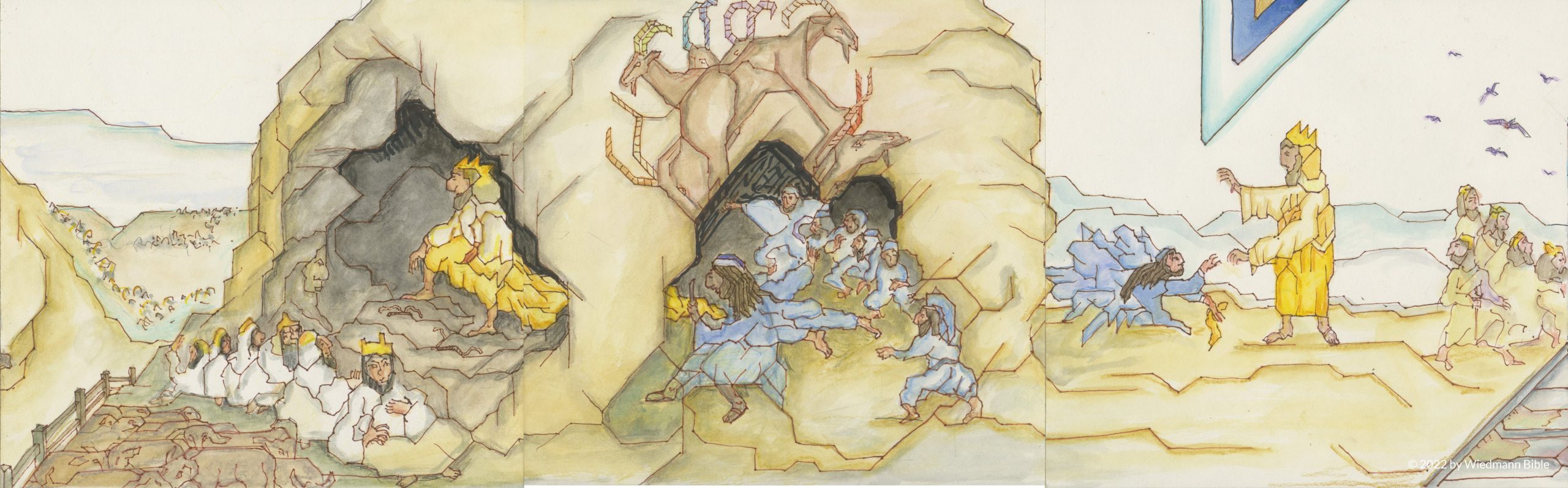
Following are a number of back-translations as well as a sample translation for translators of 1 Samuel 24:1:
Kupsabiny: “When Saul had come back from that war with the Philistines, the people told him that David had gone to the wilderness of En-gedi.” (Source: Kupsabiny Back Translation)
Newari: “After Saul came back, having done battle with the Philistines, they said, "Look, David is in the desert of En-Gedi."” (Source: Newari Back Translation)
Hiligaynon: “When Saul returned from fighting against the Filistinhon, he was-told that David (was) there in the desolate-place of En Gedi.” (Source: Hiligaynon Back Translation)
English: “After Saul and his soldiers returned home after fighting against the Philistia army, someone reported to Saul that David and his men had gone into the desert near En-Gedi.” (Source: Translation for Translators)
When Saul returned: literally “And it happened when Saul returned.” The verbal transition word is used here to mark the beginning of a new episode in the ongoing narrative of the relationship between Saul and David.
The words from following are literally “from behind.” The sense in this context is not that Saul was simply following behind the Philistines, but rather that he had been “pursuing” them (New Jerusalem Bible, New Jewish Publication Society’s Tanakh, and Revised English Bible). Contemporary English Version has “from fighting off.”
He was told: literally “they told him, saying.” Where the passive is unacceptable, a literal rendering of the Hebrew may be used. Or others may wish to say “someone told him.”
En-gedi: see the comment on 23.39.
In many cases the direct quotation in this verse may be better translated as indirect discourse following the model provided by Good News Translation.
Quoted with permission from Omanson, Roger L. and Ellington, John E. A Handbook on the First and Second Books of Samuel, Volume 1. (UBS Helps for Translators). New York: UBS, 2001. For this and other handbooks for translators see here .


Leave a Reply
You must be logged in to post a comment.