The references to mulberry in the Scriptures are all controversial. However, Zohary (Plants of the Bible. Cambridge University Press, 1982) on the basis of cognate words in Sumerian (messikanu, sukannu) confidently associates the Hebrew word mesukan in Isaiah 40:20 with the mulberry tree, as did Thompson before him. Further, they take the Greek word sucaminos in Luke 17:6 as also cognate with Sumerian sukannu. Like the apple, the pomegranate, the fig and the pistachio, the Black Mulberry Morus nigra may have been introduced into the Holy Land from one of the neighboring countries like Persia (now Iran).
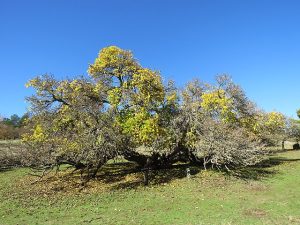
The black mulberry is a large, broad tree (6 meters [20 feet] high) that produces flowers and leaves in spring and loses its leaves every year in winter. The crown is broad and low. The trunk gets twisted as it grows old and may rot away, only to be replaced by another one from the same root. People pile stones up in order to support the low branches of old trees. The leaves are stiff, rough, and hairy. The flowers are pollinated by the wind, and the fruit is a rather tart, black berry about the size of a large cashew nut. In Europe and North America, people use mulberries mostly to make pies and wine. A different species, the white mulberry, has a whitish fruit.
The black mulberry tree is similar in size and shape to the sycomore fig. In fact, the translators of the Greek Septuagint introduced considerable confusion by translating the Hebrew word shiqmah as sucaminos (1 Kings 10:27 et al.)
There are at least eighteen subspecies of mulberry in the world, distributed from China to North America. In the Middle East area two have been cultivated, the black mulberry and the white mulberry. The black mulberry grows well in what is now Iran, and it may have been introduced into Canaan from there. In areas where the mulberry tree is found, the local name should be used in Luke 17:6. Where it is not found (for example, most of Africa), transliteration from a major language is advised, for example, muluberi or sikamayin. (French mûrier, Spanish mora, Portuguese amoreira, Arabic tut).
Although the first definite reference to elephants in the Bible is in the Greek deuterocanonical book of 1 Maccabees, ivory (literally “tooth”) is mentioned first in the time of Solomon. By this date there were already ivory trade routes from the Sudan down the Nile and by sea from where Djibouti is now on the African Red Sea coast to where Eilat is now on the Gulf of Aqaba. Some of the ivory may have been made from the teeth of the hippopotamus but two references, 1 Kings 10:22 and 2 Chronicles 9:21, specifically refer to elephant ivory (literally “elephant’s tooth”). Ivory was probably known even much earlier than this since ornaments dating from around 2300 B.C. have been found in Palestine.
The Indian Elephant Elephas maximus was domesticated and trained for use in war very early well before the second millennium B.C. When Alexander the Great extended his empire into India in the fourth century B.C. he obtained war elephants to incorporate into his army. The idea of using elephants in war then spread to the Middle East. There was a smaller variety of this elephant found in Syria and Mesopotamia. By the third century B.C. domestic Indian elephants had been introduced into Egypt. Ptolemy II is reported to have had ninety-six elephants, four to a chariot, and later that same century when Ptolemy IV defeated the Seleucid king of Syria, Antiochus III, he is reported to have captured Syrians’ elephants. However, the Seleucid kings continued to use war elephants, and the next king, Epiphanes, attacked Egypt with elephants. He and his son then used them in their campaign against the Jews. According to 1Maccabees each elephant with thirty-two soldiers mounted on it, besides the Indian handler went into battle ahead of one thousand Syrian soldiers and five hundred horsemen. One of Maccabeus’ brothers was able to kill the largest elephant by getting under it and stabbing it, but he was himself killed when the elephant fell on him. At a later time probably because the Indian elephants were difficult to obtain the African Elephant Loxodonta africana was tamed for use in war. Coins show that the elephants used by the Roman Emperor Hadrian to cross the Alps were African probably brought from North Africa.
Elephas is the word most commonly used in the deuterocanonical books although elephantarchēs which means commander of an elephant squadron is used in 2 Maccabees 14:12 and 3 Maccabees 5:4 and 3 Maccabees 5:45 and thērion which means “monster” is used in 2 Maccabees 15:20f.
Elephants are the largest land animals on earth, the males of the Indian species being about 3 meters (10 feet) in height and weighing almost 4,000 kilograms (8,800 pounds). The African species is about half a meter (20 inches) higher and weighs up to 6,000 kilograms (13,200 pounds). The elephant’s trunk is basically an elongated nose, but it has muscles that make it a very useful feature. With it the elephant can not only smell but can pull down branches to eat, pick berries off bushes, draw up water to squirt into its mouth or over its body, and can use it as a weapon. On either side of the trunk the males grow long tusks that are often over 2 meters (6 feet) in length. These are used for digging up roots, gouging bark off trees, and lifting logs. These tusks are made of ivory. Elephants have large ears, which they use to fan themselves.
They are a dark gray color and have no fur. Their body looks almost hairless but in fact they are covered with bristly hairs. They feed on vegetation such as leaves roots shoots bark and fruit.
There are local words for elephant in most African, Middle Eastern, and Asian languages, and many international languages use a word derived from the Greek name elephas. In some areas even though there are no elephants, the fossilized bones of mammoths, the ancient relative of the elephant, are known, and this local name is used for modern elephants too. In most other areas the word for elephant is a word that is borrowed from the dominant language of the area.
The Hebrew, Greek and Latin that is translated in English typically as “vine” is translated in Lak as къюмайтӀутӀул мурхьра: “the (grape-) cluster tree.”
Vitaly Voinov tells this story: “Laks (who live in the mountainous regions of Dagestan) historically have had no experience with planting and tending vineyards. They buy grapes at the market or the store, but that’s about all they know of grape growing. Thus, in field testing, none of the readers could picture the primary image of this chapter. The translator’s initial attempt of rendering ‘vine’ as ‘grape stalk’ met with complete non-understanding. After much discussion of the problem and potential solutions, we settled on what one of the field testing respondents suggested to remedy the problem: ‘vine’ was rendered as ‘the (grape-)cluster tree’ (къюмайтӀутӀул мурхьра). Technically grapes of course don’t grow on trees, but something had to be put in the text, and it had to be said in a way that the average reader/hearer could understand it. The Lak team could have borrowed the Russian word for ‘vine’ (лоза), but since this is a very low-frequency word in the Russian language, it’s likely that many Laks wouldn’t know the Russian word either. So the team settled for a reduction of accuracy in order to achieve greater clarity. After all, the primary point of importance in this passage is not a horticultural analysis, but a metaphorical comparison to the spiritual world, to the relationship between the Father, His Son, and the followers of Jesus. This rendering allows readers to get to the core of this meaning without getting tangled up in unknown terms.”
The Common Grape Vine Vitis vinifera is mentioned more often than any other plant or tree in the Bible. Excavations in Greece have discovered grape seeds dating to 4500 B.C. Egyptian records document the existence of cultivated vines in Canaan as early as 2375 B.C., and subsequent records report trade in vine products around 1360 B.C. and many times thereafter.
The vine is a creeping plant that develops a woody stem when it matures. It grows along the ground until it finds a tree or other object to climb, using tendrils. It bears bunches of small round fruit that are sweet and juicy. Today farmers grow them commercially throughout the Mediterranean area, in South Africa, in North America, and in many other countries. The first reference to the vine in the Bible (Genesis 9:20) tells us that Noah planted a vineyard (Hebrew kerem) and that he made an alcoholic drink from the fruit. Farmers since then have improved on the size, color, and quality of the fruit by careful pruning and selection until now there are at least 65 kinds of grapevines. Like many other plants in temperate areas, the vine has leaves that appear in early spring. After the fruit is picked and the weather gets cold, the leaves drop off and the plant is bare until the following spring. A typical vineyard in Bible times was surrounded by a stone fence. It had a stone tower from which the owner could watch for predators, and a place to squeeze the juice out of the fruits.
The vine is the most frequently cited plant in the Bible, and that alone makes it special. Vines, grapes, raisins, and wine were a major element of Jewish life, so it is not a surprise that the vine and its products are used figuratively probably more than any other Bible plant. After the flood purified the earth at the time of Noah, the vine became the means by which the human race was plunged again into sin (Genesis 9:20). We know from Jacob’s blessing in Genesis 49:11f. and other passages that the vine was the symbol of blessing, prosperity, and happiness. The fact that there were groups like the Nazirites and Rechabites who abstained from drinking wine simply shows the radical self-denial that these people imposed on themselves. A drink offering of wine was an important part of worship (Exodus 29:40), and the image of contentment was “every man under his vine and under his fig tree” (Micah 4:4). Jotham includes the vine in his well-known Parable of the Trees (Judges 9:7ff.). In the New Testament, Jesus rescued a man from humiliation at a wedding party by miraculously providing a fresh supply of wine (John 2:1ff.). Wine becomes a major symbol in the Christian community when Jesus foreshadows his crucifixion by comparing the wine poured out in the Passover celebration to his blood (Matthew 26:27f. et al.). He speaks of the need for Christians to be like the branches of the vine, drawing their nourishment from him, the True Vine (John 15.:1ff.). Nearly every New Testament writer makes some metaphorical reference to the vine or its products.
There are around 65 kinds of grapevines (Vitis vinifera) found in the Northern Hemisphere. They belong to a larger family of creeping plants called Vitaceae, which has over 800 species throughout the world including many in the tropical and warm climates of the world.
Grapevines have occasionally been grown in West Africa (for example, in The Gambia and in northern Nigeria) but are not well known even where they are grown commercially. Attempts at substituting a local tree name have not been entirely successful because the species chosen is usually not cultivated and/or does not have the same economic or social function that the grape had in Israel.
Thus it is probably best to use a transliteration from a major language. However, in parts of Nigeria and perhaps elsewhere, the word grep refers to “grapefruit” and should be avoided in translation. A transliteration from “vine” or “wine” is preferred, although a translator needs to be careful. The English word “vine” refers to any creeping plant, but it also refers to a particular kind of vine that produces grapes (Vitis vinifera). This can be confusing. Furthermore, translators in English-speaking countries should think carefully about what they are going to do with the word “wine.” In The Gambia, Mandinka translators first used “wayini tree” but later concluded that it may be better to have a word for “vine” that is not necessarily identical with “wine.” Bine, from binekaro (“vinegar”), was considered, as was inabi (“grape”) from Arabic.
Languages that borrow the Arabic word inabi must deal with the fact that this word bears an unfortunate resemblance to annabi (“prophet”) and new readers reading “water of inabi” in a context of prophecy may associate it, for better or worse, with prophets and prophecy. In northern Nigeria church people have gotten used to inabi in the New Testament even though many of them don’t know what it is. Basa in Nigeria uses a wild grape-like plant (afwafwa), and Igala has used the same species (achiwebetema) for years. Likewise, two translations in Mali and Burkina Faso use their local name for a wild vine (Lannea microcarpa) for the biblical vine. There is a species (Rhoicissus tridentata) in southern and eastern Africa known as “African grape” (locally called “bobbejaantou”). In such cases translators should write a footnote (or glossary item) stating that the grapes of Bible times were larger and sweeter than the local variety, and that they were cultivated extensively as a source for producing beverages. Other possibilities for transliteration are: vinyola/videra (Portuguese), vitis (Latin), and inab (Arabic).
Fruit of the vine (Hebrew ‘enav; Greek botrus, staphulē): There is some evidence that botrus refers to a bunch of grapes, while staphulē refers to individual grapes. According to Louw and Nida (Greek-English Lexicon of the New Testament based on Semantic Domains, 1988), however, both words may refer to individual grapes as well as bunches of grapes. The Hebrew word tirosh is equivalent to the word “vintage” in English, that is, the grape harvest and possibly the first squeezing of the grapes. It is normally used along with the words referring to the olive harvest (yitshar) and grain harvest (dagan).
They showed the elephants the juice of grapes and mulberries: The pronoun They may be translated “Some of the [Syrian] soldiers” (Contemporary English Version), since they were probably the people directly assigned to take care of the elephants. Grapes are purple berries that grow in clusters on vines. Mulberries are small berries that grow in clusters on trees; most varieties are a very dark purple color. Some think the elephants were given an intoxicating drink made from grapes and mulberries; for example, New American Bible has “They made the elephants drunk on grape and mulberry wine,” and New Jerusalem Bible says “The elephants were given a syrup of grapes and mulberries.” However, this is unlikely. In the first place, drunken elephants would be just as dangerous to their own army as to the enemy, particularly if surrounded by horses (see verses 35-36). Further, “wine” is not specifically mentioned; rather the juice of grapes and mulberries is literally “blood of grapes and mulberries.” Some point out that if unfermented juice is meant, this would date the battle to the autumn. Goldstein thinks that they could have kept the juice from fermenting by cooking it, but the picture of people boiling vats of juice for the benefit of elephants is a bit strange. Still further, it would take an awful lot of wine to make one elephant drunk, let alone thirty-two of them. Also, the text says nothing about the elephants drinking anything at all; they were simply shown this juice. It may have been that the color resembled blood, and that showing the animals the liquid or perhaps cloth stained with it was part of their conditioning for battle. In cultures where grape juice and mulberry juice are unknown, translators may say “the juice made from dark-red-colored fruit.”
To arouse them for battle: When their trainers showed them the juice, the elephants (that had been in battle before; see verse 30) became excited, knowing that a battle was not far off. Some commentators suggest that the elephants liked the mixture, and became very excited at the prospect of drinking some. However, if this was part of preparation for battle, it would not take very long for the animals to associate the liquid with an upcoming battle, so we believe that the former suggestion that the animals became excited when they saw the red color is the more likely. It is also possible that whatever the trainers did had no effect on the elephants at all; they just thought it ought to work. At any rate, translators are not required to explain all this to the reader. It will simply remain a peculiar statement that readers will wonder about. That’s what it has been for centuries, and it is not the only such place in Scripture. Other ways to translate this clause are “to get them ready for battle” (similarly Good News Bible) and “to make them eager to fight” (Contemporary English Version).
An alternative model for this verse is:
• Some of the soldiers showed the elephants grape and mulberry juice to make them eager to fight.
Quoted with permission from Bullard, Roger A. and Hatton, Howard A. A Handbook on 1-2 Maccabees. (UBS Helps for Translators). New York: UBS, 2011. For this and other handbooks for translators see here.



Leave a Reply
You must be logged in to post a comment.