altar

The Greek, Latin and Hebrew that is translated as “altar” in English is translated in a number of ways:

  • Obolo: ntook or “raised structure for keeping utensils (esp. sacrifice)” (source: Enene Enene)
  • Muna: medha kaefoampe’a or “offering table” (source: René van den Berg)
  • Luchazi: muytula or “the place where one sets the burden down”/”the place where the life is laid down” (source: E. Pearson in The Bible Translator 1954, p. 160ff. )
  • Tzotzil: “where they place God’s gifts” (source: John Beekman in Notes on Translation, March 1965, p. 2ff.)
  • Tsafiki: “table for giving to God” (source: Bruce Moore in Notes on Translation 1/1992, p. 1ff.)
  • Noongar: karla-kooranyi or “sacred fire” (source: Warda-Kwabba Luke-Ang)
  • Uma: “offering-burning table” (source: Uma Back Translation)
  • Yakan: “place for sacrificing” (source: Yakan Back Translation)
  • Tagbanwa: “burning-place” (source: Tagbanwa Back Translation)
  • Tibetan: mchod khri (མཆོད་​ཁྲི།) or “offering throne” (source: gSungrab website )
  • Bura-Pabir: “sacrifice mound” (source: Andy Warrren-Rothlin)
  • Kalanga: “fireplace of sacrifice” (source: project-specific notes in Paratext)
The Ignaciano translators decided to translate the difficult term in that language according to the focus of each New Testament passage in which the word appears (click or tap here to see the rest of this insight

Willis Ott (in Notes on Translation 88/1982, p. 18ff.) explains:

  • Matt. 5:23,24: “When you take your offering to God, and arriving, you remember…, do not offer your gift yet. First go to your brother…Then it is fitting to return and offer your offering to God.” (The focus is on improving relationships with people before attempting to improve a relationship with God, so the means of offering, the altar, is not focal.)
  • Matt. 23:18 (19,20): “You also teach erroneously: ‘If someone makes a promise, swearing by the offering-place/table, he is not guilty if he should break the promise. But if he swears by the gift that he put on the offering-place/table, he will be guilty if he breaks the promise.'”
  • Luke 1:11: “…to the right side of the table where they burn incense.”
  • Luke 11.51. “…the one they killed in front of the temple (or the temple enclosure).” (The focus is on location, with overtones on: “their crime was all the more heinous for killing him there”.)
  • Rom. 11:3: “Lord, they have killed all my fellow prophets that spoke for you. They do not want anyone to give offerings to you in worship.” (The focus is on the people’s rejection of religion, with God as the object of worship.)
  • 1Cor. 9:13 (10:18): “Remember that those that attend the temple have rights to eat the foods that people bring as offerings to God. They have rights to the meat that the people offer.” (The focus is on the right of priests to the offered food.)
  • Heb. 7:13: “This one of whom we are talking is from another clan. No one from that clan was ever a priest.” (The focus in on the legitimacy of this priest’s vocation.)
  • Jas. 2:21: “Remember our ancestor Abraham, when God tested him by asking him to give him his son by death. Abraham was to the point of stabbing/killing his son, thus proving his obedience.” (The focus is on the sacrifice as a demonstration of faith/obedience.)
  • Rev. 6:9 (8:3,5; 9:13; 14:18; 16:7): “I saw the souls of them that…They were under the table that holds God’s fire/coals.” (This keeps the concepts of: furniture, receptacle for keeping fire, and location near God.)
  • Rev. 11:1: “Go to the temple, Measure the building and the inside enclosure (the outside is contrasted in v. 2). Measure the burning place for offered animals. Then count the people who are worshiping there.” (This altar is probably the brazen altar in a temple on earth, since people are worshiping there and since outside this area conquerors are allowed to subjugate for a certain time.)

See also altar (Acts 17:23).


In the Hebraic English translation of Everett Fox it is translated as slaughter-site and likewise in the German translation by Buber / Rosenzweig as Schlachtstatt.
cubit

The Hebrew, Aramaic and Greek that is translated as “cubit” or into a metric or imperial measurement in English is translated in Kutu, Kwere, and Nyamwezi as makono or “armlength.” Since a cubit is the measurement from the elbow to the tip of the middle finger, one armlength (measured from the center of the chest to the fingertips) equals two cubits or roughly 1 meter. (Source: Pioneer Bible Translators, project-specific translation notes in Paratext)

Similarly, in Akoose, the translation is “arm distance.” (Source: Joseph Nkwelle Ngome and Marlie van Rooyen & Jacobus A. Naudé in Communicatio 2009, p. 251ff.)

In Klao it is converted into “hand spans” (app. 6 inches or 12 cm) and “finger spans” (app. 1 inch or 2 cm) (source: Don Slager) and in Bariai into leoa or “fathom,” which comprises the distance from a person’s fingertip to fingertip with arms outstretched, app. 6 feet (source: Bariai Back Translation).

distance (long / wide / high)

The concepts of distance that are translated in English with “long,” “wide,” and “high/tall” are translated in Kwere with one word: utali. (Source: Pioneer Bible Translators, project-specific translation notes in Paratext)

sanctuary

The Hebrew, Greek and Latin that is translated as “sanctuary” in English is translated in the Contemporary Chichewa translation (2002/2016) with opatulika or “separated place.” This is understood in a religious setup as a place designated for worship. (Source: Mawu a Mulungu mu Chichewa Chalero Back Translation)

complete verse (1 Kings 6:20)

Following are a number of back-translations as well as a sample translation for translators of 1 Kings 6:20:

  • Kupsabiny: “The House of God was partitioned in order to make a Secret room which is very much feared/respected together with a Sitting (common) room. All the sides of that Secret room were the same. Each side had thirty feet. The Sitting room had a length of sixty feet. Small pieces of timber from cedar tree were put on the walls of that house from bottom to top and cypress timber were used on the floors of the house. The timber on the walls of that house were beautified/decorated with some things which looked like gourds and flowers being engraved on (them). The timber closed/sealed everywhere as if no single stone had been used. That Secret room had been made/prepared so that the Box of the Covenant of God would be kept there. The whole wall of that Secret room was smeared with gold up to the top (ceiling). There was a altar for sweet-smelling sacrifices by the door of the Secret room of the House of God. That thing was made of cedar wood and was covered with gold. The wall of the Sitting room too was smeared with gold and the front part of that Secret room was crossed with chains made of gold. So, Solomon beautified/decorated every part of the House of God using gold.” (Source: Kupsabiny Back Translation)
  • Newari: “This Most Holy Place was 9 meters long, 9 meters wide and 9 meters high. And just outside the Most Holy Place, this altar that they made from cedar wood, they overlaid it too with the best gold.” (Source: Newari Back Translation)
  • Hiligaynon: “This room was square; its length, width, and height are-the-same 30 feet. Its walls and ceiling had- Solomon -covered with pure gold, and also with the altar that is made of cedar wood.” (Source: Hiligaynon Back Translation)
  • English: “That room was 30 feet long, 30 feet wide, and 30 feet high. They covered the walls with very thin sheets of pure gold. For burning incense they also made an altar of cedar boards.” (Source: Translation for Translators)

cedar

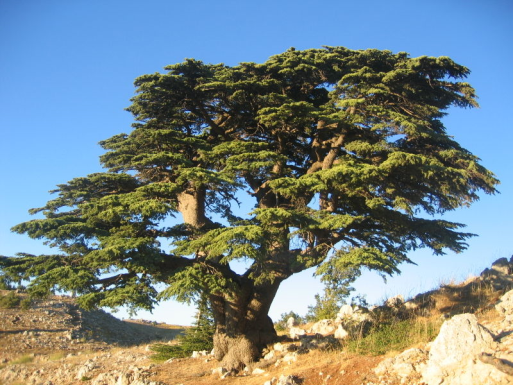
Long ago the majestic cedars of Lebanon (Cedrus libani) completely covered the upper slopes of the Lebanon Mountains on the western and northern sides. Now only a few pockets of these mighty cedars remain. At that time they were mixed, as they are today, with other trees such as Cilician fir, Grecian juniper, cypress, and Calabrian pine.

We know from 1 Kings that Solomon used cedar wood in his palace and in the Temple. Cedar was used for beams, boards, pillars, and ceilings. Historians tell us that the Assyrians also hauled cedars to their land for use in buildings. Nebuchadnezzar of Babylon also imported cedars from Lebanon. In some versions of Isaiah we read that people made idols of cedar and oak (44:14-20). Finally, when the Temple was rebuilt by the returning exiles (Ezra 3:7), they again cut down cedar trees to grace the house of God.

In 2 Samuel, 1-2 Kings, 1-2 Chronicles and Ezra, when Lebanon is specifically mentioned, there can be no doubt that ’erez is Cedrus libani, the “cedar of Lebanon,” although it is possible that sometimes the word was used loosely to include various evergreen trees.

In the description of the purification rituals (Leviticus 14:4 at al.), the word ’erez probably refers to the Phoenician juniper tree, since that was the only cedar-like tree in the Sinai Desert.

Description  Cedar trees can reach 30 meters (100 feet) high with a trunk more than 2 meters (7 feet) in diameter. The leaves of true cedars are not flat like those of most trees, but consist of tufts of dark green, shiny spines. (The cedars in North America have a flatter type of spine than the biblical cedar.) The wood is fragrant and resistant to insects. Cedars bear cones and can live to be two or three thousand years old.

The cedar of Lebanon is famous for its large size (see Isaiah 2:13 et al.), and for the fragrance of its wood. Psalm 92:12 links the cedar to righteousness, that is, presumably, to its straightness and height above other trees. The cedar is the national emblem of Lebanon.

Cedrus species are found in the mountains of North Africa, in the Himalayas, in India, and in North America. Translators in these places, should, of course, use the local name in nonfigurative references. In sub Saharan Africa, translators can transliterate from Hebrew (’erez), Greek (kedar), English (sedar), or another major language, or they can take a generic solution such as “large, beautiful tree.” In poetic passages (wisdom literature and prophecy), some translators may wish to use a cultural equivalent with these traits. In Africa, according to Burkhill (The Useful Plants of West Tropical Africa, volume 4. Kew: Royal Botanic Gardens, 1985), the Pink Mahogany Guarea cedrata is also called the pink African cedar because of the cedar-like scent of its timber. Likewise, some people in India and Australia use “cedar” to refer to the toon because of its reddish wood. I do not recommend such substitutes in historical passages, since the ’erez is not related to these trees. In some figurative passages, however, the substitution could be effective, since all are large trees with reddish wood. However, each passage has to be evaluated to determine the intended effect of the image.

Cedar of Lebanon, Wikimedia Commons

Source: Each According to its Kind: Plants and Trees in the Bible (UBS Helps for Translators)

Translation commentary on 1 Kings 6:20

The inner sanctuary …: The beginning of this verse in the Masoretic Text reads “and in front of the inner sanctuary….” This Hebrew text is difficult grammatically, and most translations (Revised Standard Version/New Revised Standard Version, Revised English Bible) follow the Septuagint, which lacks the words “in front of.” Critique Textuelle de l’Ancien Testament gives a {D} rating to the Masoretic Text and admits that the Hebrew text may not be what was written originally. If the Masoretic Text is followed, Traduction œcuménique de la Bible provides a useful model: “In front of the sacred room, whose length was twenty cubits and whose width was twenty cubits and whose height was twenty cubits, which Solomon had overlaid with pure gold, was found the altar which had been paneled in cedar” (similarly Nouvelle Bible Segond). La Bible de Jérusalem: Nouvelle édition revue et corrigée likewise reads “In front of the Debir which was twenty cubits long, twenty cubits wide and twenty cubits high, and which he had covered with pure gold, he covered the cedar altar with gold.” Translations such as Traduction œcuménique de la Bible, Nouvelle Bible Segond and New Jerusalem Bible make it clear that the altar of cedar was not in the inner sanctuary but in the room in front of it. Translations such as Revised Standard Version and Good News Translation, following the Septuagint, do not make this clear.

Twenty cubits long, twenty cubits wide, and twenty cubits high: As in verses 2, 3, and 16, the equivalent of twenty cubits is about 10 meters or 30 feet. It has already been noted in the comments on verse 16 that the inner sanctuary was cube-shaped.

He overlaid it with pure gold: The gold that is used today to overlay items is a very thin gold leaf. The gold used to cover the walls was not this thin gold leaf but rather was thick enough that it could be stripped off (see 2 Kgs 18.16). In this verse the writer says that the gold was pure. Revised English Bible translates this as “red gold,” meaning that it was the best quality gold. In other languages the idea of purity in this sense is expressed by the adjective “true.”

He also made an altar of cedar: Revised Standard Version follows the Septuagint here in reading the verb made (also Revised English Bible). The Hebrew verb in the Masoretic Text is the same as the previous verb, which is translated overlaid. So according to the Masoretic Text, the altar was not made only of cedar; rather it was made of cedar and covered with gold. Verse 22 says that the altar was covered in gold. New Living Translation says “He also overlaid the altar made of cedar”; and this may well be the intended meaning. In addition to having the verb made, the Septuagint does not have the words of cedar. De Vries follows the Septuagint in this last sentence with “And he constructed an altar.” This altar is probably the altar on which incense was burned (Exo 30.1; see also 2 Chr 26.16). It was located in front of the doors that separated the Most Holy Place from the nave.

A possible model for this verse is:

• This inner room was ten meters long, ten meters wide, and ten meters high. Solomon lined it with pure gold. He also made an altar covered with cedar paneling in front of the inner room.

Quoted with permission from Omanson, Roger L. and Ellington, John E. A Handbook on 1-2 Kings, Volume 1. (UBS Helps for Translators). New York: UBS, 2008. For this and other handbooks for translators see here .