
The Hebrew and Greek that is translated as “messenger” in English is translated in Noongar as moort yana-waangki or “person walk-talk” (source: Warda-Kwabba Luke-Ang).
complete verse (1 Chronicles 14:1)
Following are a number of back-translations as well as a sample translation for translators of 1 Chronicles 14:1:
- Kupsabiny: “After that, Hiram who was king of Tyre sent his people to go and greet David. David was brought cedars and (he) was also sent people who knew how to build (things) from stone and trees to build for him a home/palace.” (Source: Kupsabiny Back Translation)
- Newari: “Hiram king of Tyre sent messengers to David’s place. He also sent cedar, stone masons and carpenters to build a royal palace for David.” (Source: Newari Back Translation)
- Hiligaynon: “Now King Hiram of Tyre sent messengers to David along with the carpenters and stonemasons, including cedar trees, in-order to build David a palace.” (Source: Hiligaynon Back Translation)
- English: “One day Hiram, the king of Tyre city, sent some messengers to David to talk about making an agreement between their countries. Then Hiram sent cedar logs, bricklayers, and carpenters to build a palace for David.” (Source: Translation for Translators)
king
Some languages do not have a concept of kingship and therefore no immediate equivalent for the Greek, Hebrew, Aramaic, and Latin that is translated as “king” in English. Here are some (back-) translations:
(Click or tap here to see details)
- Piro: “a great one”
- Highland Totonac: “the big boss”
- Huichol: “the one who commanded” (source for this and above: Bratcher / Nida)
- Ekari: “the one who holds the country” (source: Reiling / Swellengrebel)
- Una: weik sienyi: “big headman” (source: Kroneman 2004, p. 407)
- Pass Valley Yali: “Big Man” (source: Daud Soesilo)
- Ninia Yali: “big brother with the uplifted name” (source: Daud Soesilio in Noss 2007, p. 175)
- Nyamwezi: mutemi: generic word for ruler, by specifying the city or nation it becomes clear what kind of ruler (source: Pioneer Bible Translators, project-specific translation notes in Paratext)
- Ghomála’: Fo (“The word Fo refers to the paramount ruler in the kingdoms of West Cameroon. He holds administrative, political, and religious power over his own people, who are divided into two categories: princes (descendants of royalty) and servants (everyone else).” (Source: Michel Kenmogne in Theologizing in Context: An Example from the Study of a Ghomala’ Christian Hymn))
Faye Edgerton retells how the term in Navajo (Dinė) was determined:
“[This term was] easily expressed in the language of Biblical culture, which had kings and noblemen with their brilliant trappings and their position of honor and praise. But leadership among the Navajos is not accompanied by any such titles or distinctions of dress. Those most respected, especially in earlier days, were their headmen, who were the leaders in raids, and the shaman, who was able to serve the people by appealing for them to the gods, or by exorcising evil spirits. Neither of these made any outward show. Neither held his position by political intrigue or heredity. If the headman failed consistently in raids, he was superceded by a better warrior. If the shaman failed many times in his healing ceremonies, it was considered that he was making mistakes in the chants, or had lost favor with the gods, and another was sought. The term Navajos use for headman is derived from a verb meaning ‘to move the head from side to side as in making an oration.’ The headman must be a good orator, able to move the people to go to war, or to follow him in any important decision. This word is naat’áanii which now means ‘one who rules or bosses.’ It is employed now for a foreman or boss of any kind of labor, as well as for the chairman of the tribal council. So in order to show that the king is not just a common boss but the highest ruler, the word ‘aláahgo, which expresses the superlative degree, was put before naat’áanii, and so ‘aláahgo naat’áanii ‘anyone-more-than-being around-he-moves-his-head-the-one-who’ means ‘the highest ruler.’ Naat’áanii was used for governor as the context usually shows that the person was a ruler of a country or associated with kings.”
(Source: Faye Edgerton in The Bible Translator 1962, p. 25ff. )
See also king (Japanese honorifics).
David
The name that is transliterated as “David” in English is translated in Spanish Sign Language with the sign signifying king and a sling (referring to 1 Samuel 17:49 and 2 Samuel 5:4). (Source: John Elwode in The Bible Translator 2008, p. 78ff. )
“Elizabeth” in Spanish Sign Language, source: Sociedad Bíblica de España
In German Sign Language it is only the sling. (See here ).
“David” in German Sign Language (source )
For more information on translations of proper names with sign language see Sign Language Bible Translations Have Something to Say to Hearing Christians .
The (Protestant) Mandarin Chinese transliteration of “David” is 大卫 (衛) / Dàwèi which carries an additional meaning of “Great Protector.”
Click or tap here to see a short video clip about David (source: Bible Lands 2012)
Learn more on Bible Odyssey: David .
cedar
Long ago the majestic cedars of Lebanon (Cedrus libani) completely covered the upper slopes of the Lebanon Mountains on the western and northern sides. Now only a few pockets of these mighty cedars remain. At that time they were mixed, as they are today, with other trees such as Cilician fir, Grecian juniper, cypress, and Calabrian pine.
We know from 1 Kings that Solomon used cedar wood in his palace and in the Temple. Cedar was used for beams, boards, pillars, and ceilings. Historians tell us that the Assyrians also hauled cedars to their land for use in buildings. Nebuchadnezzar of Babylon also imported cedars from Lebanon. In some versions of Isaiah we read that people made idols of cedar and oak (44:14-20). Finally, when the Temple was rebuilt by the returning exiles (Ezra 3:7), they again cut down cedar trees to grace the house of God.
In 2 Samuel, 1-2 Kings, 1-2 Chronicles and Ezra, when Lebanon is specifically mentioned, there can be no doubt that ’erez is Cedrus libani, the “cedar of Lebanon,” although it is possible that sometimes the word was used loosely to include various evergreen trees.
In the description of the purification rituals (Leviticus 14:4 at al.), the word ’erez probably refers to the Phoenician juniper tree, since that was the only cedar-like tree in the Sinai Desert.
Description Cedar trees can reach 30 meters (100 feet) high with a trunk more than 2 meters (7 feet) in diameter. The leaves of true cedars are not flat like those of most trees, but consist of tufts of dark green, shiny spines. (The cedars in North America have a flatter type of spine than the biblical cedar.) The wood is fragrant and resistant to insects. Cedars bear cones and can live to be two or three thousand years old.
The cedar of Lebanon is famous for its large size (see Isaiah 2:13 et al.), and for the fragrance of its wood. Psalm 92:12 links the cedar to righteousness, that is, presumably, to its straightness and height above other trees. The cedar is the national emblem of Lebanon.
Cedrus species are found in the mountains of North Africa, in the Himalayas, in India, and in North America. Translators in these places, should, of course, use the local name in nonfigurative references. In sub Saharan Africa, translators can transliterate from Hebrew (’erez), Greek (kedar), English (sedar), or another major language, or they can take a generic solution such as “large, beautiful tree.” In poetic passages (wisdom literature and prophecy), some translators may wish to use a cultural equivalent with these traits. In Africa, according to Burkhill (The Useful Plants of West Tropical Africa, volume 4. Kew: Royal Botanic Gardens, 1985), the Pink Mahogany Guarea cedrata is also called the pink African cedar because of the cedar-like scent of its timber. Likewise, some people in India and Australia use “cedar” to refer to the toon because of its reddish wood. I do not recommend such substitutes in historical passages, since the ’erez is not related to these trees. In some figurative passages, however, the substitution could be effective, since all are large trees with reddish wood. However, each passage has to be evaluated to determine the intended effect of the image.
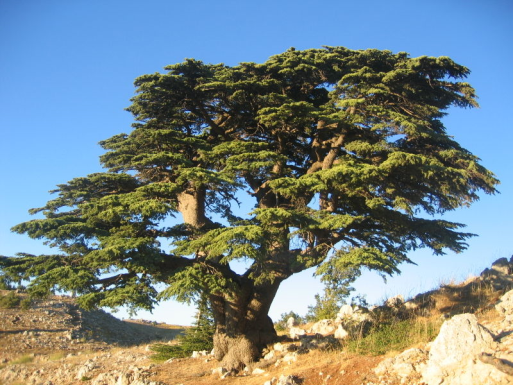
Source: Each According to its Kind: Plants and Trees in the Bible (UBS Helps for Translators)
Translation commentary on 1 Chronicles 14:1
And Hiram king of Tyre sent messengers to David …: The common Hebrew conjunction rendered And may be translated “Then” (New Living Translation) to introduce the next event in the story. Revised Standard Version reflects the order of the Hebrew by saying Hiram king of Tyre (name, title, and area of rule), but the Good News Translation translators considered it more natural in English to speak of “King Hiram of Tyre,” putting the title first. Naturalness in the receptor language should be the determining factor in deciding the order of the elements in this phrase. The king’s name is spelled Hiram in 2 Samuel and 1 Kings, but the writer of 1–2 Chronicles usually has the spelling “Huram” (see, for example, 2 Chr 2.1-13; 8.18). With the exception of Jewish Publication Version, most translations of 1 Chronicles use the same spelling here as in 2 Samuel and 1 Kings. Tyre was located on a small island on the Mediterranean coast, north of Palestine. It became the leading city of Phoenicia under Hiram I (969–935 B.C.). Some translations say “the city of Tyre” (New Century Version, Parola Del Signore: La Bibbia in Lingua Corrente, Nova Tradução na Linguagem de Hoje). David, and later Solomon, established treaties with Hiram, who supplied material and craftsmen for construction projects (2 Sam 5.11; 1 Kgs 5.1-12; 2 Chr 2.3-16).
The Hebrew word rendered messengers may also mean “angel” or “ambassador” (so Reina-Valera revisada, Nova Tradução na Linguagem de Hoje). In this context these representatives of King Hiram were more than mere messengers; they were a “delegation” (Bible en français courant, La Bible du Semeur). Several versions have “envoys” (Revised English Bible, New Jerusalem Bible, New American Bible, New Jewish Publication Society’s Tanakh). They were closely related to the sending of builders and building materials. For this reason Good News Translation speaks of a “trade mission.” But this may be difficult to translate into other languages. Some models bearing the same meaning are “representatives to talk about trade” and “agents to negotiate agreements between their two countries.”
Cedar trees could grow as tall as 30 meters (100 feet), which made them ideal for use as beams. If the receptor language uses different words for live trees and logs, it is quite clear that “cedar logs” (Good News Translation, New International Version, Holman Christian Standard Bible, New Jewish Publication Society’s Tanakh, Moffatt) or “cedar timber[s]” (New Living Translation, An American Translation) are intended here.
Masons and carpenters refer to people who worked on two different aspects of construction. Masons built with stones while carpenters used wood. In Hebrew the people who did these two different jobs are called “carvers [or, craftsmen] of walls” and “carvers of wood.” In some languages it will be necessary to say “workers who built with stones and those who built with wood.” Other renderings for masons include “stonemasons” (Good News Translation, New International Version, New Jewish Publication Society’s Tanakh) and “stonecutters” (International Children’s Bible, New Jerusalem Bible). In some languages carpenters is translated “hammerers” or “people of the hammer.”
To build a house for him: The house was clearly more than a mere house. It will be more natural in languages that have a specific word for a king’s house to use it here. Many translations say “palace” (Good News Translation, New International Version, New Jewish Publication Society’s Tanakh, Moffatt, Bible en français courant, Die Bibel im heutigen Deutsch, Biblia Dios Habla Hoy, Nova Tradução na Linguagem de Hoje). Translators should look for words that give the idea of a large and rather luxurious residence prepared for a king.
Quoted with permission from Omanson, Roger L. and Ellington, John E. A Handbook on 1-2 Chronicles, Volume 1. (UBS Helps for Translators). Miami: UBS, 2014. For this and other handbooks for translators see here .
Leave a Reply
You must be logged in to post a comment.