The Greek that is translated as “weeping and gnashing of teeth” or similar in English is translated in the German New Testament translation by Berger / Nord (publ. 1999) with heulen und vor Schmerz mit den Zähnen klappern or “weep and chatter teeth in pain.”
Also in German, the idiom Heulen und Zähneklappern (originally: Heulen und Zähneklappen), which today is used to express anger and outrage, often in a humorous context (literally “weeping and chattering of teeth”), was first coined in 1522 in the German New Testament translation by Martin Luther. (Source: Günther 2017, p. 79)
In Russian, this phrase (Плач и скрежет зубов — Plach i skrezhet zubov) is also widely-used as an idiom, although less often in a humorous content. The wording of the quote originated in the Russian Synodal Bible (publ. 1876). (Source: Reznikov 2020, p. 45)
In French, the phrase pleurs et des grincements de dents is likewise used as an idiom. (Source: Muller 1991, p. 16)
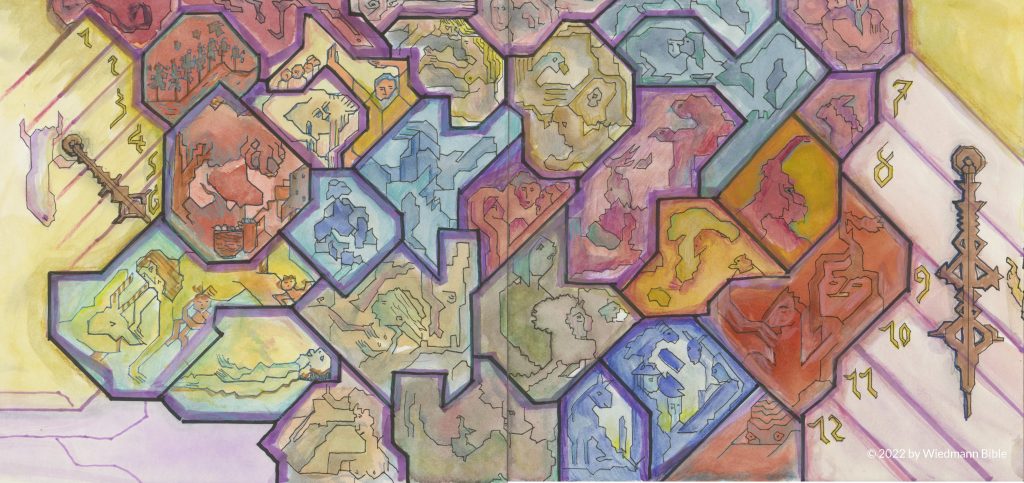
Image taken from the Wiedmann Bible. For more information about the images and ways to adopt them, see here .
For other images of Willy Wiedmann paintings in TIPs, see here.
In French, the phrase un temps pour tout is used as an idiom, comparable in meaning to “Everything comes to those who wait.” (Source: Muller 1991, p. 16)
The now commonly-used English idiom “render unto Caesar the things which are Caesar’s” (for when something needs to be given to government, usually money) was first coined in 1582 in the Douay Rheims Version (spelled as render therefore vnto Cesar, the things which are Cesars). (Source: Crystal 2010, p. 271)
In Russian, this phrase (Итак отдавайте кесарю кесарево — Itak otdavayte kesaryu kesarevo) — quoted from the Russian Synodal Bible (publ. 1876) — is also widely used as an idiom and often used in the form of lexical substitutions. All adaptations use the same syntax, but substitute the second part by another pair (often rhyming with the first); thus: кесарю – кесарево, а слесарю – слесарево (kesaryu – kesarevo, a slesaryu – slesarevo) — “render to Caesar the things which are Caesar’s, and to the plumber the things which are plumber’s” etc. (Source: Reznikov 2020, p. 20)
In French, the phrase rendez à César ce qui est à César is likewise used as an idiom. (Source: Muller 1991, p. 27)
For other idioms in English that were coined by Bible translation, see here.
The Greek that is translated as “our daily bread” or similar in most English versions was translated in the Catholic English Douay-Rheims version (publ. 1582) as “our supersubstantial bread.”
In the Kölsch translation (publ. 2017) it is translated as wat mer Minsche zum Levve bruche or “what us humans need for sustenance.” (Source: Jost Zetzsche)
In the German New Testament translation by Berger / Nord (publ. 1999) it is translated as das Brot für den kommenenden Tag or “the breads for the day ahead.”
In French, the phrase pain quotidien (“daily bread”) is used as an idiom for daily necessities or daily-occurring events or experiences. (Source: Muller 1991, p. 18)
The Greek term that was translated by the LatinVulgate translation as Calvariæ or “skulls” was transliterated from that Latin translation in many European languages, including in the EnglishKing James and Douay-Rheims versions, as well as some early translations into French (Calvaire), Portuguese (Caveira), or Spanish (Calavera).
In French, calvaire has also become idiomatic for “ordeal,” “misery,” or “martyrdom.” (Source: Muller 1991, p. 82)
In Russian, the phrase Пилат … умыл руки (Pilat … umyl ruki) or “Pilate . . . washed his hands” is widely-used as an idiom in a number of variations in every-day life. The wording of the quote originated in the Russian Synodal Bible (publ. 1876). (Source: Reznikov 2020, p. 64)
In French, the phrase “s’en laver les mains” or “wash hands” is likewise used as an idiom. (Source: Muller 1991, p. 78)
In French, the phrase A chaque jour suffit sa peine or “Each day has enough agony on its own” is used as an idiom comparable in meaning with “one day at a time.” (Source: Muller 1991, p. 20f.)
In French, the phrase le commencement de la sagesse or “the beginning of wisdom” is used as an idiom for something fundamentally important to understand. (Source: Muller 1991, p. 28)