
The German Good News Bible (Die Bibel im heutigen Deutsch) (1st edition: 1968, latest edition: 2018) says this about the translation of the Greek expressions that in English are often translated as “kingdom of God” or “kingdom of heaven” respectively:
“An example for how a term evolved is the rendering of ‘heavenly kingdom’ or ‘kingdom of God.’ A verbatim translation will be misunderstood by most readers today: as if it talks about a kingdom that is located in heaven, when in reality it refers in the Bible to God being the ruler, to that area in which that rule has been realized and everything that human beings can expect because of that. Dependent on the context, the term is therefore translated differently in this present version: When it focuses on the presence of God’s kingdom it is rendered as ‘God establishes his rule’ (Gott richtet seine Herrschaft auf), when the focus is on the future it is translated as ‘Once God finalizes his creation (or ‘work’) . . . ‘ (Wenn Gott sein Werk vollendet . . .), and when the focus is on that finished creation it is ‘God’s new world’ (Gottes neue Welt).” (p. 299 — for a longer exposition, see Rudolf Kassühlke in The Bible Translator 1974, p. 236ff. )
The respective translation choice in that German translation:
- kingdom (of God / heaven) (presence of God’s rule)
- kingdom (of God / heaven) (God’s finalized creation in the future)
- kingdom (of God / heaven) (God’s new world)
Likewise in the Gurung translation the term was also, depending on context, rendered in four different ways:
- God’s power at work in the world,
- the personal response to God, in obedience and receiving blessing,
- God’s future open ruling of the world,
- the ultimate blessings of God’s rule in heaven.
(Source: Warren Glover in The Bible Translator 1978, p. 231ff. — here you can also find a comprehensive list of examples where which translation was applied.)
Following is a list of (back-) translations from other languages:
- Tzeltal: “persons like these will reach God’s government” (as in Mark 10:14 and Luke 18:16: “the Kingdom of God belongs to those”) or “the jurisdiction of God” (in the sense of where God has the authority)
- Copainalá Zoque: “like God to rule over”
- San Miguel El Grande Mixtec: “agree to God reigning over”
- Kekchí: “power (or authority) of God”
- Laka: “God’s commanding”
- Javanese: “the rule of God”
- Huave: “where God rules”
- Huastec: “God as ruler”
- San Blas Kuna: “God’s government”
- Navajo (Dinė): “what God has charge of”
- Sayula Popoluca: “to have God rule over”
- Tzotzil: “to have God as chief”
- Highland Puebla Nahuatl: “the leadership of God”
- Wayuu: “where God is chief” (this and examples above in Bratcher / Nida)
- Fuyug “God’s clan”
- Mono: “sana lala’aha nang” — “area of chiefly rule”
- Martu Wangka: “The Father looks after his own relatives” (source for this and the two preceding: Carl Gross)
- Kâte: uucmaŋ, “a parabolic expression actually denoting the leaves of the breadfruit tree closing around the fruit to protect it (see here ).”
- Yagaria: Souve beite’na, lit. “Lord- (orig. war chief) being” (source for this and above: Renck, p. 104)
- Caribbean Javanese: Kratoné Allah (“God’s seat [of a king]”)
- Sranan Tongo: Tiri fur Gado (“the Ruling of God”) or Kownukondre fur Gado (“King’s land of God”)
- Eastern Maroon Creole: A Nyun Tii fu Massa Gadu / Saramaccan: Di Njunjun Tii u Gadu (both: “the New ruling of God”) (source for this and 2 above: Jabini 2015)
- Umiray Dumaget Agta: “protectorate of God” (source: M. Larson / B. Moore in Notes on Translation February 1970, p. 1-125.)
- Lalana Chinantec: “how God is the boss of people’s hearts”
- Chichimeca-Jonaz: “God rules as chief”
- Chuj: “everything which is in God’s hand” (source for this and two above: Viola Waterhouse in Notes on Translation August 1966, p. 86ff.)
- Kamo: kuu le Yamba: “kingdom of God” / kuu le Yamba: “kingdom of heaven.” Yamba can mean either “sky/heaven” or “God” and they distinguish between the two meanings by capitalization. The word kuu is an abstract noun meaning “rule/reign.” (source: David Frank)
.jpg)
In Mairasi, a language “where people would rather say something in a new way than in an old way,” there are a number of translations, including “Great Above One’s (=God) rule,” “His power,” “His control,” or “His place of authority/power.” (Source: Enggavoter 2004)
In Q’anjob’al, the translators stumbled on an additional difficulty. Newberry and Kittie Cox (in The Bible Translator 1950, p. 91ff. ) explain: “‘The kingdom of God’ may be translated ‘where God supervises’ (or literally ‘guards’). However, in Mark 10:15 and Luke 18:17 it is not possible to speak of ‘receiving the kingdom of God,’ for this would imply that one simply takes over the responsibility for guarding God’s country while He rests. Accordingly, the translation is adapted to meet the cultural and linguistic requirements of the language by the form ‘receive God as king.’
In British Sign Language it is translation with a sign that combines the signs for “God” and “rule.” (Source: Anna Smith)
“Kingdom of God” in British Sign Language (source: Christian BSL, used with permission)
The artist Willy Wiedmann envisioned Jesus foretelling the kingdom of God like this:
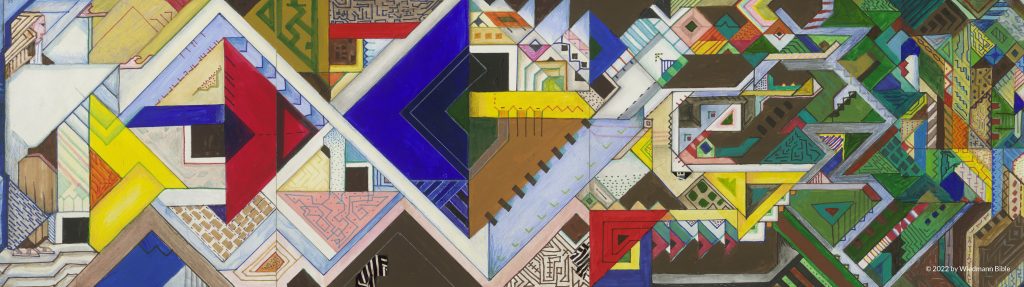
Click here to see the image in higher resolution. Image taken from the Wiedmann Bible. For more information about the images and ways to adopt them, see here . For other images of Willy Wiedmann paintings in TIPs, see here.

See also your kingdom come and kingdom of God (Japanese honorifics).
Learn more on Bible Odyssey: Kingdom of God, Kingdom of Heaven .