priest

The Hebrew, Aramaic, and Greek that are typically translated as “priest” in English (itself deriving from Latin “presbyter” — “elder”) is often translated with a consideration of existing religious traditions. (Click or tap for details)

Bratcher / Nida (1961) say this:

“However, rather than borrow local names for priests, some of which have unwanted connotations, a number of translations have employed descriptive phrases based on certain functions: (1) those describing a ceremonial activity: Pamona uses tadu, the priestess who recites the litanies in which she describes her journey to the upper or under-world to fetch life-spirit for sick people, animals or plants; Batak Toba uses the Arabic malim, ‘Muslim religious teacher;’ ‘one who presents man’s sacrifice to God’ (Bambara, Eastern Maninkakan), ‘one who presents sacrifices’ (Baoulé, Navajo (Dinė)), ‘one who takes the name of the sacrifice’ (Kpelle, and ‘to make a sacrifice go out’ (Hausa); (2) those describing an intermediary function: ‘one who speaks to God’ (Shipibo-Conibo) and ‘spokesman of the people before God’ (Tabasco Chontal).”

In Obolo it is translated as ogwu ngwugwa or “the one who offers sacrifice” (source: Enene Enene), in Mairasi as agam aevar nevwerai: “religious leader” (source: Enggavoter 2004), in Ignaciano as “blesser, one who does ritual as a practice” (using a generic term rather than the otherwise common Spanish loan word sacerdote) (source: Willis Ott in Notes on Translation 88/1982, p. 18ff.), and in Noongar as yakin-kooranyi or “holy worker” (source: Warda-Kwabba Luke-Ang).

For Guhu-Samane, Ernest Richert (in The Bible Translator, 1965, p. 81ff. ) reports this: “The [local] cult of Poro used to be an all-encompassing religious system that essentially governed all areas of life. (…) For ‘priest’ the term ‘poro father’ would at first seem to be a natural choice. However, several priests of the old cult are still living. Although they no longer function primarily as priests of the old system they still have a substantial influence on the community, and there would be more than a chance that the unqualified term would (in some contexts particularly) be equated with the priest of the poro cult. We learned, then, that the poro fathers would sometimes be called ‘knife men’ in relation to their sacrificial work. The panel was pleased to apply this term to the Jewish priest, and the Christian community has adopted it fully. [Mark 1:44, for instance, now] reads: ‘You must definitely not tell any man of this. But you go show your body to the knife man and do what Moses said about a sacrifice concerning your being healed, and the cause (base of this) will be apparent.'”

For a revision of the 1968 version of the Bible in Khmer Joseph Hong (in: The Bible Translator 1996, 233ff. ) talks about a change in wording for this term:

​​Bau cha r (បូជា‌ចារ្យ) — The use of this new construction meaning “priest” is maintained to translate the Greek word hiereus. The term “mean sang (មាន សង្ឃ)” used in the old version actually means a “Buddhist monk,” and is felt to be theologically misleading. The Khmer considers the Buddhist monk as a “paddy field of merits,” a reserve of merits to be shared with other people. So a Khmer reader would find unthinkable that the mean sang in the Bible killed animals, the gravest sin for a Buddhist; and what a scandal it would be to say that a mean sang was married, had children, and drank wine.

See also idolatrous priests.

date palm

More than forty types of date palm (Phoenix dactylifera) are found in dry tropical countries all the way from the Canary Islands, across Africa to India. They probably originated in the Middle East, where they are still found in abundance. In Leviticus 23:40 we read that the branches of date palms were to be used for the Festival of Shelters, and in John 12:13 people welcomed Jesus with date palm leaves. In the latter case there is a legitimate question of where they got the leaves, since Jerusalem is rather too high and cold for date palms. But the same could be asked about the prophetess Deborah’s palm (Judges 4:5), which was located between Ramah and Bethel, scarcely lower than Jerusalem. Jericho was known as the “city of palm trees” (temarim in Hebrew). Date fruits were eaten fresh or dried and pressed into “cakes,” and they were sometimes made into a drink. It is possible that in Deuteronomy 8:8 the Hebrew word devash that we normally take as “honey” refers to a syrup made from dates. The leaves were and are used for mats, baskets, fences, and roofs. Date palms are now cultivated intensively in the Jordan and Aravah valleys, around the Dead Sea, and on the coastal plain of Israel. The word “date” entered English from Latin dactylus via Old French datil. Latin got it from Greek daktylos, meaning “finger.”

The date palm typically grows to a height of 10-20 meters (33-66 feet) and has a cluster of immense leaves at the top. Each year, old leaves wither and droop, and people who own palms cut the old branches off. The tightly packed bunch of immature leaves is called lulav in Hebrew. Date palms start bearing fruit at around five to eight years of age. The sweet fruits, a little smaller than a human thumb, grow in large bunches. Inside the soft fruit is a very hard seed about 2.5 centimeters (1 inch) long. Date palm trees are either male or female, and there are places where the trees of one sex grow but no fruit is seen, because they lack pollination. Farmers prefer to propagate them by cultivating the suckers that grow at the base of the tree, rather than from seeds, which would produce too many male trees. The fruit appears on the female tree in the summer (June-August).

In Song of Songs 7:7 we find the palm used as a symbol of elegance and grace. In Psalm 92:1214 we are told that the righteous will flourish like the palm tree, but Job 15:32 says the wicked will wither like a dry palm branch. In 1 Maccabees 13:37 the palm branch is a symbol of peace, but in 1 Maccabees 13:51 it is a symbol of victory (so also John 12.13; Rev 7.9; 2 Macc 10.7).

Translators living along the West African coast often substitute the oil palm or the coconut palm for the date palm, which is found normally in desert areas. Others are familiar with the fan palm (Borassus, “ruhn palm”) but they should note that the shape of the leaf of the fan palm is quite different from that of the date palm. I am not aware of a non-European language that has a generic word for palm. Since the function of palm branches in the Festival of Shelters is to build rough shelters, the type of palm tree does not make a lot of difference. The same is true for references where the image of the palm is used as a decoration, as in the description of the Temple (see 1 Kings 6:29 et al.). In cases where the fruit is mentioned, a transliteration is recommended, either from the Hebrew word tamar or from a major language.

In locations where oil and coconut palm trees are found, but no date palms, the oil palm is to be preferred. In places where no palms are found, it is still possible that the date fruit is found in markets, particularly in Muslim-dominated areas, where it may be a popular item for breaking the fast during Ramadan. In northern Nigeria, a dwarf species of date palm (Phoenix reclinata) grows in ravines and bears small edible fruits much like the big palm. At least one translation there (Berom) makes use of the local name.

It would seem then that if the date palm is not known at all, the options here are:

1. use the word for oil or coconut palm (and consider writing a footnote that indicates that the Hebrew words tamar and tomer and the Greek word phoinix refer to a similar tree that has a quite different fruit);
2. transliterate from Hebrew (tomera, tamara) and Greek (fonis, fowinik);
3. transliterate from a major language, for example, nakhal/temer (Arabic), dattier (French), datil/palmera (Spanish), mtende (Swahili), khajoor (खजूर) (Hindi), and hǎizǎo (海枣 / 海棗) (Chinese);
4. use a generic phrase appropriate to the context, for example, “beautiful tree.”

Date palm, photo by Ray Pritz

Source: Each According to its Kind: Plants and Trees in the Bible (UBS Helps for Translators)

In Chichewa, gwalanga, the word for the local fan palm is used for translation. In rural areas people use the leaves for vegetables. (Source: Mawu a Mulungu mu Chichewa Chalero Back Translation)

cedar

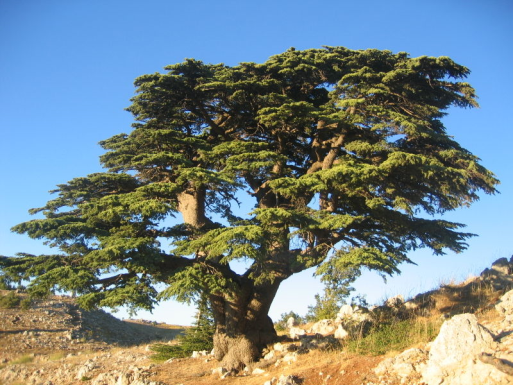
Long ago the majestic cedars of Lebanon (Cedrus libani) completely covered the upper slopes of the Lebanon Mountains on the western and northern sides. Now only a few pockets of these mighty cedars remain. At that time they were mixed, as they are today, with other trees such as Cilician fir, Grecian juniper, cypress, and Calabrian pine.

We know from 1 Kings that Solomon used cedar wood in his palace and in the Temple. Cedar was used for beams, boards, pillars, and ceilings. Historians tell us that the Assyrians also hauled cedars to their land for use in buildings. Nebuchadnezzar of Babylon also imported cedars from Lebanon. In some versions of Isaiah we read that people made idols of cedar and oak (44:14-20). Finally, when the Temple was rebuilt by the returning exiles (Ezra 3:7), they again cut down cedar trees to grace the house of God.

In 2 Samuel, 1-2 Kings, 1-2 Chronicles and Ezra, when Lebanon is specifically mentioned, there can be no doubt that ’erez is Cedrus libani, the “cedar of Lebanon,” although it is possible that sometimes the word was used loosely to include various evergreen trees.

In the description of the purification rituals (Leviticus 14:4 at al.), the word ’erez probably refers to the Phoenician juniper tree, since that was the only cedar-like tree in the Sinai Desert.

Description  Cedar trees can reach 30 meters (100 feet) high with a trunk more than 2 meters (7 feet) in diameter. The leaves of true cedars are not flat like those of most trees, but consist of tufts of dark green, shiny spines. (The cedars in North America have a flatter type of spine than the biblical cedar.) The wood is fragrant and resistant to insects. Cedars bear cones and can live to be two or three thousand years old.

The cedar of Lebanon is famous for its large size (see Isaiah 2:13 et al.), and for the fragrance of its wood. Psalm 92:12 links the cedar to righteousness, that is, presumably, to its straightness and height above other trees. The cedar is the national emblem of Lebanon.

Cedrus species are found in the mountains of North Africa, in the Himalayas, in India, and in North America. Translators in these places, should, of course, use the local name in nonfigurative references. In sub Saharan Africa, translators can transliterate from Hebrew (’erez), Greek (kedar), English (sedar), or another major language, or they can take a generic solution such as “large, beautiful tree.” In poetic passages (wisdom literature and prophecy), some translators may wish to use a cultural equivalent with these traits. In Africa, according to Burkhill (The Useful Plants of West Tropical Africa, volume 4. Kew: Royal Botanic Gardens, 1985), the Pink Mahogany Guarea cedrata is also called the pink African cedar because of the cedar-like scent of its timber. Likewise, some people in India and Australia use “cedar” to refer to the toon because of its reddish wood. I do not recommend such substitutes in historical passages, since the ’erez is not related to these trees. In some figurative passages, however, the substitution could be effective, since all are large trees with reddish wood. However, each passage has to be evaluated to determine the intended effect of the image.

Cedar of Lebanon, Wikimedia Commons

Source: Each According to its Kind: Plants and Trees in the Bible (UBS Helps for Translators)

Translation commentary on Sirach 50:12

And when he received the portions from the hands of the priests: Portions refers to “portions of the sacrifice” (Good News Translation), that is, portions of the sacrificed animal. This sacrifice is not part of the Day of Atonement ritual, but it is the offering described in Exo 29.38-42. The author describes the ritual as practiced in his own day; it is described in The Mishnah (Tamid 7.1-3) very much as it is here. Snaith compares the scene to an operating room in which nurses assist the surgeon by handing him instruments and performing other duties. Good News Translation expresses this line in the active voice by saying “When the priests handed him the portions of the sacrifice.” Some translators may wish to add “to be burned” at the end of the line.

As he stood by the hearth of the altar: The hearth of the altar refers to the pile of burning wood. Good News Translation “as he stood beside the altar” is sufficient for this line. It is possible to reverse the order of the first two lines as follows: “When he stood beside the altar, and the other priests handed him the portions of the sacrifice to be burned [or, that he was going to burn].”

With a garland of brethren around him: Good News Translation has “with his assistants circling him like a wreath.” It is possible to begin a new sentence here by saying “His assistants circled him [or, stood around him] like a wreath [or, lei].”

He was like a young cedar on Lebanon: The Greek does not necessarily say that Simon was like a young cedar. The scene is being compared to a grove of trees. We could say “it was like [or, it looked like] a grove of young cedar trees in Lebanon [or, on the Lebanon Mountains].” See the comments on 24.13.

And they surrounded him like the trunks of palm trees: This can be joined to the line above by saying “with his assistants around him like a wreath, like a circle of palm trees. It was like a grove of young cedar trees in Lebanon.” Ben Sira may be comparing the motions of the priests as they go through the ritual to the swaying of trees in the wind. For palm trees, see 24.14.

An alternative model for this verse is:

• Then he stood by the altar, and the other priests handed him the portions of the sacrifice to be burned [or, that he was going to burn], and his assistants stood around him like a wreath [or, lei] or like a circle of palm trees. It looked like a grove of young cedar trees on the Lebanon Mountains.

Quoted with permission from Bullard, Roger A. and Hatton, Howard A. A Handbook on Sirach. (UBS Helps for Translators). New York: UBS, 2008. For this and other handbooks for translators see here.