25Now there was a man in Jerusalem whose name was Simeon; this man was righteous and devout, looking forward to the consolation of Israel, and the Holy Spirit rested on him.
Tzotzil: “[people who] are zealously doing what they think is God’s word”
Mezquital Otomi: “[people who] very much believe what they have been taught about God” (source for this and five above: Viola Waterhouse in Notes on Translation August 1966, p. 86ff.)
Chichewa interconfessional translation, publ. 1999: “[people who] love God” (source: Wendland 1998, p. 90)
Uma: “[people who] submit to Lord God” (Source: Uma Back Translation)
Yakan: “very religious” (source: Yakan Back Translation)
Western Bukidnon Manobo: “[people who] are faithful in carrying out the commands of God” (source: Western Bukidnon Manobo Back Translation)
Kankanaey: “[people who] are serving God” (source: Kankanaey Back Translation)
Tagbanwa: “[people who] are indeed devout-worshipers of God” (Source: Tagbanwa Back Translation)
Bariai: “[people who] respect God” (source: Bariai Back Translation)
Kupsabiny: “[people who] have dedicated themselves to God” (source: Kupsabiny Back Translation)
German: “God-fearing” (gottesfürchtig) or “pious” (fromm)
Low German translation by Johannes Jessen, publ. 1933, republ. 2006: “[people who] take their faith very seriously” (source for this and above: Zetzsche)
HausaCommon Language Bible: “owners of worshiping God” (source: Hausa Common Language Bible Back Translation)
Hiligaynon: “godly” (source: Hiligaynon Back Translation)
The Hebrew and Greek that is translated as “consolation” or similar in English is translated in Aymara as “preparing the heart” (source: Nida 1952, p. 131) and in Elhomwe as “settle the heart.” (Source: project-specific translation notes in Paratext)
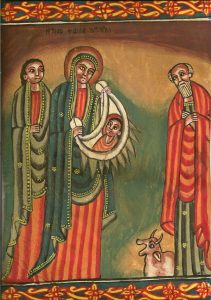
This is a contemporary tempera/gouache on leather painting by an unknown Ethiopian artist. Source: Sacred Art Pilgrim website .
Following is a painting by Chen Yuandu 陳緣督 (1902–1967):
Housed in the Société des Auxiliaires des Missions Collection – Whitworth University.
Image taken from Chinese Christian Posters . For more information on the “Ars Sacra Pekinensis” school of art, see this article , for other artworks of that school in TIPs, see here.
The name that is transliterated as “Simeon” in English is translated in Finnish Sign Language with the sign signifying “heard” (referring to Luke 2:26). (Source: Tarja Sandholm)
Following are a number of back-translations of Luke 2:25:
Noongar: “In those days, Simeon lived in Jerusalem. He was a good man. He listened to God and waited for the day when God would save Israel.” (Source: Warda-Kwabba Luke-Ang)
Uma: “In Yerusalem at that time, there was a person named Simeon. That Simeon was a straight person who submitted to God. The Holy Spirit was with him, and he hoped/trusted that the time had almost arrived for God to help the descendants of Israel.” (Source: Uma Back Translation)
Yakan: “Na, there was a person there in Awrusalam called Simiyun. This person was righteous and he always worshiped God. He was waiting for the time when the savior of the tribe of Isra’il would come. And the Holy Spirit was with him.” (Source: Yakan Back Translation)
Western Bukidnon Manobo: “There was there a man who lived in Jerusalem, whose name was Simeon. He was a righteous person who was always worshipping God. Always there in his breath was the expectancy of the fulfillment of the prophesy which said that the time would come when God would set free His chosen people, the descendants of Israel. Simeon was always controlled by the Holy Spirit.” (Source: Western Bukidnon Manobo Back Translation)
Kankanaey: “Now there was an old-man in Jerusalem named Simeon who was waiting for the salvation of his fellow descendants of Israel. He was a righteous and religious person, and the Holy Spirit was also with/in him.” (Source: Kankanaey Back Translation)
Tagbanwa: “At that time, there was a man in Jerusalem whose name was Simeon. He was straight/righteous in the sight of God and worshipful too. He was really longing very much for the promised Cristo who would save/free their nation of Israel. And he was being indwelled by the Espiritu Santo.” (Source: Tagbanwa Back Translation)
The name that is transliterated as “Jerusalem” in English is signed in French Sign Language with a sign that depicts worshiping at the Western Wall in Jerusalem:
While a similar sign is also used in British Sign Language, another, more neutral sign that combines the sign “J” and the signs for “place” is used as well. (Source: Anna Smith)
“Jerusalem” in British Sign Language (source: Christian BSL, used with permission)
The Greek, Hebrew, and Latin terms that are translated in English mostly as “righteous” as an adjective or personified noun or “righteousness” (also as “upright(ness)” and “just(ice)”) are most commonly expressed with concept of “straightness,” though this may be expressed in a number of ways. (Click or tap here to see the details)
Following is a list of (back-) translations of various languages:
Paasaal: “white heart” (source: Fabian N. Dapila in The Bible Translator 2024, p. 415ff.)
(San Mateo del Mar Huave: “completely good” (the translation does not imply sinless perfection)
Nuer: “way of right” (“there is a complex concept of “right” vs. ‘left’ in Nuer where ‘right’ indicates that which is masculine, strong, good, and moral, and ‘left’ denotes what is feminine, weak, and sinful (a strictly masculine viewpoint!) The ‘way of right’ is therefore righteousness, but of course women may also attain this way, for the opposition is more classificatory than descriptive.”) (This and all above from Bratcher / Nida except for Bilua: Carl Gross; Tiv: Rob Koops; Muna: René van den Berg)
Yatzachi Zapotec: “walk straight” (source for this and four previous: John Beekman in Notes on Translation November 1964, p. 1-22)
Makonde: “doing what God wants” (in a context of us doing) and “be good in God’s eyes” (in the context of being made righteous by God) (note that justify / justification is translated as “to be made good in the eyes of God.” (source: Pioneer Bible Translators, project-specific notes in Paratext)
Aari: The Pauline word for “righteous” is generally rendered by “makes one without sin” in the Aari, sometimes “before God” is added for clarity. (Source: Loren Bliese)
Ekari: maakodo bokouto or “enormous truth” (the same word that is also used for “truth“; bokouto — “enormous” — is being used as an attribute for abstract nouns to denote that they are of God [see also here]; source: Marion Doble in The Bible Translator 1963, p. 37ff. ).
Guhu-Samane: pobi or “right” (also: “right (side),” “(legal) right,” “straightness,” “correction,” “south,” “possession,” “pertinence,” “kingdom,” “fame,” “information,” or “speech” — “According to [Guhu-Samane] thinking there is a common core of meaning among all these glosses. Even from an English point of view the first five can be seen to be closely related, simply because of their similarity in English. However, from that point the nuances of meaning are not so apparent. They relate in some such a fashion as this: As one faces the morning sun, south lies to the right hand (as north lies to the left); then at one’s right hand are his possessions and whatever pertains to him; thus, a rich man’s many possessions and scope of power and influence is his kingdom; so, the rich and other important people encounter fame; and all of this spreads as information and forms most of the framework of the people’s speech.”) (Source: Ernest Richert in Notes on Translation 1964, p. 11ff.)
German New Testament translation by Berger / Nord (publ. 1999): Gerechtheit, a neologism to differentiate it from the commonly-used Gerechtigkeit which can mean “righteousness” but is more often used in modern German as “fairness” (Berger / Nord especially use Gerechtheit in Letter to the Romans) or Gerechtestun, also a neologism, meaning “righteous deeds” (especially in Letter to the Ephesians)



Leave a Reply
You must be logged in to post a comment.