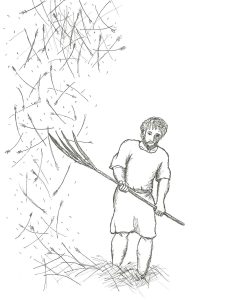
The Hebrew and Greek that is translated as “thresh” in English is illustrated for use in Bible translations in East Africa by Pioneer Bible Translators like this:
Image owned by PBT and Jonathan McDaniel and licensed with the Creative Commons Attribution 3.0 Unported License.
The Hebrew that is translated as “threshing sledge” in English is translated in Bura-Pabir as sur dəga or “threshing thing.” “It is good to use this quite general term here, since it is a hyperonym (more general term) for both the Hebrew and Bura cultural variants (a sledge and a stick respectively).” (Source: Andy Warren-Rothlin)
Following are a number of back-translations as well as a sample translation for translators of Isaiah 41:15:
Kupsabiny: “I shall make you to be a piece of wood that one threshes with, which is still new and has sharp pegs. You shall thresh mountains and crush them. You shall make the hills become chaff.” (Source: Kupsabiny Back Translation)
Newari: “Look, I will make you to be a threshing board with new and pointed nail. You will peal the mountains and beat them to Chaff.” (Source: Newari Back Translation)
Hiligaynon: “Listen! I will-make you (sing.) like a new equipment to be-used-to-thresh and has sharp and many teeth. You (sing.) will-thresh and smash the mountains and make (them) as-if-like chaff.” (Source: Hiligaynon Back Translation)
Click or tap here to see the rest of this insight.
Like a number of other East Asian languages, Japanese uses a complex system of honorifics, i.e. a system where a number of different levels of politeness are expressed in language via words, word forms or grammatical constructs. These can range from addressing someone or referring to someone with contempt (very informal) to expressing the highest level of reference (as used in addressing or referring to God) or any number of levels in-between.
One way Japanese shows different degree of politeness is through the choice of a first person singular and plural pronoun (“I” and “we” and its various forms) as shown here in the widely-used Japanese Shinkaiyaku (新改訳) Bible of 2017. The most commonly used watashi/watakushi (私) is typically used when the speaker is humble and asking for help. In these verses, where God / Jesus is referring to himself, watashi is also used but instead of the kanji writing system (私) the syllabary hiragana (わたし) is used to distinguish God from others.
In verses 15-16 God makes extensive use of farming imagery, especially that of harvesting grain. He uses this imagery to describe how Israel will defeat its enemies.
As in verse 11, the word Behold calls attention to what God will do for Israel right after he told them not to be afraid (see the comments there).
I will make of you a threshing sledge, new, sharp, and having teeth: For threshing sledge, see the comments on 28.27. Here it is a metaphor for Israel. Just as a farmer uses a threshing sledge to separate the good grain from the useless stalks and chaff, so God will use Israel to punish its enemies. The sledge is described as new, sharp, and having teeth, which means it is very effective. The adjective new may describe the sledge (so Bible en français courant) or the metal pieces (teeth) underneath it (so Good News Translation, Die Bibel im heutigen Deutsch). The adjective sharp clearly describes its metal pieces. Having teeth is literally “master of mouths.” New Jerusalem Bible has “double teeth” and New American Bible says “double-edged” since the Hebrew word for “mouths” is a double form of the word for “mouth” (see Psa 149.6, where Revised Standard Version renders this word “two-edged”). In this context it is better to say “many teeth” or simply “teeth.”
For cultures where the threshing sledge is unknown, it would be helpful to include an illustration of one here or at 28.27. Translators should also consider including a footnote describing it more fully since a long expression for it would destroy the poetic balance of the lines.
You shall thresh the mountains and crush them, and you shall make the hills like chaff: In these parallel lines mountains and hills are used figuratively, but what these two words represent has been a challenge for interpreters. Some have suggested that they refer to Israel’s enemies, and that the “threshing” points to Israel’s punishment of them. Others think that they are figures for Israel’s present difficulties that it will overcome. We prefer the first view, but since the specific reference is not clear, translators should retain the metaphors. Israel will thresh (see the comments on 21.10) and crush the mountains just as a sledge threshes and crushes stalks of grain. The Hebrew verb rendered crush can refer to grinding something so fine that it is nothing but dust, so New Jerusalem Bible translates the third line as “you will thresh and beat the mountains to dust” (similarly New Jewish Publication Society’s Tanakh). This rendering forms a suitable parallel to the next line.
And you shall make the hills like chaff indicates what the hills will become. Chaff is the outside skin of kernels of grain that comes off the grain in the threshing process (see the comments on 17.13). The wind can easily blow it away (see verse 16). Here it is an image of something useless, to be discarded or thrown away. New Jerusalem Bible and Bible en français courant have “straw.” Languages that do not have a word for chaff may say “dried grass” or “dead leaves.”
Translation examples for this verse are:
• Look, I will make you like a new threshing sledge with sharp teeth;
you will thresh the mountains and crush them to dust,
and make the hills like chaff.
• See, I will make you like a threshing sledge,
to which are attached sharp new nails;
you will thresh the mountains and turn them to dust,
and the hills you will turn into chaff.
Quoted with permission from Ogden, Graham S. and Sterk, Jan. A Handbook on Isaiah. (UBS Helps for Translators). New York: UBS, 2011. For this and other handbooks for translators see here .

Leave a Reply
You must be logged in to post a comment.