The Greek that is translated as “How often have I desired to gather your children together as a hen gathers her brood under her wings, and you were not willing!” or similar in English is translated in Ankave as “As a chicken extracts its young and gathers them under her breast, although all the time I tried to do the same to you, why did it not please you (to allow me to do so)?” (Source: Richard Speece in Notes on Translation 1988. p. 47ff.)
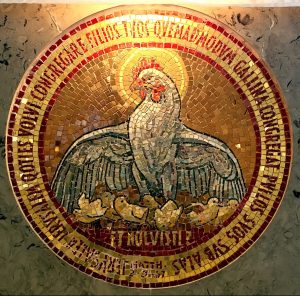
This is also depicted as a mosaic in Dominus Flevit, a Roman Catholic church on the Mount of Olives:
There is considerable doubt about the meaning of the word sekwi. However, the rendering “cock” or “rooster” has support from the Vulgate and one of the Targums, as well as the majority of commentaries. In the context of Job 38:36 the reference seems to be to the way in which the ibis is able to announce the flooding of the Nile, and the rooster is able to announce the coming of the dawn. Both of these abilities are mentioned quite often in Egyptian literature.
The word zarzir is probably related to a word meaning “narrow waisted,” but most commentaries and translations interpret this as a reference to the rooster.
The Greek word ornis and the Latin word gallina mean “hen,” and the Greek words nossia and nossion mean “chick,” that is, a baby fowl.
All modern domestic fowls are descended from the jungle fowl of India, Southeast Asia, and China. These were domesticated very early in the history of that region, almost as soon as the farming of rice and other grains began. According to the Talmud, it was forbidden to keep domestic poultry in Jerusalem, but there is evidence from ancient Hebrew seals that chickens were known in the land as early as 600 B.C. The reference to the cock crowing on the night of the crucifixion would indicate that chickens were kept near, if not in, Jerusalem.
Ancient domestic fowls would still have looked very much like the Jungle Fowl Gallus gallus from which they were descended. Jungle fowl roosters are dark, brownish red, with orange-red neck hackles, a smallish red comb on the top of their heads, and red lappets on each side under the beak. They have a white spot on their backs near the base of their long glossy black and green tails. The hens are a lighter brownish red, have no white spot or long tail, and have a smaller comb on their heads.
Domestic fowl had connotations of fertility to the Egyptians and Persians. This seems to have been adopted later in Judaism, since it became the practice to carry a cock and a hen in front of the bride and groom at a wedding. However, their significance in the Bible seems related to the fact that cocks crow very early in the morning, thus announcing the coming dawn before humans are aware of it.
Domestic fowl have now spread around the world and are well-known, apart from some areas of the tundra region.
The words sekwi, zarzir, alektruōn, and alektōr are probably best translated as “rooster,” ornis as “hen,” and nossion and nossia as “chickens.” In some languages where roosters and hens are not normally differentiated, it may not be necessary to do so in the gospel passages, since the verb “crow” will usually be sufficient context to make the meaning clear. However, in the Job and Proverbs passages it may still be necessary in some languages to say something like “male chicken.”
I gathered you as a hen gathers her brood under her wings: Compare Matt 23.37; Luke 13.34. Just as a hen protects her chicks under her wings, so God protected his people from danger. This sentence may be rendered “I brought you together to protect you the way a hen protects her chicks under her wings.”
But now, what shall I do to you?: This question is rhetorical; it does not expect an answer. It pictures God as deciding how he will punish the Jewish people. It may be translated “But how shall I punish you now?” or “But now, this is how I will punish you.”
I will cast you out from my presence may be rendered “I will have nothing more to do with you.”
Here is a possible model for this verse:
• I brought you together to protect you the way a hen protects her chicks under her wings. But now, how must I punish you? I will have nothing more to do with you.
Quoted with permission from Bullard, Roger A. and Hatton, Howard A. A Handbook on 1-2 Esdras. (UBS Helps for Translators). Miami: UBS, 2019. For this and other handbooks for translators see here.

Leave a Reply
You must be logged in to post a comment.