Click here to see the image in higher resolution.

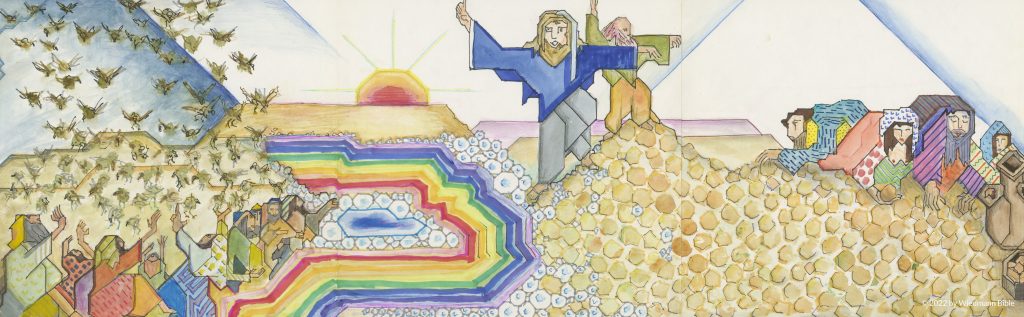
Image taken from the Wiedmann Bible. For more information about the images and ways to adopt them, see here .
For other images of Willy Wiedmann paintings in TIPs, see here.
See also quail.

Ego dolui gemitos vestros et dedi mannam vobis in escam, panem angelorum manducastis.
19I pitied your groanings and gave you manna for food; you ate the bread of angels.
The Greek, Hebrew and Aramaic that is translated as “angel” in English versions is translated in many ways:
Like a number of other East Asian languages, Japanese uses a complex system of honorifics, i.e. a system where a number of different levels of politeness are expressed in language via words, word forms or grammatical constructs. These can range from addressing someone or referring to someone with contempt (very informal) to expressing the highest level of reference (as used in addressing or referring to God) or any number of levels in-between. One way to do this is through the usage (or a lack) of an honorific prefix as shown here in the widely-used Japanese Shinkaiyaku (新改訳) Bible of 2017. When the referent is God, the “divine” honorific prefix mi- (御 or み) is used as in mi-tsukai (御使い) or “messenger (of God).” (Source: S. E. Doi, see also S. E. Doi in Journal of Translation, 18/2022, p. 37ff. )
See also angel (Acts 12:15) and this devotion on YouVersion .
I pitied your groanings may be rendered “I took pity on you [or, felt sorry for you] when I heard you groaning [or, moaning]” or “You were so miserable that I took pity on you.”
And gave you manna for food: Manna was the food that God provided for the Israelites while they wandered in the wilderness. Translators should refer to their translation of this term in Exo 16.14-35 and Num 11.7-9. For food may be translated “to eat.”
You ate the bread of angels: Manna is referred to as the bread of angels in Psa 78.25 and Wis 16.20. Angels are God’s messengers from heaven. Translators will have probably already struggled with the translation of this term both in the Old Testament (for example, Gen 16.7; 21.17) and the New Testament (for example, Matt 1.20; Luke 1.11; Acts 10.3). This clause may be translated “You ate the food that angels eat.”
Quoted with permission from Bullard, Roger A. and Hatton, Howard A. A Handbook on 1-2 Esdras. (UBS Helps for Translators). Miami: UBS, 2019. For this and other handbooks for translators see here.
No comments yet.
Leave a Reply
You must be logged in to post a comment.