The Greek that is translated in English as “endurance” (or “patience”or “perseverance”) is translated in Tzotzil as “(good) strength of heart(s).” (Source: Ellis Deibler in Notes on Translation July, 1967, p. 5ff.)
In Isthmus Zapotec it is translated as “learning not to lose patience.” (Source: Waterhouse / Parrott in Notes on Translation October 1967, p. 1ff.)
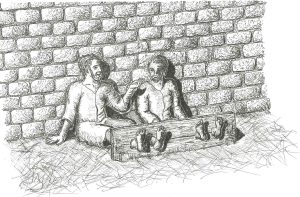
The Greek in Acts 16:24 that is typically translated as “stocks” in English is translated in Isthmus Mixe as “notched boards” (source: Ronald D. Olson in Notes on Translation January, 1968, p. 15ff.).
In Lalana Chinantec it is translated as “where planks have holes in them and where peoples’ feet are tight,” in Chichimeca-Jonaz as “bit their feet with wood,” and in Morelos Nahuatl as “stuck between two boards.” (Source: Viola Waterhouse in Notes on Translation August 1966, p. 86ff.)
“Stocks” is illustrated for use in Bible translations in East Africa by Pioneer Bible Translators like this:
Image owned by PBT and Jonathan McDaniel and licensed with the Creative Commons Attribution 3.0 Unported License.
Isthmus Mixe: “stays with me” (source for this and above: Viola Waterhouse in Notes on Translation August, 1966, p. 86ff)
Teutila Cuicatec: “in all authority at the right side” (source: Ronald D. Olson in Notes on Translation January, 1968, p. 15ff.).
In Lamnso’, the seat on the right-hand side signifies that the person seated there would have a higher position than the one to his left (vs. just being a seat of honor). To circumvent any misunderstanding of the biblical text, the translation here refers to the “highest seat next to God.” (Source: Karl Grebe in Holzhausen 1991, p. 52)
(Note that in Elhomwe the idiom “I see you through the left hand” stands for “useless.” [Source: project-specific translation notes in Paratext])
The Greek in Acts 27:14 that is translated as “But soon a violent wind, called the northeaster (or: Euroclydon), rushed down from Crete” or similar in English is translated in a lot of different ways:
Upper Guinea Crioulo: “A great storm rose up on the side of the island that came against them.” (“The point wasn’t the name of the wind [nor’easter]. All of these nautical terms can be difficult for people who aren’t seafaring. The point wasn’t so much which cardinal direction the wind was coming from. The point was that the wind was coming from a direction that made it impossible for them to go in the direction they wanted to go. This is further explained in the following verse.”) (Source: David Frank)
Caluyanun: “Not long-afterward, the wind from the aminhan/northeast got-strong, which was from the land-area of the island of Crete.” (“’Aminhan’ is the common direction of the wind during half the year.”) (Source: Kermit Titrud)
Northern Emberá: “But soon a bad wind called the Euroclidon blew forcefully from the right hand.” (“When we have to specify north and south we use left hand and right hand, respectively. But in Acts 27:14, the Northeaster wind comes from the right, hitting the right side of the ship as they headed west.”) (Source: Chaz Mortensen)
Amele: “But shortly a strong wind called Jawalti blowing from the direction of the sun coming up to the left came up.” (“East is cam tobec isec ‘the direction the sun comes up’ and west is cam tonec/nec isec ‘the direction the sun goes/comes down.’ ‘Jawalti’ is a local name for the wind that blows down from the north coast of Madang. ‘Sea corner’ is the Amele term for ‘harbour‘”) (Source: John Roberts)
Mairasi: “But after not a very long time at all already a very big wind blew from behind us. In Greek that wind is called ‘Eurokulon’ from over there in the north and east. It blew down from that island itself.” (Source: Enggavoter 2004)
Kankanaey: “But it wasn’t long, a swift wind arrived from the upper-part of Creta.” (Source: Kankanaey Back Translation)
Western Bukidnon Manobo: “And it wasn’t a long time from then, we were typhooned. A very strong wind arrived which was called Abagat. The wind came from the direction of the land.” (Source: Western Bukidnon Manobo Back Translation)
Tagbanwa: “But before we had been sailing for long, suddenly/unexpectedly the wind changed again to an off-shore wind of tremendous strength. Euraclidon was what the people from there called that wind.” (Source: Tagbanwa Back Translation)
Uma: “But in fact not long after that, a big wind came from the land, a wind called Sea Storm.” (Source: Uma Back Translation)
Yakan: “But not long after, a very strong wind blew from the coast.” (Source: Yakan Back Translation)
The Greek that is translated in English as “fellowship” or “communion” is translated in Huba as daɓǝkǝr: “joining heads.” (Source: David Frank in this blog post )
Other translations include:
Lalana Chinantec: “they were very happy since they were with their brothers”
Eastern Highland Otomi: “their hearts were happy because they all thought alike” (source for this and above: Viola Waterhouse in Notes on Translation August 1966, p. 86ff.)
The Greek in Acts 7:5 that is translated as “(not even a) foot’s length” or “(not even enough to) set a foot on” is translated in Paicî with an existing local idiom: “(not even) the dirt from under one of our fingernails.” (Source: Ian Flaws)
In Teutila Cuicatec it is translated as “not even so much as enough to place one of his feet on.” (Source: Viola Waterhouse in Notes on Translation August 1966, p. 86ff.)
The Greek and Hebrew that is translated in English as “encourage” or “comfort” is translated in Enlhet as “become calm of the innermost.” “Innermost” or valhoc is a term that is frequently used in Enlhet to describe a large variety of emotions or states of mind (for other examples see here). (Source: Jacob Loewen in The Bible Translator 1969, p. 24ff. )
In Bacama it is translated as “(to) cool stomach” (source: David Frank in this blog post ), in Yatzachi Zapotec as “cause hearts to mature,” in Isthmus Zapotec “hearts may lie quiet” (source: Waterhouse / Parrott in Notes on Translation October 1967, p. 1ff.) and in Thai “give heart power to” (source: Bratcher / Hatton 2000).