kingdom (of God / heaven)

The German Good News Bible (Die Bibel im heutigen Deutsch) (1st edition: 1968, latest edition: 2018) says this about the translation of the Greek expressions that in English are often translated as “kingdom of God” or “kingdom of heaven” respectively:

“An example for how a term evolved is the rendering of ‘heavenly kingdom’ or ‘kingdom of God.’ A verbatim translation will be misunderstood by most readers today: as if it talks about a kingdom that is located in heaven, when in reality it refers in the Bible to God being the ruler, to that area in which that rule has been realized and everything that human beings can expect because of that. Dependent on the context, the term is therefore translated differently in this present version: When it focuses on the presence of God’s kingdom it is rendered as ‘God establishes his rule’ (Gott richtet seine Herrschaft auf), when the focus is on the future it is translated as ‘Once God finalizes his creation (or ‘work’) . . . ‘ (Wenn Gott sein Werk vollendet . . .), and when the focus is on that finished creation it is ‘God’s new world’ (Gottes neue Welt).” (p. 299 — for a longer exposition, see Rudolf Kassühlke in The Bible Translator 1974, p. 236ff. )

The respective translation choice in that German translation:

Likewise in the Gurung translation the term was also, depending on context, rendered in four different ways:

  • God’s power at work in the world,
  • the personal response to God, in obedience and receiving blessing,
  • God’s future open ruling of the world,
  • the ultimate blessings of God’s rule in heaven.

(Source: Warren Glover in The Bible Translator 1978, p. 231ff. — here you can also find a comprehensive list of examples where which translation was applied.)

Following is a list of (back-) translations from other languages:

  • Tzeltal: “persons like these will reach God’s government” (as in Mark 10:14 and Luke 18:16: “the Kingdom of God belongs to those”) or “the jurisdiction of God” (in the sense of where God has the authority)
  • Copainalá Zoque: “like God to rule over”
  • San Miguel El Grande Mixtec: “agree to God reigning over”
  • Kekchí: “power (or authority) of God”
  • Laka: “God’s commanding”
  • Javanese: “the rule of God”
  • Huave: “where God rules”
  • Huastec: “God as ruler”
  • San Blas Kuna: “God’s government”
  • Navajo (Dinė): “what God has charge of”
  • Sayula Popoluca: “to have God rule over”
  • Tzotzil: “to have God as chief”
  • Highland Puebla Nahuatl: “the leadership of God”
  • Wayuu: “where God is chief” (this and examples above in Bratcher / Nida)
  • Fuyug “God’s clan”
  • Mono: “sana lala’aha nang” — “area of chiefly rule”
  • Martu Wangka: “The Father looks after his own relatives” (source for this and the two preceding: Carl Gross)
  • Kâte: uucmaŋ, “a parabolic expression actually denoting the leaves of the breadfruit tree closing around the fruit to protect it (see here ).”
  • Yagaria: Souve beite’na, lit. “Lord- (orig. war chief) being” (source for this and above: Renck, p. 104)
  • Caribbean Javanese: Kratoné Allah (“God’s seat [of a king]”)
  • Sranan Tongo: Tiri fur Gado (“the Ruling of God”) or Kownukondre fur Gado (“King’s land of God”)
  • Eastern Maroon Creole: A Nyun Tii fu Massa Gadu / Saramaccan: Di Njunjun Tii u Gadu (both: “the New ruling of God”) (source for this and 2 above: Jabini 2015)
  • Umiray Dumaget Agta: “protectorate of God” (source: M. Larson / B. Moore in Notes on Translation February 1970, p. 1-125.)
  • Lalana Chinantec: “how God is the boss of people’s hearts”
  • Chichimeca-Jonaz: “God rules as chief”
  • Chuj: “everything which is in God’s hand” (source for this and two above: Viola Waterhouse in Notes on Translation August 1966, p. 86ff.)
  • Kamo: kuu le Yamba: “kingdom of God” / kuu le Yamba: “kingdom of heaven.” Yamba can mean either “sky/heaven” or “God” and they distinguish between the two meanings by capitalization. The word kuu is an abstract noun meaning “rule/reign.” (source: David Frank)

In Mairasi, a language “where people would rather say something in a new way than in an old way,” there are a number of translations, including “Great Above One’s (=God) rule,” “His power,” “His control,” or “His place of authority/power.” (Source: Enggavoter 2004)

In Q’anjob’al, the translators stumbled on an additional difficulty. Newberry and Kittie Cox (in The Bible Translator 1950, p. 91ff. ) explain: “‘The kingdom of God’ may be translated ‘where God supervises’ (or literally ‘guards’). However, in Mark 10:15 and Luke 18:17 it is not possible to speak of ‘receiving the kingdom of God,’ for this would imply that one simply takes over the responsibility for guarding God’s country while He rests. Accordingly, the translation is adapted to meet the cultural and linguistic requirements of the language by the form ‘receive God as king.’

In British Sign Language it is translation with a sign that combines the signs for “God” and “rule.” (Source: Anna Smith)


“Kingdom of God” in British Sign Language (source: Christian BSL, used with permission)

The artist Willy Wiedmann envisioned Jesus foretelling the kingdom of God like this:
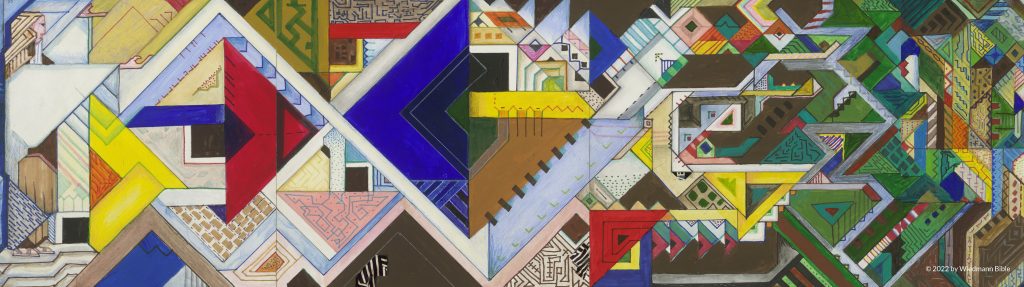
Click here to see the image in higher resolution. Image taken from the Wiedmann Bible. For more information about the images and ways to adopt them, see here . For other images of Willy Wiedmann paintings in TIPs, see here.

See also your kingdom come and kingdom of God (Japanese honorifics).

Learn more on Bible Odyssey: Kingdom of God, Kingdom of Heaven .

harbor

The Greek in Acts 27:12 that is translated as “harbor” (or “harbour”) in English is translated in Kouya as “big canoe stopping place.”

Philip Saunders (p. 231) explains:

“Acts chapter 27 was a challenge! It describes Paul’s sea voyage to Italy, and finally Rome. There is a storm at sea and a shipwreck on Malta, and the chapter includes much detailed nautical vocabulary. How do you translate this for a landlocked people group, most of whom have never seen the ocean? All they know are small rivers and dugout canoes.

“We knew that we could later insert some illustrations during the final paging process which would help the Kouya readers to picture what was happening, but meanwhile we struggled to find or invent meaningful terms. The ‘ship’ was a ‘big canoe’ and the ‘passengers’ were ‘the people in the big canoe’; the ‘crew’ were the ‘workers in the big canoe’; the ‘pilot’ was the ‘driver of the big canoe’; the ‘big canoe stopping place’ was the ‘harbour’, and the ‘big canoe stopping metal’ was the ‘anchor’!”

In Amele, “harbor” is translated as “sea corner” (source: John Roberts) and in Xicotepec De Juárez Totonac as “boat resting place” (source: Viola Waterhouse in Notes on Translation August 1966, p. 86ff.).

third hour

The Greek that is translated as “third hour (of the day)” or “nine in the morning” in English is translated in Mende as “the morning sun is only just getting strong.” (Source: John Ellington)

It is translated as “still early” in Desano, as “up-sun (9 a.m.)” in Chuj, as “still not really high sun at all” in Chichimeca-Jonaz, and as “the sun is barely gone half way to the top” in San Mateo del Mar Huave. (Source: Viola Waterhouse in Notes on Translation August 1966, p. 86ff.)

vision

The Hebrew, Aramaic, Latin and Greek that is translated as “vision” in English is translated in a variety in the following languages:

  • Chol: “as if in a dream” (source: Robert Bascom)
  • Obolo: ilaak ọkpọchieen̄ or “dreaming awake” (source: Enene Enene)
  • Eastern Highland Otomi: “a showing like dreams”
  • Desano: “see in a dream what God will send”
  • Rincón Zapotec: “see what God shows”
  • Mayo: “see things from God as in a dream”
  • Lalana Chinantec: “dream how it is going to be”
  • Chuj: “like dreaming they see”
  • San Mateo del Mar Huave: “understand what they see as if in a dream”
  • Ayutla Mixtec: “see that which will happen” (source for this and seven above: Viola Waterhouse in Notes on Translation August 1966, p. 86ff.)
  • Tagbanwa: “being caused to dream by God” (source: Tagbanwa Back Translation)
  • Chichewa: azidzaona zinthu m’masomphenya: “they will see things as if face-to-face” (interconfessional translation, publ. 1999) (Source: Wendland 1998, p. 69)
  • Mandarin Chinese yì xiàng (异象 / 異象), lit. “different (or: strange) appearance.” (Source: Zetzsche)

The Greek in the books of Revelation and Acts is translated as obq-rmwible: “look-dream” in Natügu. Brenda Boerger (in Beerle-Moor / Voinov, p. 162ff.) tells the story of that translation: “In the book of Revelation, the author, John, talks about having visions. Mr. Simon [the native language translator] and I discussed what this meant and he invented the compound verb obq-rmwible ‘look-dream’ to express it. Interestingly, during village testing no one ever had to ask what this neologism meant.”

See also see a vision.

baptize with the Holy Spirit

The Greek that is translated in English as “baptize with the Holy Spirit” is translated in Ixcatlán Mazatec as “(baptize so that) the Holy Spirit will come upon/enter you” (source: Robert Bascom) and in Mairasi as “wash with the Holy Spirit” (“water” baptism is “wash with water”) (source: Enggavoter 2004).

Other languages translate as follows:

  • Rincón Zapotec: “be baptized with the Holy Spirit the Holy Spirit will come to be with you”
  • Teutila Cuicatec: “God’s Holy Spirit will possess you”
  • Chuj: “God’s Spirit will be given to you”
  • Mezquital Otomi: “be baptized with the power of the Holy Spirit”
  • Mayo: “receive the Holy Spirit in the same way you receive baptism”
  • Lalana Chinantec: “the Great Spirit will enter your hearts” (Source for this and above: Viola Waterhouse in Notes on Translation August 1966, p. 86ff.)

See also Holy Spirit and baptism / baptize.

build up

The Greek that is translated as “building up” in many English versions is translated in Chol with a term that specifically indicates to make others better (here and elsewhere, in their faith in Christ). (Source: Robert Bascom)

In Huehuetla Tepehua it is translated as “have more confidence in Christ,” in Chicahuaxtla Triqui as “cause that their hearts grow strong with reference to the way of God,” in Yatzachi Zapotec as “to become stronger in their faith,” and in Central Tarahumara as “so that they can believe better yet.” (Source: Waterhouse / Parrott in Notes on Translation October 1967, p. 1ff.)

nor anything else in all creation will be able to separate us from the love of God that is in Christ Jesus our Lord

The Greek in Romans 8:39 that is translated in English as “nor anything else in all creation, will be able to separate us from the love of God that is in Christ Jesus our Lord” or similar is translated into Tezoatlán Mixtec as “And nothing that God has made is able to cause that God stops loving us, for He shows His great love for us through what Jesus Christ, our Lord, did for us.” (Source: John Williams in the Seeing Scripture Anew blog.)

Just the latter part (“separate us from the love of God that is in Christ Jesus our Lord”) is translated as “make God forget us so that he won’t love us who have put our confidence in our chief Jesus Christ” in Huehuetla Tepehua, as “God on account of Jesus Christ our Lord loves us. And therefore nothing which is made can tear us away from him.” in Hopi, and as “cause that God should lose his grip on us because God loves us thanks to Jesus Christ our Lord” in Chicahuaxtla Triqui. (Source: Waterhouse / Parrott in Notes on Translation October 1967, p. 1ff.)

high priest

The Greek and Hebrew that is translated as “high priest” in English is translated in the following ways:

  • Yatzachi Zapotec: “the ruler of the priests of our nation”
  • Chol: “very great priest” (source for this and above: M. Larson / B. Moore in Notes on Translation February 1970, p. 1-125.)
  • Ayutla Mixtec: “first over the priests”
  • Desano: “chief of the priests” (source for this and one above: Viola Waterhouse in Notes on Translation August 1966, p. 86ff.).
  • Uma: “Big Priest” (source: Uma Back Translation)
  • Western Bukidnon Manobo: “high sacrificer” (source: Western Bukidnon Manobo Back Translation)
  • Tagbanwa as “Most-important Priest of God” (source: Tagbanwa Back Translation)
  • Bariai: “Big leader of offerings” (source: Bariai Back Translation)

In Khoekhoe the translation for “high priest” is only capitalized when it refers to Jesus (as is Hebrews 2:17 et al.). (Source: project-specific notes in Paratext)

See also priest and chief priest.