LORD God / Lord God

The Hebrew and Greek that is translated in English as “Lord God” or “Lord God” encountered an issue in Tok Pisin. Norm Mundhenk explains why (in The Bible Translator 1985, p. 442ff. ):

“I am not aware of any serious objections to either the word God [for “God”] or Bikpela [for YHWH] alone. However, when trying to translate the expression ‘the Lord God,’ the translators first tried to use Bikpela God. But Bikpela is also an adjective meaning ‘big’ and in the expression Bikpela God, it would usually be understood as “Big God,’ as though there were other smaller gods around also.

“In the Old Testament, as the recent articles have clearly pointed out, the English word ‘Lord‘ often stands for the Hebrew name of God, YHWH, which is usually spelled these days as Yahweh. With this in mind, the name Yawe was tried in Tok Pisin, but it was felt that most readers did not connect this strange name with God. Eventually, we decided to keep Bikpela, but to translate ‘Lord God’ as God, Bikpela, literally ‘God, the Lord.’

“The reason for this decision was really only that the words could be used naturally in this order, without the problem of giving a wrong meaning which we had when putting Bikpela first. It was not until some people asked if it was right to ‘turn around’ the name and the title in this way that we realized that there was really a deeper reason for doing what we did. In fact, for most speakers of Tok Pisin, God is the only God they know, and it seems likely that God is understood as the personal name of God, rather than as a class name. Bikpela, on the other hand, is a class name — there can be more than one Bikpela, though it is recognized that God is the greatest of them and there is no confusion when he is referred to simply as Bikpela. Thus, in Hebrew an expression like ‘YHWH, the God of Israel,’ has the personal name first, followed by the class name explaining who he is. And we have exactly the same situation in Tok Pisin when we say God, Bikpela bilong Isrel. I suspect that in many other languages which have borrowed the word ‘God,’ we might find that it has been borrowed basically as a personal name, rather than as a class name.”
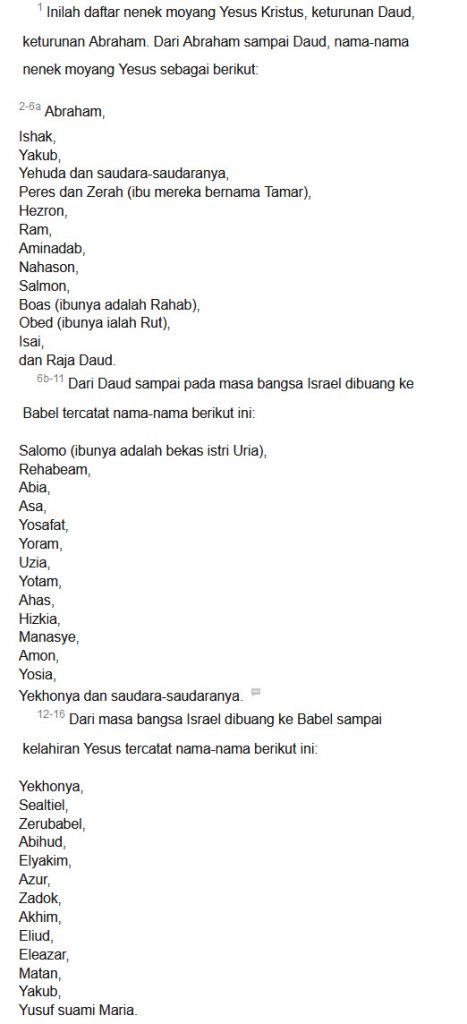
genealogy in Matthew 1

Genealogies play an important role among many of Indonesian language groups and it’s important to follow the right format to make them recognizable as such. Daniel Arichea explains (in The Bible Translator 1986. p. 232ff. ):

“In translating the genealogies, we need to pay attention to the standard form of genealogical lists in the language of translation. Among the Bataks, it was discovered after some research that the genealogies are recorded in the form of a list of ancestors. Furthermore, this list almost always starts from the ancestor and goes down to the descendants. This seems to be true also for many other Indonesian groups, although there are some variations. For the genealogies to have meaning among the Bataks and other groups of similar cultures, these genealogies must be in a form which is appropriate.

“In Matthew 1:2-16, the biblical form is strange to many Indonesians. (…) The second edition of the Common Language Indonesian New Testament (Alkitab dalam Bahasa Indonesia Masa Kini) discarded the biblical form and came out with a series of ancestral lists. (…) When this was tested, however, many Indonesians did not recognize these lists as genealogical lists, but saw them simply as a list of names. In the light of such reactions, the new edition which is included in the recently published common language Bible has printed these lists as genealogical lists moving downward from the ancestors to the descendants. Thus, verse 2 reads: “From Abraham until David, the names of the ancestors of Jesus are as follows” [which is then followed by a list].”

You can see this in the following screen capture (available right here ):


Similarly to that, Joanne Shetler (1992) describes the impact of the genealogy in the Balangao language of the Philippines:

“Then one day Ama [the co-translator and Christian leader] casually picked up an English New Testament from my shipping-crate desk. He opened it to the first page, Matthew 1, which is a list of names. He stood frozen, staring at it. Incredulous, he asked me, ‘You mean this has a genealogy in it?’

“I said, ‘Yeah, but just skip over that so you can get to the good part.’

“‘You mean this is true?’ he asked. Eyes riveted to the page, he struggled through the list of names.

“Something’s going on here! I got some shelf paper and made a genealogy from Adam to Jesus, from the ceiling clear down to the floor. Ama took it all over the village. He carefully explained, ‘We always thought it was the rock and the banana plant that gave birth to people. But we don’t have their names written down. Look, here are ALL the names—written down!’

“Balangaos had their own creation story, passed down from generation to generation through oral tradition. Ama told me their story:

“Long ago, when there were no people yet on the earth, the rock and the banana plant argued as to which of them would give birth to people and populate the earth. In the course of events, it was the frail banana plant from whom all the people of the earth descended. After producing fruit, the banana plant dies and new shoots spring up for succeeding generations. People have inherited all the frailty of the banana plant and are susceptible to all kinds of dangers and inevitably, death.

“Although their story accounted for man’s frailty, it didn’t have their ancestors’ names written down. A genealogy written was powerful. Balangaos loved that genealogy from the Gospel of Matthew. It proved the Bible was true: for the first time they had the actual names from the beginning of the world — written down.

In the Kölsch translation (publ. 2017), the genealogy is summarized: “From Abraham to David there were fourteen generations. There were another fourteen generations from David until the Jews were deported to Babylon and from Babylon to Jesus there were yet another fourteen generations. This shows that Joseph (Jupp), Mary’s husband, was a descendant of Abraham and David.” (Translation: Jost Zetzsche)

Christ Jesus

In the instances where the Greek New Testament says Christos Iēsous (Χριστὸς Ἰησοῦς) rather than the more common Iēsous Christos and English translations typically translate as “Christ Jesus,” the Bokyi translation says Jisos Karâs or “Jesus Christ.”

Paul Bruns explains (in The Bible Translator 1986, p. 234ff. ):

“Bokyi is a rather small language in the Cross River State of Nigeria. In one Bokyi village named Bansan the oldest man’s name is Otu Obyi. There is another man in another Bokyi village named Obyi Otu. Even though these two men share the same names every Bokyi person knows that they are two different people because of the order in which their names are used.

“If you are a translator and your language uses this same method of naming people, you can not sometimes write Jesus Christ in your translation and sometimes write Christ Jesus, and still refer to the same person. It will refer to two different people. You should always write Jesus Christ or Christ Jesus, but not both. You will have to decide which order is the most natural in your language.”

marking the Parable of the Good Samaritan as historical

Indonesian uses a way to introduce a person in the beginning of a story that communicates to the reader or listener whether the story is a historical account a non-historical account. Ada seorang is used for the historical account and adalah seorang for the non-historical account. “In the Indonesian Common Language Bible (Alkitab dalam Bahasa Indonesia Masa Kini, publ. 1985), the second formula is used in the parable of the Prodigal Son (Luke 15), in the parable of the rich man and Lazarus (Luke 16), and in many other places. The first formula however is used in the parable of the Good Samaritan in Luke 10. Why is it used here when in fact this is a non-historical account? Simply because while it is a parable, yet Jesus told it as if it was a real historical account. This is shown, for example, by the ending of the parable where Jesus asked the religious teacher to give his opinion as to which man showed love to his neighbor.” (Source: Daniel Arichea in The Bible Translator 1986. p. 235f. )

complete section (John 12:12-19)

The translator of the Wichí Lhamtés Nocten New Testament rearranged the chronology of John 12:12-19, because he found the traditional order of verses confusing. The new order is 12a, 14a, 17, 18, 12b, 13, 14b, 15, 16, 19.

The back-translation of this section is as follows:

The next day, when many people had already gone to Jerusalem to gather for the festival of Passover, Jesus mounted a donkey and then he too went into that city. And the people who had been with him the day recently when he called Lazarus who was in the tomb to rise from amongst the dead, they told others what they had seen Jesus do. And that’s why the people, when they heard that Jesus was about to enter Jerusalem, cut palm leaves and went to meet him and kept crying out saying:

“God is great! Blessing is with the man who comes with the word (authority) of the Lord! Blessing is with him who is the King of the people of Israel!”

Just as the age-old Writing says:

“People of Zion, don’t be afraid.
Look upon your King, he comes on a little donkey.”

But at first his disciples did not understand such things. But later when Jesus entered his greatness, then they remembered that all things that had been done thus were indeed what the age-old Writing had said about Jesus.

But the Pharisees, when they saw those things, spoke amongst themselves saying:

“You see this. If it is so, we can do nothing. Because look, everybody is going with him!”

Source: Robert Lund in The Bible Translator 1987, 445f.

What is impossible for mortals is possible for God

The Greek that is translated as “What is impossible for mortals is possible for God” in English is translated in Nivaclé as “What is impossible with men is possible for God.”

In one printed edition of that New Testament in 1969, however, the Nivaclé translation of Napi nivacle yisasinatjop pa lhech lhjunash, lhan’e ja Dios nisaseemjop was misprinted as Napi nivacle yisasinatjop pa lhech lhjunash, lhan’e ja Dios nisaeemjop (note the missing second “s” in nisaeemjop). Unfortunately this misprint also had some meaning: “What is impossible with men is impossible for God.”

(Source: Roger Omanson in The Bible Translator 1989, p. 432ff. )

word play in Amos 8:2

The Hebrew in Amos 8:2 uses a word play between the words for “summer fruit” (qāyiṣ) and “end” (haqqêṣ) that some English translations try to emulate subtly: “What do you see, Amos?” he asked. “A basket of ripe fruit,” I answered. Then the Lord said to me, “The time is ripe for my people Israel; I will spare them no longer.” (New International Version) and some more explicitly: “What do you see, Amos?” he asked. I replied, “A basket full of ripe fruit.” Then the Lord said, “Like this fruit, Israel is ripe for punishment! I will not delay their punishment again.” (New Living Version).

Source: John Ellington in The Bible Translator 1991, p. 301ff.

rhyme in Judges 16:24

The Hebrew in Judges 16:25 uses a rhyme in the praise chant of the Philistines to their god Dagon where each line ends with the syllable nū (נוּ), the first person plural pronoun.

In the Lingala version this is replicated in the following manner:

« Nzambe na biso akabi na maboko na biso,
monguna na biso,
oyo azalaki kobebisa mokili na biso
mpe koboma bato ebele kati na biso. »

In some versions of other languages, some kind of rhyme scheme is used as well such as in the German Gute Nachricht Bibel (last revision 2018): Hand — Land; Macht — umgebracht.

Source: John Ellington in The Bible Translator 1991, p. 301ff.