The Greek in Mark 12:28 that is translated as “first commandment” in English is translated in Guhu-Samane as “the head of the rest of the commandments… .” This solves a potential confusion for Guhu-Samane speakers whether the commandment is “the first in point of time, or of importance. [This way] it speaks obviously of the primacy of the commandment.”
The Greek that is translated as “there you will see him” in English is translated in Guhu-Samane as “there you will see his substance.”
“There you will see him” caused “puzzlement: Will see him, but in spirit form, or corporeal? (A valid question for people of this culture to whom the spirits of departed ones frequently appear.) [But] ‘there you will see his substance’ is now clearly and unambiguously understood to mean Christ would be seen corporeally.”
The Greek and Hebrew terms that are translated as “redeem” or “redemption” in most English translations (see more on that below) are translated in Kissi as “buying back.” “Ownership of some object may be forfeited or lost, but the original owner may redeem his possession by buying it back. So God, who made us for Himself, permitted us to accept or reject Him. In order to reconcile rebellious mankind He demonstrated His redemptive love in the death of His Son on our behalf.
“The San Blas Kuna describe redemption in a more spiritual sense. They say that it consists of ‘recapturing the spirit.’ A sinful person is one in rebellion against God, and he must be recaptured by God or he will destroy himself. The need of the spirit is to be captured by God. The tragedy is that too many people find their greatest pleasure in secretly trying to elude God, as though they could find some place in the universe where He could not find them. They regard life as a purely private affair, and they object to the claims of God as presented by the church. They accuse the pastor of interfering with the privacy of their own iniquity. Such souls, if they are to be redeemed, must be ‘recaptured.'” (Source: Nida 1952, p. 138)
Click or tap here for more translations or “redeem” / “redemption”
In Ajië a term is used, nawi, that refers to the “custom of planting a small tree on land cursed either by the blood of battle or some calamity.” Clifford (1992, p. 83ff.) retells the story: “Maurice Leenhardt tells how he finally arrived at a term that would express ‘redemption.’ Previous missionaries had interpreted it as an exchange — an exchange of life, that of Jesus for ours. But in Melanesian thinking more strict equivalents were demanded in the exchanges structuring social life. It remained unclear to them how Jesus’ sacrifice could possibly redeem mankind. So unclear was it that even the natas [Melanesians pastors] gave up trying to explain a concept they did not understand very well themselves and simply employed the term “release.” So the matter stood, with the missionary driven to the use of cumbersome circumlocutions, until one day during a conversation on 1 Corinthians 1:30, [Melanesian pastor and Leenhardt’s co-worker] Boesoou Erijisi used a surprising expression: nawi. The term referred to the custom of planting a small tree on land cursed either by the blood of battle or some calamity. ‘Jesus was thus the one who has accomplished the sacrifice and has planted himself like a tree, as though to absorb all the misfortunes of men and to free the world from its taboos.’ Here at last was a concept that seemed to render the principle of ‘redemption’ and could reach deeply enough into living modes of thought. ‘The idea was a rich one, but how could I be sure I understood it right?’ The key test was in the reaction of students and natas to his provisional version. They were, he reports, overjoyed with the ‘deep’ translation.”
In Folopa, the translation team also found a deeply indigenous term. Neil Anderson (in Holzhausen 1991, p. 51) explains: “While I was explaining the meaning of the [concept] to the Folopa men, I could see their faces brighten. They said that this was a common thing among them: ‘If someone falls a tree and it tips to the wrong side, killing someone, the relatives of the injured party claim the life of the guilty party. But in order to save his life, his relatives make amends. Pigs, shells (which are still used as currency here) and other valuables are given to the relatives of the deceased as payment for the life of the guilty party. In this way he can live because others stand up for him.’ Full of joy, I began to utilize this thought to the difficult translation of the word ‘redemption.’ Mark 10:45 reads now, translated back from the Folopa: ‘Jesus came to make an atonement, by which he takes upon himself the punishment for the evil deeds of many. He came so that through his death many might be liberated.’ After working on this verse for half an hour, I read it to my friends. They became silent and moved their slightly bowed heads thoughtfully back and forth. Finally, one of them took the floor, ‘We give a lot to right a wrong. But we have never given a human being as a price of atonement. Jesus did a great work for us when he made restitution. Because he died, all of us now don’t have to bear the punishment we deserve. We are liberated.'”
In Samoan the translation is togiola which originally refers to a fine mat. John Bradshaw (in The Bible Translator 1967, p. 75ff. ) explains: “The rite of submission applies in cases of grave sin which demands an extreme punishment: offenses such as murder, adultery or disrespectful behavior towards a chief. Submission is made in expectation of forgiveness. The rite is normally enacted at dawn. The prisoner and his family, or even his whole village bow down in silence before the house of the chief or other offended party. The prisoner heads the group and is covered with a fine mat, offered as his ransom. In other words, he submits himself completely to the authority of those whom he has offended. Many such submissions have been successfully offered and received. Those inside the house will come out, and bring into it those offering submission. The priestly orators speak sweetly and all join in a meal. The fine mat is accepted, while the prisoner is set free and forgiven. He no longer goes in fear of retribution for his sin. (…) If now we turn to the relation between the believer and the Redeemer, we notice at once that the word togiola, literally the price of one’s life, was the word used to denote the fine mat with which the sinner covered himself in the rite of Submission. The acceptance of the togiola set free the prisoner. It was inevitable that togiola should render lutron, ransom, as in Matthew 20:28.”
“In Hebrew there are two terms, ga’al and padah, usually rendered ‘to redeem,’ which have likewise undergone significant changes in meaning with resulting obscurity and misunderstanding. Both terms are used in the Old Testament for a person being redeemed from slavery. In the case of padah, the primary emphasis is upon the redemption by means of payment, and in ga’al the redemption of an individual, usually by payment, is made by some relative or an individual of the same clan or society. These two words, however, are used in the Old Testament in circumstances in which there is no payment at all. For example, the redemption of Jews from Egypt is referred to by these two terms, but clearly there was no payment made to the Egyptians or to Pharaoh.
“In the New Testament a related problem occurs, for the words agorázō and exagorazó, meaning literally ‘to buy’ or ‘to buy back’ and ‘to buy out,’ were translated into Latin as redimo and into English normally as ‘redeem.’ The almost exclusive association of Latin redimo with payment became such a focal element of meaning that during the Middle Ages a theory developed that God had to pay the Devil in order to get believers out of hell and into heaven.
“As in the case of the Old Testament, New Testament contexts employing the Greek verb lutroó, literally ‘to redeem’ or ‘to ransom,’ do not refer primarily to payment but focus upon deliverance and being set free. But even today there is such a heavy tradition of the theological concept of payment that any attempt to translate lutroó as ‘to deliver’ or ‘to set free’ is misjudged by some as being heretical.” (Source: Nida 1984, p. 114f.)
“A particularly interesting development in the history of Christianity [related to translation] took place with respect to the Greek term monogenés, literally, ‘only, unique, one of kind.’ It was used of Isaac as the son of Abraham [see Gen. 22:2], though Isaac was not the only son of Abraham, for he had a son Ishmael, and with a later wife Keturah, several sons. But Isaac was the only son of a particular kind, that is to say, the unique son of the promise. The term monogenés was translated into the LatinVulgate as unigenitus, meaning literally ‘only begotten’ [in English — or likewise traditionally in Mandarin Chinese: “dúshēng 獨 生,” Italian: “unigenito,” Spanish “unigénito,” or German: “eingeboren”] but in Greek the equivalent of ‘only begotten’ would have two n’s and not just one (monogennes). Nevertheless, the Latin misinterpretation of monogenés has constituted such a long tradition that any attempt to speak of Jesus as the ‘unique son of God’ rather than the ‘only begotten son’ is often announced as a case of blatant heresy.” (Source: Nida 1984, p. 114.)
In Waiwai, the Greek that is translated as “only begotten Son” in English in John 3:16 is translated as cewnan tumumururosa okwe, where the “particle okwe indicates dearness, and it must be included in Waiwai for the expression ‘only begotten Son’ to mean anything like what it means to God or to us as Christians.” (Source: Robert Hawkins (in The Bible Translator 1962, pp. 164ff. )
The German Good News Bible (Die Bibel im heutigen Deutsch) (1st edition: 1968, latest edition: 2018) says this about the translation of the Greek expressions that in English are often translated as “kingdom of God” or “kingdom of heaven” respectively:
“An example for how a term evolved is the rendering of ‘heavenly kingdom’ or ‘kingdom of God.’ A verbatim translation will be misunderstood by most readers today: as if it talks about a kingdom that is located in heaven, when in reality it refers in the Bible to God being the ruler, to that area in which that rule has been realized and everything that human beings can expect because of that. Dependent on the context, the term is therefore translated differently in this present version: When it focuses on the presence of God’s kingdom it is rendered as ‘God establishes his rule’ (Gott richtet seine Herrschaft auf), when the focus is on the future it is translated as ‘Once God finalizes his creation (or ‘work’) . . . ‘ (Wenn Gott sein Werk vollendet . . .), and when the focus is on that finished creation it is ‘God’s new world’ (Gottes neue Welt).” (p. 299 — for a longer exposition, see Rudolf Kassühlke in The Bible Translator 1974, p. 236ff. )
The respective translation choice in that German translation:
Likewise in the Gurung translation the term was also, depending on context, rendered in four different ways:
God’s power at work in the world,
the personal response to God, in obedience and receiving blessing,
God’s future open ruling of the world,
the ultimate blessings of God’s rule in heaven.
(Source: Warren Glover in The Bible Translator 1978, p. 231ff. — here you can also find a comprehensive list of examples where which translation was applied.)
Following is a list of (back-) translations from other languages:
Tzeltal: “persons like these will reach God’s government” (as in Mark 10:14 and Luke 18:16: “the Kingdom of God belongs to those”) or “the jurisdiction of God” (in the sense of where God has the authority)
Sranan Tongo: Tiri fur Gado (“the Ruling of God”) or Kownukondre fur Gado (“King’s land of God”)
Eastern Maroon Creole: A Nyun Tii fu Massa Gadu / Saramaccan: Di Njunjun Tii u Gadu (both: “the New ruling of God”) (source for this and 2 above: Jabini 2015)
Umiray Dumaget Agta: “protectorate of God” (source: M. Larson / B. Moore in Notes on Translation February 1970, p. 1-125.)
Chuj: “everything which is in God’s hand” (source for this and two above: Viola Waterhouse in Notes on Translation August 1966, p. 86ff.)
Kamo: kuu le Yamba: “kingdom of God” / kuu le Yamba: “kingdom of heaven.” Yamba can mean either “sky/heaven” or “God” and they distinguish between the two meanings by capitalization. The word kuu is an abstract noun meaning “rule/reign.” (source: David Frank)
In Mairasi, a language “where people would rather say something in a new way than in an old way,” there are a number of translations, including “Great Above One’s (=God) rule,” “His power,” “His control,” or “His place of authority/power.” (Source: Enggavoter 2004)
In Q’anjob’al, the translators stumbled on an additional difficulty. Newberry and Kittie Cox (in The Bible Translator 1950, p. 91ff. ) explain: “‘The kingdom of God’ may be translated ‘where God supervises’ (or literally ‘guards’). However, in Mark 10:15 and Luke 18:17 it is not possible to speak of ‘receiving the kingdom of God,’ for this would imply that one simply takes over the responsibility for guarding God’s country while He rests. Accordingly, the translation is adapted to meet the cultural and linguistic requirements of the language by the form ‘receive God as king.’
In British Sign Language it is translation with a sign that combines the signs for “God” and “rule.” (Source: Anna Smith)
“Kingdom of God” in British Sign Language (source: Christian BSL, used with permission)
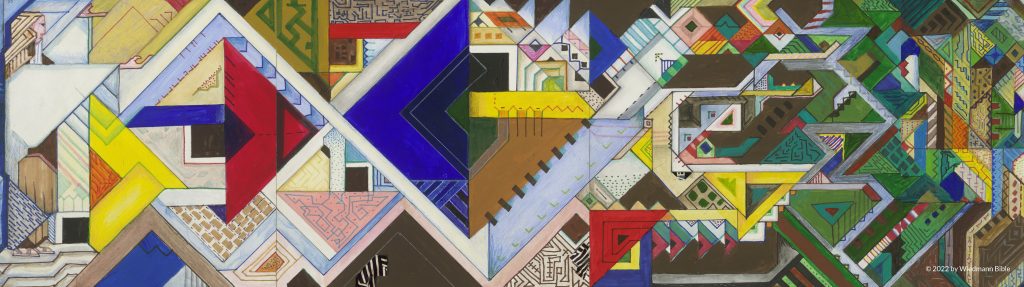
The artist Willy Wiedmann envisioned Jesus foretelling the kingdom of God like this:
Click here to see the image in higher resolution. Image taken from the Wiedmann Bible. For more information about the images and ways to adopt them, see here . For other images of Willy Wiedmann paintings in TIPs, see here.
The Hebrew that is translated as “firmament,” “expanse,” or “dome” in English is translated in Roviana as galegalearane: “the open space between the earth and the sky,” in Moru as “empty space” and in Hausa as sararin sama or “space of the sky” (Sabon Rai Don Kowa, publ. 2020).
In Idoma it is translated as okpanco — “the top of the sky.” “According to tradition, when the world began, the okpanco was low. A woman was pounding yams and her pestle kept hitting okpanco and it started going higher and higher.”
In Naskapi it is translated as “sky skin” — “like a caribou skin.”
(Sources: Roviana: Carl Gross; Moru: Jan Sterk; Hausa: Andy Warren-Rothlin; Idoma: Rob Koops; Naskapi: Doug Lockhart in Word Alive 2013 )
In Lingala it is translated as “surface.” Sigurd F. Westberg (in The Bible Translator 1956, p. 117ff. ) explains: “The ‘firmament’ in Genesis 1 gave us another problem. Its meaning in English is certainly not immediately obvious. The dictionary tells us that the Hebrew means something close to our English word ’expanse.’ It seems, however, that the Hebrew idea may not always have been as abstract as that, for Isaiah says that the Lord ‘stretcheth out the heavens as a curtain, and spreadeth them out as a tent to dwell in.’ But the Greek word used in the Septuagint gives the idea of a firm and solid structure, and this is the idea that is carried out in our English word ‘firmament.’ Modern translations into English, Swedish, Norwegian and French take one or the other of these two leads. It is the predicament of the translator that he dare not hesitate too long between ideas. (…) In this case we tried to arrive at ’expanse’ by the use of a word meaning ’width,’ but we found that it is not really understandable except as it is associated with the noun of which it indicates the width. It cannot be used alone. The word we finally used means ‘surface,’ but it also has the idea of something stretched out or smoothed out. It is more concrete than we should like, but it does not require identity with a concrete object as does the word for width’.’
In Newari it is translated as “upper part of water” (Gen. 1:6 is translated “height between two portions of water”) (source: Newari Back Translation), in Bariai as “barrier” (source: Bariai Back Translation), and in Hiligaynon as “division” (source: Hiligaynon Back Translation).
In Tenharim a translation for “firmament” was not deemed possible because there were no overlaps in the world view of the Tenharim speakers and that of the cosmology of Genesis. LaVera Betts (in: Notes on Translation, September 1971, p. 16ff.) explains: “[In their view,] heaven’s edge is curbed and solid. It can become meshed releasing the water above it onto the clouds, which to the Parintintín [the Tenharim speakers] are gathered wind, in order for this water to be dispersed in the form of rain. An entrance, position and description unknown, is available to the occupants of the layers of heaven through which they may pass to the world. To each layer of heaven and heaven as a whole they apply the same word: yvaga.
“The sun, moon, and stars attach to the world’s side of heaven’s edge. The sun and moon have separate paths-the moon making a half revolution and returning, and the sun making a complete revolution. No all-inclusive term for the heavenly bodies, earth, and the expanse between them so far has been encountered in Parintintín. Nor has there been found a suitable term for this expanse alone. During the day the expanse could be called the open/clear space: mytuêa; but at night it disappears into heaven and night takes its place. Its occurrence, then, is contingent on the presence of light and therefore inappropriate for expressing firmament (Genesis 1:6).
“To translate ‘firmament’ as a vault the translator possibly could have used heaven’s edge which, although suiting their world view grandly, poses problems in the translator’s mind especially as to the restricted meaning it would force on the translation for them. That a good shaman is believed to be able to bring heaven down immediately over the earth reveals that to them the expanse over the earth is empty, or compressible and flexible, and the ‘vault’ movable.
“The possible translation of atmosphere for firmament was settled upon and the term used was ‘wind’: yvytua. The phrase ‘and God called the firmament heaven’ was deleted. A possible alternate ‘and God called the place of the wind heaven’ also was not used as Coriolano [the indigenous translator] did not know where the wind went when it is not seen in the form of clouds nor felt; however, he insisted the wind is everlasting — unlike one’s breath which is not lasting. Animates do not breathe air/wind but their hearts pump their own breath.”
The Greek that is translated as “we might become the righteousness of God” in English is translated in Tzotzil as “we are given straight (righteous) hearts like God’s straight heart.”
This was done to avoid communicating that God gave his righteousness away without keeping it for himself. (Source: Marion Cowan in The Bible Translator 1963, p. 90)
“It was interesting to find how similar some of the Hebrew ways of expression are to Bari idiom. (…) [For instance], in Genesis 49:14 (‘Issachar is a strong(-boned) donkey’) Hebrew literally has ‘a bony donkey.’ In English this would convey the opposite meaning, as we associate ‘bony’ with ‘thin’; but when we came to translate this, Daniele [the language assistant] told me that Bari says ‘You are a man with bones,’ or ‘You have ribs,’ meaning that you are strong. So it seems that it is the bones and ribs in Bari which denote strength, as seems to be the case in Hebrew, rather than the muscles, as in English.” (Source: P. Guillebaud in The Bible Translator 1965, p. 189ff. )
The Samaritan Pentateuch reads this as “ass of sojourners” ( חמר גרים ) or more probably “castrated ass,” which is the meaning that the New English Bible (1961/1970) follows with “gelded ass.” (Source: Jan de Waard in The Bible Translator 1974, p. 107ff. )