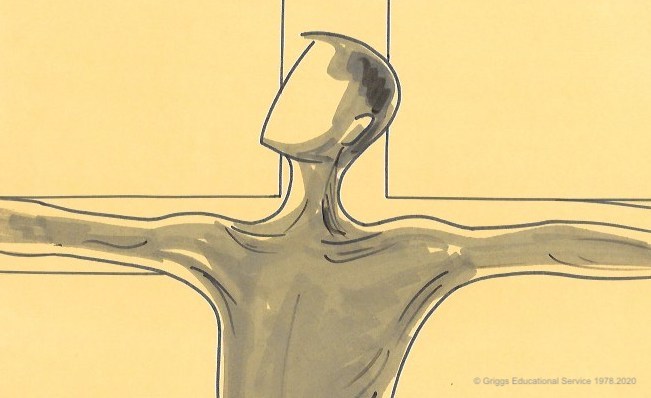
The Greek that is translated in English as “blessed is the one who comes in the name of the Lord” is translated in Mazagway with a phrase that can be back-translated to “God puts the hand of the chief on the man who has come in his name.” (Source: Ken Hollingsworth)
Illustration by Annie Vallotton, copyright by Donald and Patricia Griggs of Griggs Educational Service. More images can be viewed at rotation.org .
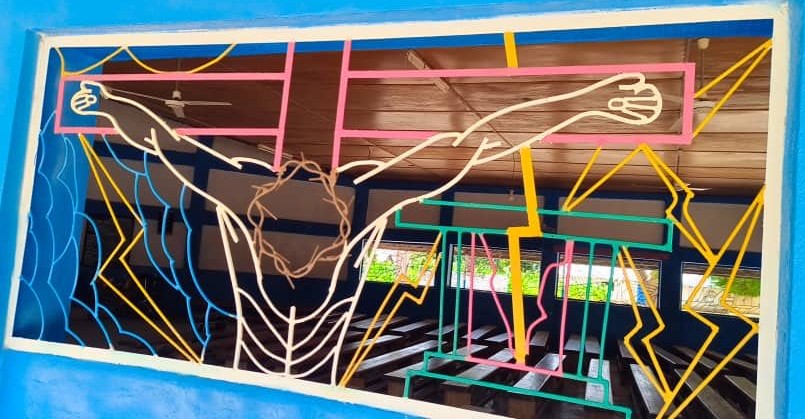
The following is a church window based on another image of Annie Vallotton of the same scene. This is installed in a church of the Union des Églises Baptistes du Cameroun in Mowo (Mokong), Cameroon.
Photo and the following description by Ken Hollingsworth
“The windows are open with no screens or glass. The pictures were fabricated by projecting the picture using an overhead projector on a piece of plywood. They were drawn on the plywood with charcoal. Then the fabricator cut pieces of iron rebar to make the picture. Then the iron pieces were welded together. Later, when the pictures were installed, they were painted with different colors to help the people ‘see’ the picture.”
The Greek in Luke 15:25 that is translated in English as “music” is translated in Muna as “the sound of the gong and the drum.” René van den Berg explains: “There is no abstract word for ‘music’ (the footnote has the loan musik).”
Mairasi: “the sound of songs” (source: Enggavoter 2004)
Hiligaynon: “sounds” (source: Hiligaynon Back Translation)
Burmese: “the sound of beating-blowing” (“‘Beating blowing’ is a general term for instrumental music and covers the sound of percussion instruments, wind and brass instruments which are blown, and some stringed instruments which are also ‘beaten.'” — source: Anonymous)
Painting by Wang Suda 王肅達 (1910-1963),
Copyright by the Catholic University Peking, China
Text under painting translated from Literary Chinese into English: Jesus Ascended to Heaven
The Lord returned to Heaven and was seated at the right hand of Father
Image taken from Chinese Christian Posters . For more information on the “Ars Sacra Pekinensis” school of art, see this article , for other artworks of that school in TIPs, see here.
Following is a painting (“Ascension”) by Kim Ki-chang (1913-2001):
Kim Ki-chang (pen name: Unbo) had been deaf and partially mute since the age of 7. He painted a series of 30 paintings for the “Life of Christ” cycle in 1952 during the Korean War. Kim portrayed Jesus as a seonbi / 선비, or a Joseon Period (1392-1910) gentleman scholar, wearing a gat / 갓 (hat) and dopo / 도포 (robe). For other images of Kim Ki-chang art works in TIPs, see here.
The following is a church window based on an of Annie Vallotton. This is installed in a church of the Union des Églises Baptistes du Cameroun in Mowo (Mokong), Cameroon.
Photo and the following description by Ken Hollingsworth
“The windows are open with no screens or glass. The pictures were fabricated by projecting the picture using an overhead projector on a piece of plywood. They were drawn on the plywood with charcoal. Then the fabricator cut pieces of iron rebar to make the picture. Then the iron pieces were welded together. Later, when the pictures were installed, they were painted with different colors to help the people ‘see’ the picture.”
The following is a church window based on an image of Annie Vallotton. This is installed in a church of the Union des Églises Baptistes du Cameroun in Mowo (Mokong), Cameroon.
Photo and the following description by Ken Hollingsworth
“The windows are open with no screens or glass. The pictures were fabricated by projecting the picture using an overhead projector on a piece of plywood. They were drawn on the plywood with charcoal. Then the fabricator cut pieces of iron rebar to make the picture. Then the iron pieces were welded together. Later, when the pictures were installed, they were painted with different colors to help the people ‘see’ the picture.”
The following is a church window based on an image of Annie Vallotton. This is installed in a church of the Union des Églises Baptistes du Cameroun in Mowo (Mokong), Cameroon.
Photo and the following description by Ken Hollingsworth
“The windows are open with no screens or glass. The pictures were fabricated by projecting the picture using an overhead projector on a piece of plywood. They were drawn on the plywood with charcoal. Then the fabricator cut pieces of iron rebar to make the picture. Then the iron pieces were welded together. Later, when the pictures were installed, they were painted with different colors to help the people ‘see’ the picture.”