Most modern scholars are of the opinion that the Hebrew word te’o refers to the oryx. Oryx bones have been found in proximity to Israelite and Canaanite domestic and sacrificial sites that date over a very wide time span proof that the animal was fairly common and was considered to be acceptable to eat. Furthermore it is known that until the mid-nineteenth century large numbers of oryx roamed the Negev in Palestine.
The Arabian or Desert Oryx Oryx leucoryx is a medium-sized antelope, about the size of a donkey. It is closely related to the African oryxes, such as the Gemsbok Oryx gazella of the Kalahari and Namib semideserts, the East African Oryx Oryx beisa, and the Scimitar-horned Oryx Oryx algazel of the Sudan and Egypt. In many ways the oryx is also similar to, but smaller than, the Sable Antelope Hippotragus niger and the Roan Antelope Hippotragus equinus, both of which are found in South Africa, Zimbabwe, Zambia, and Angola.
The Arabian oryx, which was once plentiful in the land of Israel is now almost extinct and the only remaining specimens have been bred in semicaptivity and in captivity from one small breeding herd. This inbreeding and captivity have resulted in marked genetic deterioration so that today’s specimens are smaller and weaker than their ancestors and many have deformed horns. So although the specimens in photographs give us a rough idea of what the original Arabian oryx was like, these modern defects should be borne in mind.
Both males and females of the Arabian oryx have long slender horns that are usually over a meter (3 feet) long. The horns are almost straight and slope back from the animal’s head at about thirty degrees from the perpendicular. The adults are a light fawn color with dark brown markings on the face and on the lower part of both front and back legs. The belly is white.
In the wild oryxes are well able to defend themselves with their long horns and the African species are often able to drive off lions and other predators sometimes even killing their attackers. When wounded by hunters they are extremely dangerous. They are also very strong runners. They live in semi-desert conditions and are very hardy.
The oryx was known for its strength (perhaps exaggerated since strength was associated with long horns) and bravery. Oryx horns are the longest horns known in the Middle East and North Africa and since horns were a symbol of power and strength this probably added to the association of the oryx with power. According to some Jewish scholars oryx horns were later used to make special shofar trumpets blown only at Passover. The oryx is listed among the clean animals.
In Africa and other areas where oryxes or sable and roan antelopes are known, the word for one of these animals could be used throughout. Elsewhere, a term, such as “long-horned antelopes”, could be used for te’o, or a transliteration of the Hebrew word might be considered, with a description given in a footnote or in the glossary.
The word chazir is used for domestic and wild pigs. The domesticated pig was known in Egypt around 2500 B.C. and was probably domesticated in Canaan about that time too. Domestication of wild pigs seems to have coincided everywhere with the development of agriculture. Wild pigs were probably penned in large enclosures and fed scraps, thus keeping them away from planted fields. Later on, when full domestication had taken place, it was more usual for pigs to be herded rather than kept in pens. Pigs eat almost anything and herding did away with the necessity to feed them. It soon was noticed that the rooting activity of the pigs rid areas of tree roots and shrubs and promoted the growth of grass for grazing. So early swineherds herded the pigs into areas where future grazing was wanted, away from planted fields. Jews who kept pigs may not have done so with the idea of eating their meat, which was unclean, but to promote grazing grass and to sell the pigs to neighboring tribes.
Wild pigs, in the form of the European Boar Sus scrofus, were once abundant in Israel, especially in the Jordan Valley. Even now since neither Jews nor Moslems eat the meat of wild pigs, and thus do not hunt them, they can still be found in the Jordan Valley and in many other areas where there is both water and thick undergrowth.
The Greek words choiros and hueios mean “pig” or “pig meat”. The word hus means a female pig or sow.
The domesticated pigs of biblical times looked much more like wild pigs than the modern breeds of pig. They would have been brown or gray in color and fairly hairy. The young pigs probably had horizontal stripes.
Of all animals the pig was considered the most unclean.
In languages that differentiate between wild and domestic pigs, in Psalms 80:13 the word for a wild pig should be used. In 2 Peter 2:22, although the Greek specifies a female pig, the gender of the pig is not really important in the proverb. Many translations have simply “pig”.
There is general agreement about the meaning of the Latin word aper. The animal referred to is the European Wild Boar Sus scrofa, which was once plentiful in forested areas of Europe and the Middle East from the Atlantic Coast to as far east as the Tian Shan Range in China.
Although wild boars are the ancestors of domestic pigs, they are much more active and robust animals. They are taller, almost a meter (3 feet) at the shoulder, and much more hairy all over. Their underside is covered in hairs longer than those on the rest of their body. Their color varies from gray to black. Adult males have short tusks that are used both for digging and for protection. They have flat mobile snouts that are also used for digging. The piglets, up to twelve in a litter, are covered with dark stripes and spots running from head to tail. The adults are extremely protective of the younger animals and are fearlessly aggressive. This makes them very dangerous animals. Wild boars are omnivorous, eating mainly roots, but also eating grass, leaves, insects, and small animals and birds. They need to live close to water, as they rely on the cooling effects of wallowing in mud to regulate their body temperature. In Israel they were found in the Huleh swamps, and even now they can be found in the Jordan Valley and in some remote wadis.
Like domestic pigs wild boars are considered by Jews to be unclean. They are also associated with ferocity and aggressiveness. In Egypt Assyria Babylonia and later in Persia Greece and Rome the boar’s head was a common symbol of military might.
Wild pigs similar to Sus scrofa are found in Africa and Asia. They include the Giant Forest Hog Hylochoerus meinertzerhageni of the equatorial regions of Africa; the Bush Pig Potamochaerus porcus, found in the savannah areas of sub-Saharan Africa; and the Crested Wild Boar (Soor) Sus cristatus, found on the Indian subcontinent, and in Myanmar, Thailand, Laos, and southwestern China. All of these share the aggressive nature of the wild boar.
In Indonesia and some Philippine islands the nearest equivalent is the Babirusa Babyrousa babyrussa. However, since this animal is not nearly as large or as fierce as the wild boar, translations in these areas should probably use an expression meaning “big, fierce babirusa”.
In the southern United States, Mexico, and adjacent areas of Latin America as far south as southern Brazil and Paraguay, the closest equivalent to the wild boar is the animal known as the collared peccary, javelina, or Musk Hog Tayassu angulatus. This animal is not as large or as fierce as the wild boar, so a more descriptive expression such as “big, fierce peccary” might be the best way of translating the word.
While Psalms 80:13 has the word chazir, normally translated “pig”, the context makes it clear that this is a wild animal, and “wild boar” is the better translation.
There is considerable doubt about the meaning of the word sekwi. However, the rendering “cock” or “rooster” has support from the Vulgate and one of the Targums, as well as the majority of commentaries. In the context of Job 38:36 the reference seems to be to the way in which the ibis is able to announce the flooding of the Nile, and the rooster is able to announce the coming of the dawn. Both of these abilities are mentioned quite often in Egyptian literature.
The word zarzir is probably related to a word meaning “narrow waisted,” but most commentaries and translations interpret this as a reference to the rooster.
The Greek word ornis and the Latin word gallina mean “hen,” and the Greek words nossia and nossion mean “chick,” that is, a baby fowl.
All modern domestic fowls are descended from the jungle fowl of India, Southeast Asia, and China. These were domesticated very early in the history of that region, almost as soon as the farming of rice and other grains began. According to the Talmud, it was forbidden to keep domestic poultry in Jerusalem, but there is evidence from ancient Hebrew seals that chickens were known in the land as early as 600 B.C. The reference to the cock crowing on the night of the crucifixion would indicate that chickens were kept near, if not in, Jerusalem.
Ancient domestic fowls would still have looked very much like the Jungle Fowl Gallus gallus from which they were descended. Jungle fowl roosters are dark, brownish red, with orange-red neck hackles, a smallish red comb on the top of their heads, and red lappets on each side under the beak. They have a white spot on their backs near the base of their long glossy black and green tails. The hens are a lighter brownish red, have no white spot or long tail, and have a smaller comb on their heads.
Domestic fowl had connotations of fertility to the Egyptians and Persians. This seems to have been adopted later in Judaism, since it became the practice to carry a cock and a hen in front of the bride and groom at a wedding. However, their significance in the Bible seems related to the fact that cocks crow very early in the morning, thus announcing the coming dawn before humans are aware of it.
Domestic fowl have now spread around the world and are well-known, apart from some areas of the tundra region.
The words sekwi, zarzir, alektruōn, and alektōr are probably best translated as “rooster,” ornis as “hen,” and nossion and nossia as “chickens.” In some languages where roosters and hens are not normally differentiated, it may not be necessary to do so in the gospel passages, since the verb “crow” will usually be sufficient context to make the meaning clear. However, in the Job and Proverbs passages it may still be necessary in some languages to say something like “male chicken.”
Although the translation of shalak as “cormorant” has a tradition going back to the seventeenth century, there has always been considerable doubt about this translation. For one thing, the root of the word shalak means “to throw or hurl”, which would indicate that the bird with this name “throws” itself down onto its prey, something cormorants do not do. They swim low in the water and dive underwater to hunt their prey. This led the late G. R. Driver to suggest the translation “fisher owl”. However, there are problems with this suggestion too. The fisher owl, or more correctly, the Brown Fish Owl Scotopelia ceylonensis, is not likely to have been a bird that was well known, and its fishing habits would only have been seen by fishermen on moonlit nights, and that very rarely. The Israelites were not yet a fishing people in the period of the Exodus.
In modern Hebrew shalak is the name given to the Osprey Pandion haliaetus, which is a type of fishing eagle that plunges into the water from a height and catches fish in its claws. Some Israeli scholars have suggested that it may have been the ancient name for the Smyrna Kingfisher Halcyon smyrnensis, or the Gannet Sula bassana, both of which drop down from a height onto their prey, which they catch underwater in their beaks.
Since there is so much doubt about the identification of this bird, the translation “osprey” seems to have as much, if not more, justification than “cormorant”.
The White-necked Cormorant Phala-crocorax carbo, which is the most common type of cormorant in the Middle East, is a large bird with a long slim body and a long beak that is hooked at the tip. The adults are black all over with a small yellow pouch where the throat meets the beak. They also have yellow skin on their faces. This type of cormorant is found along the sea and lake coasts, along the larger rivers, and in swampy areas. It has webbed feet like a duck and swims in the water, but with most of the body under the water. It dives and can swim quite a long way underwater hunting fish.
Like all cormorants its feathers are not waterproof, and this enables it to swim underwater easily. However, it also means that after diving or swimming for a while, a cormorant has to come out of the water to dry out its wings. Thus cormorants can often be seen perched on logs or rocks, with their wings spread out to dry.
During the daytime they can usually be found in small groups of four or five, but in the evening when they roost in trees they come together in large numbers and are very noisy. In seasons when large shoals of small fish swim near the surface, large numbers of black cormorants can often be seen flying fast and low above the water in long lines one behind the other, searching for such a shoal. When they find it, they all land on the water together and feed in great excitement.
Apart from the fact that the shalak is found in the lists of unclean birds, it has no other significance in the Bible.
If the translator chooses to identify shalak as “cormorant”, it should not be difficult to find some species of cormorant locally, since cormorants are found all over the world near large bodies of water. The white-necked cormorant is in fact found not only in Israel but also near the coasts, lake shores, large rivers, and swamps throughout Europe, Asia, Australasia, Africa, and the eastern half of North America. In southern Africa a slightly different form of the white-necked cormorant is found, called the white-breasted cormorant. It has a white breast and throat and a smaller throat pouch, but has the same scientific name. Elsewhere there will be local species of cormorant, which can be identified by the habit of perching with wings spread out to dry.
The occurrence of this word in Isaiah 38:14 is problematic, where it appears in the phrase sus ‘agur, which looks like a head noun followed by a qualifying noun, so it is the name of a single bird (a type of swift) rather than of two. The phrase is thus translated as “swallow” by some English versions, but as two birds by others. In Jeremiah 8:7, however, all versions treat the word as a common noun, although interpreting it differently.
The interpretation in Jeremiah of ‘agur as “crane” has quite good support. For one thing the crane is one of the most obvious of the migrating birds passing over Israel, and thousands can be seen passing noisily overhead each year as they move from Europe and Asia to Africa for the summer and return again in March. They stay in Israel only for a few days and then move on. Second, the translation “crane” neatly preserves the structure and the images of the Hebrew poem. The structure here is what is referred to as a chiasmus. In this chiasmus four items are mentioned, with the first and last forming one pair and the middle two forming another: stork, dove, swift, crane. This is a common feature of Hebrew poetry. Here “stork” and “crane” are paired, and since both are passing migrants and both have long necks and legs and are about the same size, the pairing is well motivated. Third, but perhaps less important, ‘agur is the modern Hebrew word for crane. Some Hebrew scholars relate the word to the verb ga‘ar, “to cry”, a reference to the noisy call of the crane.
Cranes are large long-legged, long-necked birds, which are best known for their dancing displays. At breeding time especially, but at other times too, a small group of cranes will start “dancing” together, bobbing up and down, jumping into the air, and turning around. The crane mentioned in Jeremiah 8:7 is most likely the Eurasian or Common Crane Grus grus. This is a large gray bird with a trace of red on the top of its head, and whitish cheeks. It has a wingspan of over two meters (6 feet), a long neck, and long bare legs. It behaves very much like a stork, spending most of its time walking on the ground in search of frogs, lizards, grasshoppers, and other insects.
It is one of the birds noted in the Bible for its migrating habits.
It is better to translate sus ‘agur in Isaiah 38:14 as one bird only, namely the swift.
Cranes are found worldwide except in South America, New Zealand, and small island localities. In most parts of the world then, it will not be difficult to find a word for one of the local cranes. However, in most parts of the world the local cranes are not migrating birds, but permanently resident. In these cases it may be good to have a footnote indicating that in Israel cranes migrate in large numbers over the land in spring and autumn, moving from Europe and Asia to Africa and back again. Alternatively, in places where two types of migrating stork are known, as in many parts of central, eastern, and southern Africa, the name of one type can be used to translate ‘agur in Jeremiah 8:7.
African cranes include the Blue Crane Anthropoides paradisea, the Wattled Crane Grus carunculata, and the Crested Crane (also called the Crowned Crane) Balearica regulorum. Australian cranes include the Brolga Grus rubicunda and the Sarus Crane Grus antigone.
Among the Asian cranes is the red-headed Siberian crane, which nests in Siberia and migrates to Iran, Pakistan, India, and China.
In Egypt, Sudan, Ethiopia, and southeastern Europe, it should be possible to find a local word for the Common Crane Grus grus.
Elsewhere the best solution is a word for crane borrowed from English, Spanish, or Portuguese, or a transliteration of the scientific name Grus.
There is no disagreement about the meaning of these words. The Hebrew ‘orev and the two Greek words are general names given to any member of the crow family. This includes any of the three types of raven, two types of crow, and the rook, which are found in Israel. Of these the Brown-necked Raven Corvus ruficolllis, the Fan-tailed Raven Corvus rhipidurus, and the Hooded Crow Corvus corone cornix are common residents. The Common Raven Corvus corax is resident but not as common in modern Israel as it must have been in ancient times. The remaining types of crow found in Israel are visiting migrants that do not stay long.
Crows and ravens are large black birds with thick strong beaks, and fairly short legs. They are highly intelligent and seem to enjoy flying. Often if there is a good thermal current of air, they will soar around in circles, riding the thermal and calling. Some varieties will congregate in great numbers in these thermals and circle around together. On sunny windy days they will sometimes spread their wings and ride the wind, not going anywhere, sometimes even anchoring themselves by hanging on to the end of a branch with one foot. They eat almost anything, including grain, fruit, insects, lizards, frogs, eggs, nestlings, and the meat of dead animals. When the raven released by Noah failed to return to the ark, this was a sign that some land had emerged from the flood and that the raven had found food, probably the carcasses of the people and creatures drowned in the flood.
Crows and ravens build their nests out of twigs and grass in the forks of trees or on ledges on cliffs. The nests are quite large and untidy. Ravens tend to keep to the rocky hills and are found near Galilee, the Judean Desert, the Dead Sea coast, the Negev, and the escarpment bordering the Aravah Rift Valley.
Ravens are unclean birds and are associated in biblical culture with death. They are thus symbols of the devastation resulting from war. They are also singled out as fed by God (Job 38:41). Even though they are unclean and have some horrible habits, they are not forgotten by God. Thus they are also a symbol of God’s kindness. Finally, for the inhabitants of Israel there was nothing blacker than the raven, which in fact is usually glossy as well as black.
Crows and ravens are very widespread around the world. Some types are not all black, but black and white, black and gray, or black and brown. In all there over one hundred species distributed throughout the world. They are usually found in mountainous areas or near towns, but seldom in dense rain forest. In Africa south of the Sahara, the Pied Crow Corvus albus is the most common, but in the mountains of eastern and southern Africa the larger White-necked Raven Corvus albicollis is also found. A relative of the Middle Eastern hooded crow, called the Australian Raven Corvus coronoides, is found in most parts of Australia. The House Crow Corvus splendens, which was originally indigenous to India, has now spread to countries as far away as Australia and South Africa.
In most parts of the world, therefore, except in those rain forest areas that have no towns, there will be local crows or ravens.
In Lingala it is translated in all cases as “pied crow” (see here ) because ravens are unknown in the area where Lingala speakers traditionally live. (Source: Sigurd F. Westberg in The Bible Translator 1956, p. 117ff. )
Vultures and eagles were much more common in the ancient world than they are today. In fact since the end of World War II in 1945 the world’s population of vultures and eagles has been reduced by over sixty percent. This is due mainly to a) calcium deficiencies as a result of eating animals in which there were high concentrations of the insecticide DDT, b) eating poisoned rats, and c) the reduction in the amount of carrion due to both the disappearance of wild animals since the invention of the modern rifle, and the modern garbage disposal systems.
Click or tap here for the rest of this entry in United Bible Societies’ All Creatures Great and Small: Living things in the Bible
Nesher: As is the case with many Hebrew bird names, the word nesher refers both to one particular bird and to a general class of birds. It seems likely that nesher refers specifically to the largest of the local birds of prey, namely the Griffon Vulture Gyps fulvus, but since this word also refers to large birds of prey, it also has a general reference to all or any of them. Thus this category of large birds probably also includes the Lappet-faced Vulture Torgos tracheliotus negevensis, (now fairly uncommon, but previously very numerous), the Golden Eagle Aquila chrysaetos, the Imperial Eagle Aquila heleiaca, the Steppe Eagle Aquila nipalensis, and possibly the Black or Verreaux’s Eagle Aquila verreauxii. The last mentioned bird has only been breeding in modern Israel in the last thirty-five years, but some ornithologists believe that it may have lived there in ancient times, since it is associated closely with the hyrax, its favorite prey.
‘Ozniyah: There is considerable doubt about the meaning of this word. Its meaning is basically derived from its position in the list of unclean birds, and this makes a type of vulture more likely than the osprey. Since the Black Vulture Aegypius monachus is slightly smaller than the lappet-faced vulture and the bearded vulture, this seems to be the most likely candidate. It probably represents eagles and buzzards of the same size as itself, that is, some of the eagles mentioned above. In modern Hebrew ‘ozniyah is the name for the lappet-faced and black vultures.
‘Ayit: There is general agreement that the word ‘ayit in the Bible is a word that includes in its meaning both eagles and vultures. However, it probably does not include smaller birds of prey, such as the hawk, sparrow hawk, or smaller falcons. In the contexts in which it occurs it is clear that carrion-eating birds of prey are meant, rather than all birds of prey. Therefore the English expression “birds of prey” is too inclusive, but the term “carrion birds” is probably more correct.
The word ‘ayit is usually taken to be derived from a Hebrew root meaning “to scream”, hence “the screamer”, and is obviously a bird in Genesis 15:11 and other passages. However, there are also scholars who relate ‘ayit to a different Hebrew root meaning “to attack greedily”.
Peres, a word derived from a Hebrew root meaning “to tear apart” or “to break”, probably refers to the Bearded Vulture or Lammergeir Gypaëtus barbatus, which looks much like an eagle. It probably represents a grouping of eagles and vultures slightly smaller than those mentioned above under nesher and would include the Black-breasted Snake Eagle (also called the Short-toed Eagle or the Black-chested Harrier Eagle) Circaetus gallicus (alternatively Circaetus pectoralus) and the Booted Eagle Hieraeetus pennatus, as well as one or two others.
Racham refers to something that is black and white. The position of the name in the list of unclean birds would indicate that it is a waterside bird. This narrows the choice to two possibilities, the Egyptian Vulture Neophron percnopterus and the Osprey Pandion haliatus. In modern Hebrew racham is the name for the Egyptian vulture.
The Egyptian vulture is smaller than the other vultures mentioned above. It has long, untidy, light orange-brown feathers on its neck and head, with a bare yellow face and yellow beak that is longer and less hooked than most vultures. The rest of the body and wings are white with black wing tips. In flight the body and the front half of the wings are white, with the wing tips and the back half of the wings black.
While this vulture does eat carrion, it is usually the scraps dropped by larger vultures, since its beak is not strong enough to tear skin and meat easily. It usually scavenges scraps on beaches or rubbish dumps and eats the eggs of ground-nesting waterside birds such as plovers, sandpipers, curlews, and others, which it breaks by knocking them with a large stone.
Aetos: This is the usual Greek word for any kind of eagle.
Aquila: This is the usual Latin word for any kind of eagle.
True eagles have feathers on the lower part of their legs, but vultures, snake-eagles, hawks, and others usually have no such feathers. Vultures have slightly longer beaks and longer necks than eagles, and their heads and necks are usually either bald or have sparse down covering them rather than proper feathers.
Griffon vulture: This is the largest of the Gyps vultures, having a wingspan of about 2.5 meters (8 feet), and weighing up to 10 kilograms (22 pounds). It has a thick hooked black beak. Its head and neck are covered in fine down, and it always looks as though it is frowning. It has a tuft of feathers on its back between its shoulders. The head, neck, and chest are gray and fawn, and its back is dark brown with darker feathers on the edges of its wings. When it is soaring, its body and the leading edges of its wings appear light brown with a broad dark band on the trailing edge of the wings. Like all true vultures, it has featherless legs.
Griffons live in fairly large groups and roost and nest together on high rock ledges, and, like most other vultures of large size, they have to wait until mid-morning when there is warm air rising up from the ground before they can fly. They then soar in spirals, going higher and higher.
They have very specialized eyes that enable them to see great distances. A proverb quoted in the Talmud says, “A vulture in Babylon sees a carcass in Israel.” They keep watch to find any dead or dying animals, and at the same time they keep track of other vultures flying nearby. They soar fairly slowly, without beating their wings. As soon as one stops spiraling and heads toward its prey, it gathers speed quickly in a shallow dive, still not beating its wings, but often reaching high speeds. The Hebrew name nesher may reflect the swishing sound made by its wings when it is flying this fast. Other vultures will notice this movement and will start to follow.
In African countries where both griffon and lappet-faced vultures live, griffons usually arrive at a carcass in fairly large numbers, with the lappet-faced vultures arriving in pairs. Often a dead cow will attract twenty griffons or more and perhaps four lappet-faced vultures. It is likely that this ratio was the case in ancient Israel too.
The griffons attack the stomach and other soft parts of the carcass and thrust their heads deep into the body to eat the liver and other soft organs before starting on the softer meat, eating “from the inside out.” They eat very quickly and can consume a kilogram (2 pounds) of meat in about two minutes. After gorging themselves it is difficult for them to fly, and they need to run and hop along the ground before getting airborne. If there is no obvious danger, they prefer to remain on the ground or to perch on logs or in nearby trees after eating.
Lappet-faced vulture: This vulture is almost as big as the griffon in terms of height and wingspan but has a lighter build. They live singly or in pairs in the Negev and roost and nest in the tops of flat-topped trees such as acacias. The lappet-faced vulture has a yellowish beak, which is thicker and stronger than that of the griffon, and this enables it to eat skin, sinews, and tough meat. The head, face, and neck are covered with bare red skin. The head and neck have thick wrinkles. The rest of the body is dark brown or black with white thighs and shoulders. When they are soaring they appear to be uniformly black except for a thin white streak on the leading edge of the wings, with the white thighs (usually referred to by bird watchers as their “white pants”) clearly visible.
At a carcass they feed “from the outside in,” tearing the skin and eating it before starting on the meat. Lappet-faced vultures are very aggressive and dominate the griffons at a carcass they are sharing. Although carrion is their main food, they also sometimes kill their own prey, mainly small mammals such as young gazelles or hares.
Black vulture: The black vulture, as its name suggests, is black all over apart from the bare head and neck, which are a bluish gray. When viewed from below it appears completely black.
Large eagles: The golden, imperial, and Verreaux’s eagles mentioned above are all very large and have a wingspan of at least 2 meters (6 feet). They are not mainly scavengers, but may occasionally join vultures at a carcass. Generally their prey is small mammals, such as baby gazelles, lambs, hyraxes, hares, and young ibexes, as well as occasional game birds such as partridges and doves.
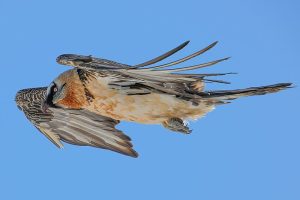
Bearded vulture: Also known as the lammergeir, this bird is unique among vultures, as it has feathered legs like an eagle. It is smaller than the vultures mentioned above. Its head, neck, and body are an orange-brown, and it has a black stripe running from the back of its head, through its eye to the beak, where it ends in a short bristly black beard on both sides of the beak. Its back and wings are dark brown. In flight it is easily recognized by its coloring and its large diamond shaped tail. It usually feeds when other vultures have eaten, and it has the unique habit of carrying bones high into the air and then dropping them onto a large rock to break them so that it can eat the marrow and the bone fragments. It will use the same rock for this purpose for many years.
Both eagles and vultures are associated with large size and great strength. Especially important is their ability to fly great distances at high speed, without even beating their wings. Both Egyptian and Assyrian deities had the eagle or vulture as their symbol, and this, as well as their diet of meat, meant that these birds were “unclean” to the Jews. The famous mummy of Tutankhamen, the young Egyptian king, was found with a large collar made of gold and colored glass adorning his neck and shoulders, in the form of a flying vulture representing the goddess Nekhbet. The eagle in Scripture is also a symbol of protection, and in Deuteronomy the eagle is a metaphor for God.
As carrion-eating birds of prey, eagles and vultures symbolized death in battle, in which the corpses were not buried. They are listed among the unclean birds.
The vulture or eagle was a symbol of healthy, long life. In actual fact these birds can live for a great many years. One fairly reliable report from Austria refers to an eagle kept in captivity for 104 years. Some scholars relate the Hebrew association of long life and the eagle to the ancient Arabian myth about the phoenix, usually portrayed as some sort of eagle, which flew to the sun every five hundred years, was consumed by the sun’s fire, and emerged reborn from its own ashes.
By the time of the New Testament the eagle, besides the symbolism mentioned above, had also become a symbol of the power of the Roman Empire.
The context will usually indicate whether vultures or eagles are intended by the author. When there is reference to speed and swooping down on the prey, the eagle is intended, but when there is reference to eating dead bodies, the vulture is intended. When the text speaks of flying high or nesting in safety on high cliffs, either eagles or vultures fit the context.
Three linguistic situations are possible: a) Languages in which the same word is used for both vultures and eagles (for example, Lisu, Lahu, and other Tibeto-Burman languages). Here there is no need to differentiate between them, except where both Hebrew words appear together. b) Languages in which there are no generic words for vultures or eagles, but each individual subspecies has its own name (as with many southeastern Bantu languages). In these cases it is best to choose the biggest vulture or eagle for nesher and a slightly smaller one for peres. c) Languages in which there are two generic words, one for vultures and another for eagles (as is the case in English). Here the context will determine the choice.
Care should be taken in those contexts where the nest is referred to as high on a cliff face, since some species of vulture and eagle nest in trees. In these cases a cliff-nesting alternative should be chosen, even if it is a smaller bird of prey.
‘Ozniyah: Probably a word for the black vulture or a type of medium-sized eagle. An expression meaning “small vulture” is probably the best equivalent.
Another name for an eagle or vulture of similar size as the black vulture can be used in the lists of unclean birds for ‘ozniyah, or it can be included, along with peres, in a general expression covering both fairly large vultures and eagles.
‘Ayit: In languages that do not have a single word including both eagles and vultures, but where both types of bird are found, such as in Africa and the Middle East, it is better to use a simple phrase meaning “eagles and vultures.” A phrase such as “scavenging birds of prey,” or simply “vultures,” could also be used.
True vultures are not found in the Americas or Australasia, but a word for “buzzards,” or, in the case of the Americas, “condors” can substitute for “vultures.” Elsewhere a phrase such as “eagles that eat dead things” or a borrowed word can be used.
Peres: The bearded vulture is found in the mountainous regions of southern Europe, Central and South Asia, and eastern and southern Africa. The medium-sized short-toed eagle is found throughout Eastern Europe, the Middle East, and Africa. The booted eagle is found all over Europe, Asia, and Africa. Elsewhere, the name for a medium-sized vulture or eagle can be used to translate peres.
In Africa there are many vultures closely related to the griffon vulture, and the lappet-faced vulture is common in most areas of the African continent. The African griffons include the White-backed Vulture Gyps africanus(alternately Gyps bengalensis), which nests in trees, the Cape Vulture Gyps coprotheres, and Ruppell’s Vulture Gyps ruppelli. The local word for any of these would be a good equivalent in contexts where the text refers to vultures.
Griffons are also found in central and eastern Europe and on the Indian sub-continent. The condors of Latin America and California would be local equivalents. The Wedge-tailed Eagle Aquila audax of Australia would be an equivalent there.
Golden and imperial eagles are found in most of western Europe as well as Israel.
African equivalents of the golden and imperial eagles would be the Black or Verreaux’s Eagle Aquila verreauxii and the Martial Eagle Polemaetus bellicosus.
The Steppe Eagle Aquila nipalensis migrates across Israel to as far south as the northern parts of South Africa. It is also found in eastern Europe, Kazakhstan, Central Asia, and South Asia.
In North America the Bald Eagle Haliaeetus leucocephalus would be an equivalent in some contexts of the Hebrew nesher.