
In the German Gute Nachricht (Good News) translation of 1982, this occurrence of the Greek term which is translated in most English versions of “kingdom (of God or heaven)” is translated with a form of “God establishes his rule” (Gott richtet seine Herrschaft auf) or “God’s rule” (Herrschaft). For an explanation of the differentiated translation in German as well as translation choices in a number of languages, see Kingdom (of God / heaven).
Christ, Messiah
The Greek Christos (Χρηστός) is typically transliterated when it appears together with Iésous (Ἰησοῦς) (Jesus). In English the transliteration is the Anglicized “Christ,” whereas in many other languages it is based on the Greek or Latin as “Kristus,” “Cristo,” or similar.
When used as a descriptive term in the New Testament — as it’s typically done in the gospels (with the possible exceptions of for instance John 1:17 and 17:3) — Christos is seen as the Greek translation of the Hebrew mashiaḥ (המשיח) (“anointed”). Accordingly, a transliteration of mashiaḥ is used, either as “Messiah” or based on the Greek or Latin as a form of “Messias.”
This transliteration is also used in the two instances where the Greek term Μεσσίας (Messias) is used in John 1:41 and 4:25.
In some languages and some translations, the term “Messiah” is supplemented with an explanation. Such as in the German Gute Nachricht with “the Messiah, the promised savior” (Wir haben den Messias gefunden, den versprochenen Retter) or in Muna with “Messiah, the Saving King” (Mesias, Omputo Fosalamatino) (source: René van den Berg).
In predominantly Muslim areas or for Bible translations for a Muslim target group, Christos is usually transliterated from the Arabic al-Masih (ٱلْمَسِيحِ) — “Messiah.” In most cases, this practice corresponds with languages that also use a form of the Arabic Isa (عيسى) for Jesus (see Jesus). There are some exceptions, though, including modern translations in Arabic which use Yasua (يَسُوعَ) (coming from the Aramaic Yēšūa’) alongside a transliteration of al-Masih, Hausa which uses Yesu but Almahisu, and some Fula languages (Adamawa Fulfulde, Nigerian Fulfulde, and Central-Eastern Niger Fulfulde) which also use a form of Iésous (Yeesu) but Almasiihu (or Almasiifu) for Christos.
In Indonesian, while most Bible translations had already used Yesus Kristus rather than Isa al Masih, three public holidays used to be described using the term Isa Al Masih. From 2024 on, the government is using Yesus Kristus in those holiday names instead (see this article in Christianity Today ).
Other solutions that are used by a number of languages include these:
- Dobel: “The important one that God had appointed to come” (source: Jock Hughes)
- Noongar: Keny Mammarap or “The One Man” (source: Warda-Kwabba Luke-Ang)
- Mairasi: “King of not dying for life all mashed out infinitely” (for “mashed out,” see salvation; source: Lloyd Peckham)
- Western Bukidnon Manobo: “One chosen by God to rule mankind” (source: Western Bukidnon Manobo Back Translation)
- Bacama: Ma Pwa a Ngɨltən: “The one God has chosen” (source: David Frank in this blog post )
- Binumarien: Anutuna: originally a term that was used for a man that was blessed by elders for a task by the laying on of hands (source: Desmond Oatridges, Holzhausen 1991, p. 49f.)
- Noongar: Keny Boolanga-Yira Waangki-Koorliny: “One God is Sending” (source: Warda-Kwabba Luke-Ang)
- Uab Meto: Neno Anan: “Son of heaven” P. Middelkoop explains: “The idea of heavenly power bestowed on a Timorese king is rendered in the title Neno Anan. It is based on the historical fact that chiefs in general came from overseas and they who come thence are believed to have come down from heaven, from the land beyond the sea, that means the sphere of God and the ghosts of the dead. The symbolical act of anointing has been made subservient to the revelation of an eternal truth and when the term Neno Anan is used as a translation thereof, it also is made subservient to a new revelation of God in Jesus Christ. The very fact that Jesus came from heaven makes this translation hit the mark.” (Source: P. Middelkoop in The Bible Translator 1953, p. 183ff. )
In Finnish Sign Language both “Christ” and “Messiah” are translated with a sign signifying “king.” (Source: Tarja Sandholm)
“Christ / Messiah” in Finnish Sign Language (source )
Law (2013, p. 97) writes about how the Ancient Greek Septuagint‘s translation of the Hebrew mashiah was used by the New Testament writers as a bridge between the Old and New Testaments (click or tap here to read more):
“Another important word in the New Testament that comes from the Septuagint is christos, ‘Christ.’ Christ is not part of the name of the man from Nazareth, as if ‘the Christs’ were written above the door of his family home. Rather, ‘Christ’ is an explicitly messianic title used by the writers of the New Testament who have learned this word from the Septuagint’s translation of the Hebrew mashiach, ‘anointed,’ which itself is often rendered in English as ‘Messiah.’ To be sure, one detects a messianic intent on the part of the Septuagint translator in some places. Amos 4:13 may have been one of these. In the Hebrew Bible, God ‘reveals his thoughts to mortals,’ but the Septuagint has ‘announcing his anointed to humans.’ A fine distinction must be made, however, between theology that was intended by the Septuagint translators and that developed by later Christian writers. In Amos 4:13 it is merely possible we have a messianic reading, but it is unquestionably the case that the New Testament writers exploit the Septuagint’s use of christos, in Amos and elsewhere, to messianic ends.”
Learn more on Bible Odyssey: Christ .
complete verse (Ezekiel 37:1)
Following are a number of back-translations as well as a sample translation for translators of Ezekiel 37:1:
- Kupsabiny: “Then again I saw that the power of God brought me along. His Spirit took me to go down to a valley which had not a few bones.” (Source: Kupsabiny Back Translation)
- Hiligaynon: “Now, I was-empowered by the LORD and I was-brought by his Spirit to the middle of the valley which was full of bones.” (Source: Hiligaynon Back Translation)
- German Gute Nachricht Bibel 2018: “I felt the Lord lay his hand on me. In the Spirit he led me through the air and set me down in the middle of the plain. The whole ground was covered with bones of the dead.”
- English: “One day Yahweh gave me another vision. In the vision I felt the power of God on me, and by his Spirit he took me to the middle of a valley. It was full of bones of people who had been killed.” (Source: Translation for Translators)
Abused Freedom (Galatians 5)

Illustration by Horst Lemke (1922-1985) for the German Gute Nachricht für Sie – NT68, one of the first editions of the Good News Bible in German of 1968. Lemke was a well-known illustrator who illustrated books by Erich Kästner , Astrid Lindgren and many others.
Peace to Mankind (Luke 2)

Illustration by Horst Lemke (1922-1985) for the German Gute Nachricht für Sie – NT68, one of the first editions of the Good News Bible in German of 1968. Lemke was a well-known illustrator who illustrated books by Erich Kästner , Astrid Lindgren and many others.
He is Giving Answers (John 3)
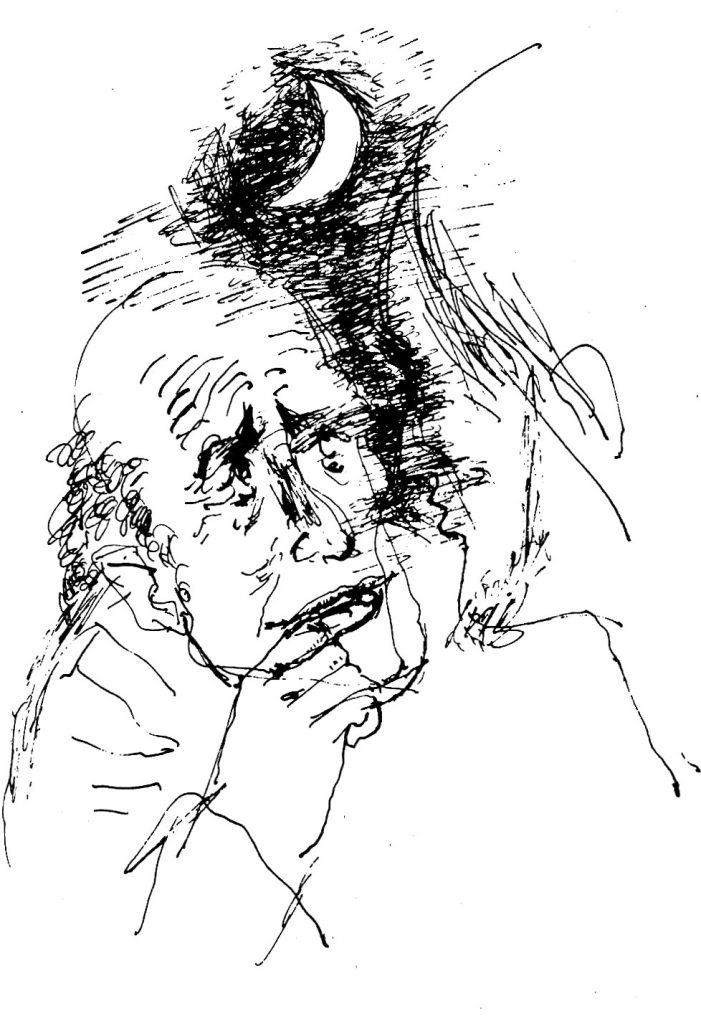
Illustration by Horst Lemke (1922-1985) for the German Gute Nachricht für Sie – NT68, one of the first editions of the Good News Bible in German of 1968. Lemke was a well-known illustrator who illustrated books by Erich Kästner , Astrid Lindgren and many others.
The True Realists (1 Peter 3)
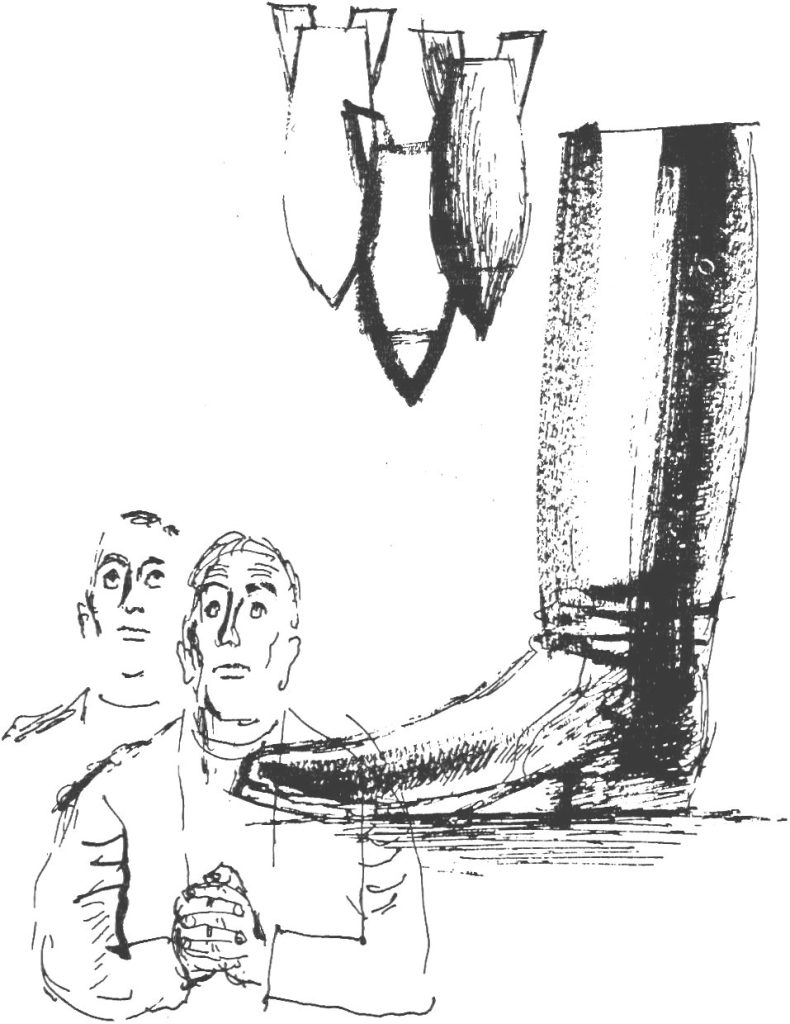
Illustration by Horst Lemke (1922-1985) for the German Gute Nachricht für Sie – NT68, one of the first editions of the Good News Bible in German of 1968. Lemke was a well-known illustrator who illustrated books by Erich Kästner , Astrid Lindgren and many others.
The Tempting Goal (Philippians 3:12-21)

Illustration by Horst Lemke (1922-1985) for the German Gute Nachricht für Sie – NT68, one of the first editions of the Good News Bible in German of 1968. Lemke was a well-known illustrator who illustrated books by Erich Kästner , Astrid Lindgren and many others.