The Greek that is translated as “The spirit is willing, but the flesh is weak” or similar in English is translated in the German New Testament translation by Berger / Nord (publ. 1999) with Der Heilige Geist macht mutig, aber als bloße Menschen sind wir feige or “The Holy Spirit makes us courageous, but as mere humans we are cowards.”
The now commonly-used English idiom “The spirit is willing, but the flesh is weak” (meaning a person pretending to be harmless) was first coined in 1526 in the English New Testament translation of William Tyndale. (Source: Crystal 2010, p. 281)
For other idioms in English that were coined by Bible translation, see here.
The Greek that is translated as “weeping and gnashing of teeth” or similar in English is translated in the German New Testament translation by Berger / Nord (publ. 1999) with heulen und vor Schmerz mit den Zähnen klappern or “weep and chatter teeth in pain.”
Also in German, the idiom Heulen und Zähneklappern (originally: Heulen und Zähneklappen), which today is used to express anger and outrage, often in a humorous context (literally “weeping and chattering of teeth”), was first coined in 1522 in the German New Testament translation by Martin Luther. (Source: Günther 2017, p. 79)
In Russian, this phrase (Плач и скрежет зубов — Plach i skrezhet zubov) is also widely-used as an idiom, although less often in a humorous content. The wording of the quote originated in the Russian Synodal Bible (publ. 1876). (Source: Reznikov 2020, p. 45)
In French, the phrase pleurs et des grincements de dents is likewise used as an idiom. (Source: Muller 1991, p. 16)
The now commonly-used German idiom die Augen gehen über (literally “the eyes overflow”), which today primarily means “amazed” (in the sense of “making big eyes”) was made popular in 1522 in the German New Testament translation by Martin Luther. For other idioms or terms in German that were coined by Bible translation, see here.
In the German New Testament translation by Berger / Nord (publ. 1999) it is translated as Jesus brach in Tränen aus or “Jesus burst into tears.”
In Burmese, the widely-used translation by Judson adds an honorific particle to every verb that describes an action of Jesus, so here he “cries royally.” (source: S.V. Vincent in The Bible Translator 1962, p. 196f. )
In the Pfälzisch translation by Walter Sauer (publ. 2012) it is idiomatically translated as (Do sin Jesus) die Träne kumme, literally “Jesus’ tears came.” (source: Zetzsche)
The Greek that is translated as “with burning enthusiasm” or similar in English is translated in Low German idiomatically with the alliteration mit Feuer und Flamme, lit. “with fire and flame” (translation by Johannes Jessen, publ. 1933, republ. 2006).
In the German New Testament translation by Berger / Nord (publ. 1999) it is translated as man spürte die Glut des Heiligen Geistes or “one could sense the fervor (lit.: “glow”) of the Holy Spirit.”
The Greek that is translated as “fruit of the Spirit” in English is translated in British Sign Language with a sign that depicts the Spirit coming in to a person and then the person giving out. (Source: Anna Smith)
“Fruit of the Spirit” in British Sign Language (source: Christian BSL, used with permission)
In the German New Testament translation by Berger / Nord (publ. 1999) it is translated wer sich vom Heiligen Geist leiten lässt, der kann… or “whoever is guided by the Holy Spirit is able to… .”
The following is a stained glass window from John Hardman Powell (1827–1895) in the Christ Church Cathedral in Dublin, depicting the fruit of the Spirit:
Photo and accompanying text by Andreas F. Borchert, hosted by Wikimedia Commons under a Creative Commons Attribution-Share Alike 3.0 Germany license
“In its centre is the Lord as Good Shepherd along with the Fruit of the Spirit, namely Love (inscription in centre), Joy & Peace (top inscription), and in clockwise direction: Longsuffering, Faith, Gentleness, Goodness, Meekness, Temperance in reference to Galatians 5:22-23, surrounded by medaillons, depicting an angel carrying a scroll with the inscription Gloria in excelsis deo (top, representing joy & peace), and then in clockwise direction: Job (upper right, representing longsuffering), Jonathan (lower right, representing faithfulness), Ruth (bottom, representing goodness and gentleness), Moses (lower left, representing meekness), and John the Baptist (upper left, representing temperance, see Matthew 3:4).”
Stained glass is not just highly decorative, it’s a medium which has been used to express important religious messages for centuries. Literacy was not widespread in the medieval and Renaissance periods and the Church used stained glass and other artworks to teach the central beliefs of Christianity. In Gothic churches, the windows were filled with extensive narrative scenes in stained glass — like huge and colorful picture storybooks — in which worshipers could ‘read’ the stories of Christ and the saints and learn what was required for their religious salvation. (Source: Victoria and Albert Museum )
The Latin Vulgate translation added three “fruits”: “forbearance” (longanimitas), “courtesy” (modestia), and “chastity” (castitas). This meant that all Catholic translations before app. 1950 that were based on the Latin version also had those additional attributes (EnglishDouay-Rheims: longanimity, modesty, chastity; SpanishBiblia Torres Amat: longanimidad, modestia, castidad etc.)
Ronald Knox writes in his translation of the Vulgate (1946): “The Greek only mentions nine of the Twelve Fruits; viz. the first six, together with gentleness, faith, and temperateness. It is possible that the Latin version has accidentally included, in some cases, two renderings of the same Greek word.” Note that either earlier Latin versions (Vetus Latina) now the revision of the Vulgate of 1979 / 1986 (Nova Vulgata) have these attributes. (Source: Jost Zetzsche)
The Greek in Luke 10:40 that is translated as “do you not care” or similar in English is translated in Elhomwe as “do you not feel pity,” the commonly-used expression in that situation. (Source: project-specific translation notes in Paratext)
In the German New Testament translation by Berger / Nord (publ. 1999) it is translated as findest du es nicht merkwürdig or “don’t you find it strange.”
The Greek in Luke 15:16 that is translated as “pods” in English is translated in Elhomwe as makattha, a term given to all kind of peelings, which are given to pigs. (Source: project-specific translation notes in Paratext)
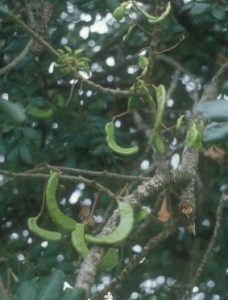
In the German New Testament translation by Berger / Nord (publ. 1999) with Johannisbrotbaum-Schoten or “carob pods,” the kind of pods that likely would have been fed to pigs in Palestine.
The Carob Ceratonia siliqua is a very common tree found throughout the Mediterranean area and also in Arabia, Somalia, and Oman. It is native to Israel, where it was called charuv, according to Jewish religious writings of the first few centuries after Christ. Arabs call it kharrub.
In Bible times, as now, carob trees were found in the coastal plain and in the foothills (Shephelah) and on the eastern slopes of Galilee and Samaria. The carob seed pods are filled with a sweet moist pulp that was popular with poor people. The pods were also used to feed animals. That is probably the basis for Jesus’ statement that the prodigal boy in the parable looked hungrily at the carob keration (“pods”) that he had to feed to the pigs (Luke 15:16).
The carob tree is an evergreen with dark green leaves and many low leafy branches that hide a short trunk. The crown of the tree is round and may reach as high as 12 meters (40 feet). As is the case of the acacia, the date palm and the fig, the carob tree is a lonely representative of a large tropical family (in this case the pea sub-family Caesalpinioideae) that found its way into parts of Israel many millennia ago. The trees in this family are legumes, that is, they put nitrogen into the soil by way of little nodules on the roots. As the tree ages, the trunk be-comes twisted. In contrast to many other trees of the Bible lands, this one bears flowers in autumn, and the seed pods form the following summer. The mature pod is dark brown and about 15-25 centimeters (6-10 inches) in length and 2.5-3.5 centimeters (1-1.5 inches) broad.
If indeed the “pods” of Luke 15.16 were carob pods, it would certainly indicate that they were not considered high-class food. The tree is also called “St. John’s bread” on the belief that John the Baptist must have eaten these fruits when he lived in the desert of Judea. It is quite likely that John did eat carob pods. However, the suggestion that the “locusts” in Mark 1:6 were locust bean pods is not correct, since John probably did eat locusts, as some people in the world still do today. Ironically, carob pod pulp, which was once the “food of the poor” has become, in the last few years, an expensive “health food” in England and America! The word “carat” used in weighing diamonds comes from the Greek name of this tree, since the seeds were used as a standard for measurement. They typically weigh about two hundred milligrams.
Since the Greek word for carob does not actually occur in Luke 15:16, and keration could possibly refer to some other sort of pods, we cannot actually name a species here. If translators have a word for the edible seed pods of trees, they should use it. Otherwise they will have to use something like “fruit of wild trees.” In study notes translators may wish to refer to major language terms, for example, French caroube, Spanish algarrobo, Portuguese alfarroba, and Arabic kharrub.
The Greek in Acts 21:3 that is translated as “filled with new wine” in English is translated in Elhomwe as evonille ottheka or “drunk,” literally “to be full of beer.” (Source: project-specific translation notes in Paratext)
In the German New Testament translation by Berger / Nord (publ. 1999) is is translated with zuviel Süßwein gesoffen or “boozed on too much sweet wine.”