
The Greek in Acts 18:24 that is often translated as “eloquent” in English is translated as “very fluent speaker” in San Mateo del Mar Huave, as “preached well” in Isthmus Mixe and Lalana Chinantec, as “had a beautiful way to talk” in Morelos Nahuatl, and as “really able to speak” Chichimeca-Jonaz. (Source: Viola Waterhouse in Notes on Translation August 1966, p. 86ff.)
Language-specific Insights
unleavened bread
The Hebrew and Greek that is translated as “unleavened bread” in English is translated in various ways:
- Chichimeca-Jonaz: “bread that doesn’t have its medicine that makes it puff up”
- Teutila Cuicatec: “bread without its sour”
- Tepeuxila Cuicatec: “bread that has no mother” (source for this and above: Viola Waterhouse in Notes on Translation August 1966, p. 86ff.)
- Mairasi: “bread without other ingredient” (source: Enggavoter 2004)
I will strike the shepherd
The Greek in Mark 14:27 that is translated as “I will strike the shepherd” or similar in English is translated in San Mateo Del Mar Huave as “I will give room for the shepherd to be killed” and in Chichimeca-Jonaz as “It is written that which God said was going to happen to me: I am going to allow them to kill the shepherd.” (Source: B. Moore / G. Turner in Notes on Translation 1967, p. 1ff.)
apostle, apostles
The Greek term that is usually translated as “apostle(s)” in English is (back-) translated in the following ways:
- Eastern Highland Otomi, Tzeltal, Western Kanjobal, Western Highland Purepecha, Navajo (Dinė), Copainalá Zoque, Chol, Balanta-Kentohe, English (original meaning of “apostle”): “the sent ones”
- Kituba, Pamona, Mezquital Otomi, Central Pame: “messengers”
- Ngäbere: “word carriers”
- Southern Subanen: “those commanded to carry the message”
- San Blas Kuna: “witnesses to God” (meaning “those who speak up and out for God” (source for this and all above: Bratcher / Nida, except Balanta-Kentohe: Rob Koops)
- Mairasi: sasiri atatuemnev nesovnaa or “sent witnesses” (source: Enggavoter 2004)
- Ekari: “one-who-goes-and-tells-for-someone” (source: Reiling / Swellengrebel)
- Khmer: Christtout (“messenger representing Christ”) or when Jesus addresses them: Tout robas Preah Ang (“his messengers-representatives”) (source: Joseph Hong in The Bible Translator 1996, p. 233ff. )
- Pwo Karen: “eyeballs” (i.e., “right-hand men”) (source: David Clark)
- Tzeltal, Coatlán Mixe: “spreader-of-words”
- Chicahuaxtla Triqui: “one who goes about preaching the good word” (source for this and above: Waterhouse / Parrott in Notes on Translation October 1967, p. 1ff.)
- Noongar: Moorta Ngany Waangki-Koorl or “People I (Jesus) Send” (source: Warda-Kwabba Luke-Ang)
- Ayutla Mixtec: “those who bore the word of God’s mouth”
- Chichimeca-Jonaz: “elders messengers” (source for this and above: Viola Waterhouse in Notes on Translation August 1966, p. 86ff.)
- Yakan: “commissioned ones” (source: Yakan Back Translation) — note that Scot McKnight in the English The Second Testament (publ. 2023) translates it as commissioners
- Tenango Otomi: “(Jesus’) representatives” (source: Tenango Otomi Back Translation)
- Tsamakko: “ones-who-work-for-Christ” (source: Chris Pluger)
Scot McKnight (in The Second Testament, publ. 2023) translates it into English as commissioner.
In American Sign Language it is translated with a combination of the signs for “following” plus the sign for “authority” to differentiate it from disciple. (Source: Ruth Anna Spooner, Ron Lawer)
“apostles” in American Sign Language, source: Deaf Harbor
in the name of, on the account of his (or: my) name
Some of the Hebrew and Greek phrases that are translated in English in association with “name,” including “in the name of,” “in my name,” “in your name,” “on the account of my name,” “on the account of your name” (according to a classification by Robert Bratcher in The Bible Translator 1963, p. 72ff. , phrases that belong to the categories of “Agency or instrumentality” and “Representation”) present a number of challenges in other languages.
Click or tap here to see the rest of this insight
Eugene Nida (1947, p 178ff.) explains this way:
“The biblical attitudes toward human personality are of great theological importance. There is, however, only one word which produces any considerable difficulty in other languages. This is the word ‘name.’ The great difference attached to the significance of the name of a person in the Bible times in contrast with our own culture is very important. Note such phrases as ‘whatsoever ye shall ask in my name,’ John 14:13, ‘believed in the name of the only begotten Son of God,’ John 3:18, and ‘life through his name,’ John 20:31. These expressions are generally difficult for us to understand, for the word ‘name’ does not mean the same to us as it meant to those of Bible times. To them the name was the symbolization of the authority and personality of the individual who possessed the name. To us a name is far less important. It may be changed whenever one can convince a judge that another name might be more economically advantageous. The name is also a legal method of giving one’s written assent to certain business transactions, but to us it is not the symbol of the personality.”
The translation in Eastern Huasteca Nahuatl typically is “in someone’s authority” (for instance “I have come in my Father’s name” in John 5:43 becomes “I have come on my Father’s authority”) (source Nida 1947, p. 179), or in Highland Puebla Nahuatl with the more paraphrastic equivalent “as though on orders from you” or in Tzeltal as “by your authority, so he said” (both examples for Mark 9:38 and 39, see Bratcher / Nida).
In Guhu-Samane, Mark 11:9 (in English: “Blessed is he that comes in the name of the Lord”) is translated as “Blessed is the Lord’s namesake who comes.” “In the name of the Lord” caused “puzzlement [because] “has he just assumed the name of the Lord, valid or otherwise? [But] with ‘blessed is the Lord’s namesake who comes’ the strong bond between the namesake and the important ancestor for whom named entitles the namesake to the deference due the ancestor. Thought very proper in this context.” (Source: Ernest L. Richert in Notes on Translation December 1963: p. 4-7; reprinted in The Bible Translator 1965, p. 198ff. )
Barclay Newman (see The Bible Translator 1974, pp, 432ff. ) reports on different solutions for the translation of the Today’s Malay Version (Alkitab Berita Baik, 1987):
In Malay “the phrase ‘in my name’ is problematic (…) since it sounds like the use of magic. For this reason [the English] Today’s English Version (Good News Bible) was followed at such passages as John 5:43 and 10:25, where ‘in the name of my Father’ is translated as ‘with my Father’s authority’ and ‘by my Father’s authority’ [respectively]. In John 12:13 ‘in the name of the Lord’ has become ‘in his (the Lord’s) behalf,’ following the common language German translation Die Gute Nachricht. In John 14:13, ‘because you are my followers’ is used, in John in 15:16, 16:23 and 24 ‘as my followers,’ in John 17:11 ‘by your own power, the power you gave me,’ and in John 14:26 ‘in my place.'”
Other translations for “in the name of Jesus Christ” include “in the authority of Jesus Christ” (Isthmus Mixe), “calling on Jesus Christ” (Teutila Cuicatec), “calling the name of Jesus Christ over you” (Ayutla Mixtec), “because of Jesus” (Tepeuxila Cuicatec), “by the power of the name of Jesus Christ” (Chichimeca-Jonaz), “the word of Jesus Christ is strong” (Lalana Chinantec) (source for this and above: Viola Waterhouse in Notes on Translation August 1966, p. 86ff.), and “mentioning the name of Jesus” (Elhomwe — source: project-specific translation notes in Paratext).
See also not speak in the name of Jesus, be baptized in the name of Jesus Christ, and as the LORD lives.
stocks
The Greek in Acts 16:24 that is typically translated as “stocks” in English is translated in Isthmus Mixe as “notched boards” (source: Ronald D. Olson in Notes on Translation January, 1968, p. 15ff.).
In Lalana Chinantec it is translated as “where planks have holes in them and where peoples’ feet are tight,” in Chichimeca-Jonaz as “bit their feet with wood,” and in Morelos Nahuatl as “stuck between two boards.” (Source: Viola Waterhouse in Notes on Translation August 1966, p. 86ff.)
“Stocks” is illustrated for use in Bible translations in East Africa by Pioneer Bible Translators like this:
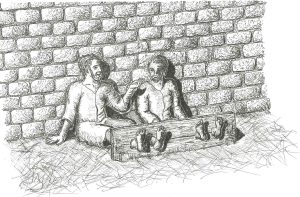
Image owned by PBT and Jonathan McDaniel and licensed with the Creative Commons Attribution 3.0 Unported License.
right hand of
The Greek and Hebrew that is typically translated as “(to the) right hand of” is often translated much more descriptively in other languages:
- Yakan: “at the right side, here in the greatest/most important/most honored place/seat”
- Mezquital Otomi: “the right hand, at the place of honor”
- Chuj: “exalted at the right hand”
- Chichimeca-Jonaz: “in a high place there at the right”
- Lalana Chinantec: “make great”
- Isthmus Mixe: “given great authority”
- Morelos Nahuatl: “placed big” or “heart-strengthens me”
- Isthmus Mixe: “stays with me” (source for this and above: Viola Waterhouse in Notes on Translation August, 1966, p. 86ff)
- Teutila Cuicatec: “in all authority at the right side” (source: Ronald D. Olson in Notes on Translation January, 1968, p. 15ff.).
In Lamnso’, the seat on the right-hand side signifies that the person seated there would have a higher position than the one to his left (vs. just being a seat of honor). To circumvent any misunderstanding of the biblical text, the translation here refers to the “highest seat next to God.” (Source: Karl Grebe in Holzhausen 1991, p. 52)
(Note that in Elhomwe the idiom “I see you through the left hand” stands for “useless.” [Source: project-specific translation notes in Paratext])
For Old Testament examples of blessing and power associated with God’s right hand, see Gen 48:14, 48:17, Exodus 15:6, 15:12, Psalm 48:10, 80:15, 80:17, 89:13.
fellowship
The Greek that is translated in English as “fellowship” or “communion” is translated in Huba as daɓǝkǝr: “joining heads.” (Source: David Frank in this blog post )
Other translations include:
- Lalana Chinantec: “they were very happy since they were with their brothers”
- Chichimeca-Jonaz “always well they talk together”
- Chuj: “were at peace with each other”
- San Mateo del Mar Huave: “they accompanied the other believers”
- Ayutla Mixtec: “they were united together”
- Eastern Highland Otomi: “their hearts were happy because they all thought alike” (source for this and above: Viola Waterhouse in Notes on Translation August 1966, p. 86ff.)
- Uma: “harmony” (source: Uma Back Translation)
- Yakan: “become one” (source: Yakan Back Translation)
- Western Bukidnon Manobo: “have an intimate relationship” (source: Western Bukidnon Manobo Back Translation)
- Kankanaey: “companionship” (source: Kankanaey Back Translation)
- Tenango Otomi: “be friends” (source: Tenango Otomi Back Translation)
- Yatzachi Zapotec: “head-hearts are one”
- Eastern Highland Otomi: “be of the same mind” (source for this and two above: John Beekman in Notes on Translation 1964, p. 1ff.)