The Greek that is translated as “propitiation” or “atoning sacrifice” in English is translated in South Bolivian Quechua as “putting out [as in putting out a fire] on account of our sins” (source: T.E. Hudspith in The Bible Translator 1952, p. 66ff. ).
In Chichewa, it is translated as nsembe yopepsera machimo athu or “a sacrifice for saying sorry for our sins” (interconfessional translation, publ. 1999) and in Chitonga as cipaizyo cakumanya mulandu or “the sacrifice for putting an end to the case/offense [of our sins].” (Source: Wendland 1998, p. 91)
Tzotzil: “[people who] are zealously doing what they think is God’s word”
Mezquital Otomi: “[people who] very much believe what they have been taught about God” (source for this and five above: Viola Waterhouse in Notes on Translation August 1966, p. 86ff.)
Chichewa interconfessional translation, publ. 1999: “[people who] love God” (source: Wendland 1998, p. 90)
Uma: “[people who] submit to Lord God” (Source: Uma Back Translation)
Yakan: “very religious” (source: Yakan Back Translation)
Western Bukidnon Manobo: “[people who] are faithful in carrying out the commands of God” (source: Western Bukidnon Manobo Back Translation)
Kankanaey: “[people who] are serving God” (source: Kankanaey Back Translation)
Tagbanwa: “[people who] are indeed devout-worshipers of God” (Source: Tagbanwa Back Translation)
Bariai: “[people who] respect God” (source: Bariai Back Translation)
Kupsabiny: “[people who] have dedicated themselves to God” (source: Kupsabiny Back Translation)
German: “God-fearing” (gottesfürchtig) or “pious” (fromm)
Low German translation by Johannes Jessen, publ. 1933, republ. 2006: “[people who] take their faith very seriously” (source for this and above: Zetzsche)
HausaCommon Language Bible: “owners of worshiping God” (source: Hausa Common Language Bible Back Translation)
Hiligaynon: “godly” (source: Hiligaynon Back Translation)
The Hebrew and Greek that is often translated as “your blood be on your own heads” or similar in English is translated as
“you have the guilt if you don’t receive eternal life” in Highland Popoluca
“you are to blame if you lose your own souls” in Coatlán Mixe
“you will be to blame yourselves when you do not go to a good place” in Isthmus Mixe
“you will be lost but you are at fault yourselves” in Morelos Nahuatl
“you are the ones who are guilty that you will be lost” in Lalana Chinantec (source for this and above: Viola Waterhouse in Notes on Translation August 1966, p. 86ff.)
“if you die in your bad deeds, it’s your own bad fault” in Bariai (source: Bariai Back Translation)
“let your own blood alone eat you” in Kupsabiny (source: Kupsabiny Back Translation)
“You have killed yourselves with your own heart” in Chichewa (source: Wendland 1987, p. 28)
“your blood will be to you” (existing idiom) in Kwere (source: Pioneer Bible Translators, project-specific translation notes in Paratext)
The Hebrew that is translated in English as “Rahab” is translated in the interconfessional Chichewa translation (publ. 1999) as chilombo cha m’nyanja or “beast of the sea.” (Source: Wendland 1998, p. 96)
The Hebrew that is translated as “stork” in English is translated in Maan as “big water bird,” as the stork is not locally know. (Source: Don Slager)
In the Contemporary Chichewa translation (2002/2016) with mulungu wachilendo it is translated as kakowa or “egret.” (Source: Mawu a Mulungu mu Chichewa Chalero Back Translation)
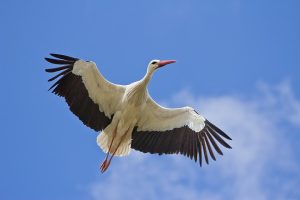
There is almost complete agreement that chasidah is the stork. There are two species of stork that pass over Israel, where they stay for a few days as they migrate from Europe to Africa and vice versa. These are the White Stork Ciconia ciconia and the Black Stork Ciconia nigra.
Both of these storks are large birds with long legs and long necks. They are heavier than most herons or cranes. The white stork has a white body, black wings, and a red beak and legs. The black stork is a glossy brownish black color with a white belly. It also has a red beak and legs. These storks migrate from central and eastern Europe to East and Central Africa, occasionally reaching Zimbabwe and parts of South Africa in good rainy seasons. Both types spend most of the time on the ground or in shallow water searching for food. The white stork eats mainly locusts, grasshoppers, and other insects, as well as frogs, lizards, and the chicks of ground-nesting birds. The black stork prefers fish and frogs but also eats the same things as the white stork.
When storks are about to move to another feeding ground, they usually soar around in upward currents of air called thermals, reaching great heights, and then they soar off in the direction they have chosen, conserving their energy by only occasionally beating their wings.
It is possible that the name chasidah is derived from the word chesed, meaning “kindness” or “faithfulness”, perhaps a reference to the fact that they seem to take especially good care of their young when nesting.
Storks of various species are found in most parts of the world, and many of them have migrating habits. There are species of stork that migrate from Europe to India and the Far East, some that migrate from Southeast Asia to Australia, and one, the Abdim’s Stork Ciconia abdimii, which migrates from Ethiopia to Zimbabwe and Botswana, signaling the arrival of the rainy season wherever it goes.
In the few areas where storks are not known, a borrowed word or a transliteration can be used, perhaps with a footnote to indicate that this is a big bird that migrates long distances over Israel.
The Hebrew in Job 1:11 that is translated as “curse you to your face” in English is translated in the Chichewa Buku Lopatulika translation (publ. 2018) with pamaso panu or “(curse you) in your eyes,” i.e. publicly. (Source: project-specific translation notes in Paratext)
The Hebrew in Psalm 2:3 that is translated as “bonds” or similar in English is translated in the Contemporary Chichewa translation (2002/2016) as magoli or “yokes.” This word is used to refer to two instruments. The first one was used to tie slaves around their necks. It was a beam made out of wood, leather, and sometimes chains placed on the shoulders of the enslaved people. Once slaves were tied to it they could not run away as they were being transported from one place to another. Sometimes it is used to refer to a wooden piece that is used to join two oxen together for plowing or transporting of goods in agricultural and other contexts. When two oxen are tied to the yoke, their movement is controlled by the one who is operating the plow or oxcart. In Chichewa culture, a yoke is a symbol of subjugation, exploitation, and powerlessness. (Source: Mawu a Mulungu mu Chichewa Chalero Back Translation)
The Hebrew in Psalm 6:6 that is translated as “couch” or similar in English is translated in the Contemporary Chichewa translation (2002/2016) as pogona panga, which is used to refer to a place a person sleeps on and also means “bed.” (Source: Mawu a Mulungu mu Chichewa Chalero Back Translation)



.jpg)