The Greek that is translated as “elder” in most English versions (“presbyter” in The Orthodox New Testament, 2000) is translated as “Old-Man Leader” in Eastern Highland Otomi (source: John Beekman in Notes on Translation November 1964, p. 1-22) and in Bacama as mi kpan-kpani vɨnə hiutə: “big/old person of house of prayer” (source: David Frank in this blog post ).
Other translations include:
“person who commands among the people of Jesus” in Lalana Chinantec
“supervisor of the creed” in Guhu-Samane (source for this and three above: Ellis Deibler in Notes on Translation July, 1967, p. 5ff.)
“older person” with an implication of that being a leader-like person in Matumbi (source: Pioneer Bible Translators, project-specific notes in Paratext)
“person who has taken on responsibilities in the congregation” in German (das Buch translation by Roland Werner, publ. 2009-2022)
The German New Testament translation by Berger / Nord (publ. 1999) chooses for the occurrences in Revelation the translation of Würdenträger or “dignitary.” Elsewhere (for instance in 1 Peter 5:1) it has “elders, your congregational leadership.”
Isthmus Mixe: “stays with me” (source for this and above: Viola Waterhouse in Notes on Translation August, 1966, p. 86ff)
Teutila Cuicatec: “in all authority at the right side” (source: Ronald D. Olson in Notes on Translation January, 1968, p. 15ff.).
In Lamnso’, the seat on the right-hand side signifies that the person seated there would have a higher position than the one to his left (vs. just being a seat of honor). To circumvent any misunderstanding of the biblical text, the translation here refers to the “highest seat next to God.” (Source: Karl Grebe in Holzhausen 1991, p. 52)
(Note that in Elhomwe the idiom “I see you through the left hand” stands for “useless.” [Source: project-specific translation notes in Paratext])
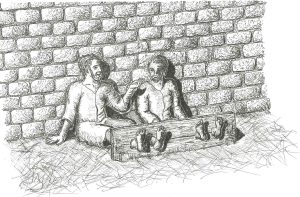
The Greek in Acts 16:24 that is typically translated as “stocks” in English is translated in Isthmus Mixe as “notched boards” (source: Ronald D. Olson in Notes on Translation January, 1968, p. 15ff.).
In Lalana Chinantec it is translated as “where planks have holes in them and where peoples’ feet are tight,” in Chichimeca-Jonaz as “bit their feet with wood,” and in Morelos Nahuatl as “stuck between two boards.” (Source: Viola Waterhouse in Notes on Translation August 1966, p. 86ff.)
“Stocks” is illustrated for use in Bible translations in East Africa by Pioneer Bible Translators like this:
Image owned by PBT and Jonathan McDaniel and licensed with the Creative Commons Attribution 3.0 Unported License.
The Greek that is translated in English as “the voice of one crying out in the wilderness” is translated in Una as “ss for this person who will speak my words, while he will be in a place where people usually do not live, he will shout words.” (Source: Kroneman 2004, p. 408)
In Isthmus Mixe this is translated as “the messenger will cry out in the wilderness.” (Source: B. Moore / G. Turner in Notes on Translation 1967, p. 1ff.)
Tepeuxila Cuicatec: “a person who pardons people of their sins” (source for this and two above: Viola Waterhouse in Notes on Translation August 1966, p. 86ff.)
Noongar: Keny-Barranginy-Ngandabat or “One Bringing Life” (source: Warda-Kwabba Luke-Ang)
Uma: “the King who lifts us from the punishment of our sins” (source: Uma Back Translation)
Western Bukidnon Manobo: “one who delivers us from punishment” (source: Western Bukidnon Manobo Back Translation)
Kankanaey: “one whom we hope/expect will do all we are waiting for” (source: Kankanaey Back Translation)
Tagbanwa: “one who is the pledge of our assurance of salvation in the future.” (Source: Tagbanwa Back Translation)
Kâte: bâbâpiaŋ or “healer” (source: Renck 1990, p. 104)
In various German and Dutch Bible translations, the term Heiland is used, which was introduced by Martin Luther in the 16th century and means “the healing one.” This term (as “Hælend”) was used in Old English as a translation for “Jesus” — see Swain 2019 and Jesus.
In American Sign Language it is signed with a sign describing releasing someone from bondage. (Source: Yates 2011, p. 52)
Some of the Hebrew and Greek phrases that are translated in English in association with “name,” including “in the name of,” “in my name,” “in your name,” “on the account of my name,” “on the account of your name” (according to a classification by Robert Bratcher in The Bible Translator 1963, p. 72ff. , phrases that belong to the categories of “Agency or instrumentality” and “Representation”) present a number of challenges in other languages.
Click or tap here to see the rest of this insight
Eugene Nida (1947, p 178ff.) explains this way:
“The biblical attitudes toward human personality are of great theological importance. There is, however, only one word which produces any considerable difficulty in other languages. This is the word ‘name.’ The great difference attached to the significance of the name of a person in the Bible times in contrast with our own culture is very important. Note such phrases as ‘whatsoever ye shall ask in my name,’ John 14:13, ‘believed in the name of the only begotten Son of God,’ John 3:18, and ‘life through his name,’ John 20:31. These expressions are generally difficult for us to understand, for the word ‘name’ does not mean the same to us as it meant to those of Bible times. To them the name was the symbolization of the authority and personality of the individual who possessed the name. To us a name is far less important. It may be changed whenever one can convince a judge that another name might be more economically advantageous. The name is also a legal method of giving one’s written assent to certain business transactions, but to us it is not the symbol of the personality.”
The translation in Eastern Huasteca Nahuatl typically is “in someone’s authority” (for instance “I have come in my Father’s name” in John 5:43 becomes “I have come on my Father’s authority”) (source Nida 1947, p. 179), or in Highland Puebla Nahuatl with the more paraphrastic equivalent “as though on orders from you” or in Tzeltal as “by your authority, so he said” (both examples for Mark 9:38 and 39, see Bratcher / Nida).
In Guhu-Samane, Mark 11:9 (in English: “Blessed is he that comes in the name of the Lord”) is translated as “Blessed is the Lord’s namesake who comes.” “In the name of the Lord” caused “puzzlement [because] “has he just assumed the name of the Lord, valid or otherwise? [But] with ‘blessed is the Lord’s namesake who comes’ the strong bond between the namesake and the important ancestor for whom named entitles the namesake to the deference due the ancestor. Thought very proper in this context.” (Source: Ernest L. Richert in Notes on Translation December 1963: p. 4-7; reprinted in The Bible Translator 1965, p. 198ff. )
Barclay Newman (see The Bible Translator 1974, pp, 432ff. ) reports on different solutions for the translation of the Today’s Malay Version (Alkitab Berita Baik, 1987):
In Malay “the phrase ‘in my name’ is problematic (…) since it sounds like the use of magic. For this reason [the English] Today’s English Version (Good News Bible) was followed at such passages as John 5:43 and 10:25, where ‘in the name of my Father’ is translated as ‘with my Father’s authority’ and ‘by my Father’s authority’ [respectively]. In John 12:13 ‘in the name of the Lord’ has become ‘in his (the Lord’s) behalf,’ following the common language German translation Die Gute Nachricht. In John 14:13, ‘because you are my followers’ is used, in John in 15:16, 16:23 and 24 ‘as my followers,’ in John 17:11 ‘by your own power, the power you gave me,’ and in John 14:26 ‘in my place.'”
Other translations for “in the name of Jesus Christ” include “in the authority of Jesus Christ” (Isthmus Mixe), “calling on Jesus Christ” (Teutila Cuicatec), “calling the name of Jesus Christ over you” (Ayutla Mixtec), “because of Jesus” (Tepeuxila Cuicatec), “by the power of the name of Jesus Christ” (Chichimeca-Jonaz), “the word of Jesus Christ is strong” (Lalana Chinantec) (source for this and above: Viola Waterhouse in Notes on Translation August 1966, p. 86ff.), and “mentioning the name of Jesus” (Elhomwe — source: project-specific translation notes in Paratext).
The Greek that is translated as “saint” in English is rendered into Highland Puebla Nahuatl as “one with a clean hearts,” into Northwestern Dinka as “one with a white hearts,” and into Western Kanjobal as “person of prayer.” (Source: Nida 1952, p. 146)
Chichewa “(person with a) white heart” since “white” is the word that is used in Chichewa for the translation of “holy.” (Source: Mawu a Mulungu mu Chichewa Chalero Back Translation)
Teutila Cuicatec: “God who has a great rule” (source for this and above: Viola Waterhouse in Notes on Translation August 1966, p. 86ff.)
Sa’a: “God, the Surpassing One” (source: Carl Gross)
Elhomwe: Mulluku Muullupalli or “God the Great” (source: project-specific translation notes in Paratext)
Chichewa: Wammwambamwamba: A name of God. While this word is difficult to translate into English, its sense implies that God is highly above everything in his power and greatness. (Source: Mawu a Mulungu mu Chichewa Chalero Back Translation)