Painting by Wang Suda 王肅達 (1910-1963),
Copyright by the Catholic University Peking, China
Text under painting translated from Literary Chinese into English:
Healing the Paralytic
The Lord said to him, “Rise! Walk!”
Image taken from Chinese Christian Posters . For more information on the “Ars Sacra Pekinensis” school of art, see this article , for other artworks of that school in TIPs, see here.
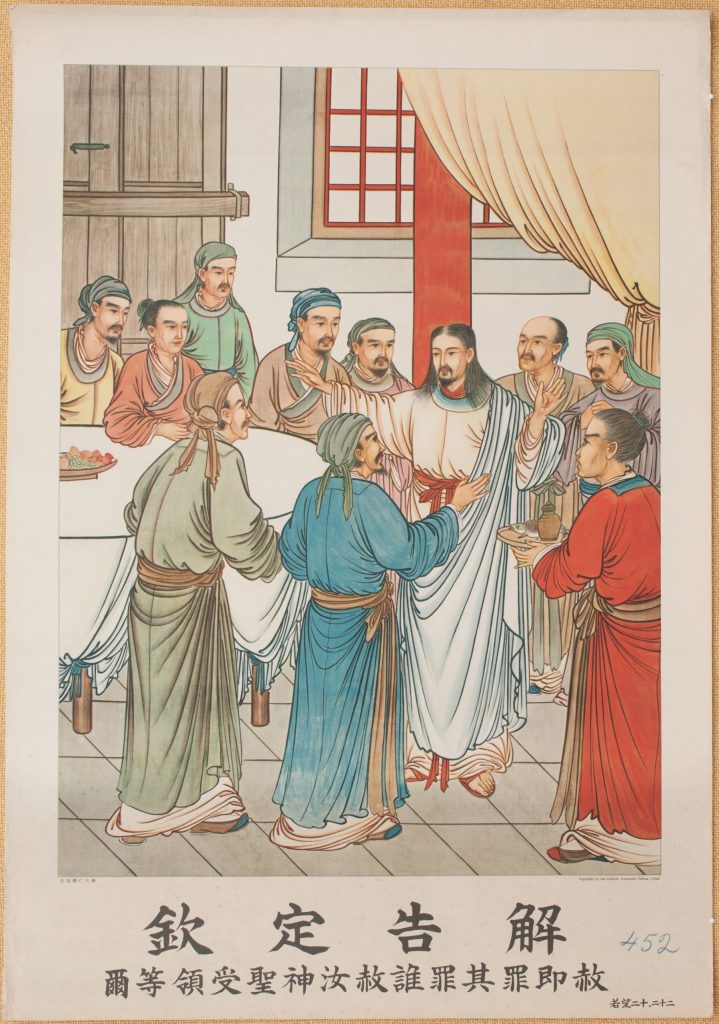
Painting by Wang Suda 王肅達 (1910-1963),
Copyright by the Catholic University Peking, China
Text under painting translated from Literary Chinese into English:
Authorized Confession
Receive the Holy Spirit. If you forgive anyone their sins, they are forgiven.
Image taken from Chinese Christian Posters . For more information on the “Ars Sacra Pekinensis” school of art, see this article , for other artworks of that school in TIPs, see here.
Painting by Wang Suda 王肅達 (1910-1963),
Copyright by the Catholic University Peking, China
Text under painting translated from Literary Chinese into English:
Establishing the Church
You are the rock, on this I will establish my Church
Image taken from Chinese Christian Posters . For more information on the “Ars Sacra Pekinensis” school of art, see this article , for other artworks of that school in TIPs, see here.
The Greek that is a transliteration from the Aramaic abba (אבא) and is itself transliterated into “Abba” in English is transliterated into Mandarin Chinese as ābà (阿爸). This is interesting because bà (爸) is the regularly-used term of endearment for “father” (“daddy”) and even the very combination of ābà (阿爸) is used in some dialects as the equivalent of “daddy.” This is exactly the meaning of the Aramaic abba as well.
The Hebrew that is translated in most English versions as “wild ox” was translated by the Ancient GreekSeptuagint translation as μονόκερως (monókeros) or “unicorn” (though it actually is the Greek word for “rhinoceros” — see below).
Bibles in the Protestant tradition also used an equivalent of that translation up into the early 20th century. This includes translations like the EnglishKing James Version/Authorised Version (unicorn), the German translation by Luther (up to and including the revision of 1912) (Einhorn), or the SwedishCharles XII Bible of 1686 (enhörningen).
Since translations of the Orthodox traditions tend to follow the Septuagint (see above), they also use an equivalent of “unicorn,” such as the Russian Synod translation with единорог (yedinorog).
Translations in the Catholic tradition tended to use an equivalent of “rhinoceros,” going back to the LatinVulgate’srinoceros. Modern Catholic translations that follow the Hebrew text now also use “wild ox” or an equivalent.
The influential Literary / Classical ChineseDelegates Version (publ. 1854) used sì (兕), a mythological Chinese creature that also only had one horn (see here ).
Click or tap here for the rest of the entry about “wild ox” in United Bible Societies’ All Creatures Great and Small: Living things in the Bible.
Since the beginning of the twentieth century re’em has been translated as “wild ox” in English versions, following the original suggestion made by Canon Tristram in the previous century. However, there are problems connected with this rendering. The usual justifications for this translation are a) that the Akkadian equivalent word rimu refers to the wild ox or Aurochs Bos primigenius, which was frequently hunted by Akkadian kings and b) that wild ox or aurochs fits the description of the wild untameable animal referred to in the Bible.
Both of these arguments have weaknesses from a zoological point of view and the linguistic argument is also debatable. Firstly, the aurochs hunted by the Akkadian kings was an animal found in high rainfall areas with forests. In historical times it was found only in the wooded areas of central and southeastern Europe Armenia (including the southern coastland of the Black Sea) and Mesopotamia. The only aurochs remains found in the land of Israel and the Arabian Peninsula date from the early Pleistocene Age. It is highly unlikely that this animal lived in Israel in biblical times.
Secondly, while the Akkadian rimu is usually translated as “wild ox”, the Ugariticrum has been translated by some scholars as “buffalo”, and the Old Arabic rim is usually translated as “oryx”. Both of these words are related to the Hebrew re’em. Some scholars have argued that the re’em is really the oryx.
Furthermore, while the wild aurochs was very large, dangerous, and strong, it was not really “untameable”. Its dependence on water made it fairly easy to capture in nets and it was domesticated very early. It is the ancestor of all short-horned European cattle. Ancient pictures carved in limestone found in the excavations at Kujunjik in Iraq show carts being pulled by cattle that look exactly the same as the aurochs pictured in hunting scenes from an earlier period.
An animal similar to the aurochs was hunted by early Egyptian kings but it had disappeared from Egypt as early as the reign of Rameses III (about 1190 B.C.), who hunted instead “wild ox” (probably the Cape buffalo) in forested areas of the Sudan, where there is no evidence that the aurochs ever lived. (A commemorative painting of one of these hunts clearly shows aurochs-like animals being hunted from chariots, but this may be artistic license or a traditional stereotype-the lions in similar paintings are certainly fanciful stereotypes.)
Among the many animal mummies found in Egypt there are a number of bubal or red hartebeest and Cape buffalo. Both of these animals fit the biblical description of “wild ox”, and the hartebeest certainly lived in Arabia and the land of Israel.
The Septuagint translates re’em as monokerōs which literally means “one-horned” (hence the KJV “unicorn”) but is the ancient Greek word for rhinoceros. This translation needs to be taken seriously, because of its early date. The rhinoceros would have been an animal known to the Jews, since it was found in parts of Egypt. The ancient naturalist, Strabo of Amasia, who lived in the early part of the first century A.D., describes a rhinoceros that he saw in Egypt and refers to another naturalist of the time who had also described this animal. A variety of rhinoceros was found in Egypt, Sudan, and Ethiopia at the time of the Exodus, and a second variety was found in Mesopotamia.
At the time of the Exodus then, the aurochs would have been found in the forests of southeast Europe, the far north of Asia Minor, and Mesopotamia, but not in Egypt, Canaan, the Arabian Peninsula, Sinai, or Syria. However, the oryx and the bubal hartebeest would have been plentiful and well known, and the Cape buffalo and rhinoceros would have been known too, at least by hearsay.
There is another aspect of the question that needs to be kept in mind. Throughout human history large, prominent animals have had symbolic importance, even in societies that would never have seen the animal. Thus the lion has been important in Chinese and British culture for centuries, but there is no evidence that lions have ever lived in China or Britain. Thus the aurochs, while it may be a rather improbable interpretation, cannot be ruled out entirely.
Four things can be said for certain about the re’em. It was a wild, untameable animal, it had horns, it was very strong, and it was appropriate to contrast or compare it with domestic cattle and with lions.
Aurochs: The Aurochs Bos primigenius, which is now extinct, was a very large animal, with prominent forward-pointing horns. It looked very similar to the bulls used in Spain for bull-fighting in modern times, but it was probably even larger. The bulls were dark brown or black, with a pale stripe down the spine, while the females were a lighter brown. The German zoos of Berlin, Munich, and Frankfurt have been fairly successful in genetic engineering experiments that have been aimed at reintroducing the aurochs’ original genetic characteristics, by selective breeding from domestic cattle that have the required characteristics. The resulting animals seem to resemble closely the original aurochs.
Cape Buffalo: The Cape Buffalo Syncerus caffer is also a very large animal not as tall as the aurochs but heavier. It is found wherever there is adequate water supply all over sub-Saharan Africa. It prefers thick bush or riverine forest in which to take cover during the day. It has very thick horns that emerge from a broad boss on its forehead then sweep sideways and down before curving sharply upward toward the head. The males have thicker horns than the females. The skin is covered in short hair that varies from black to gray or brown and is usually covered with dry mud so that the buffaloes look the same color as the local soil.
Cape buffaloes live in large herds often numbering over five hundred animals. They are extremely strong cunning and fearless and are probably the most dangerous animals in Africa. Although they have become accustomed to man in some protected areas they are unpredictable and easily provoked. Unlike the Asian water buffalo or carabao the Cape buffalo has never been domesticated.
Rhinoceros: The rhinoceros found in Mesopotamia in biblical times was a subvariety of the Great Indian Rhinoceros Rhinoceros unicornis while the variety found in Egypt and Sudan would have been the Hook-lipped or Black Rhinoceros Diceros bicornis. The hook-lipped rhinoceros weighs up to 2000 kilograms (4400 pounds) and is about 1.7 meters (70 inches) tall at the shoulder. It has two horns above the nose, one behind the other, the front one growing over half a meter (20 inches) in length. They live in bushy country and feed on leaves and twigs. They are solitary animals with poor eyesight and are very aggressive. The great Indian rhinoceros was even larger and had a single horn.
Because of the uncertainty of identifying this animal, it is probably best to have an equivalent of “wild ox” or “wild bull” in the text and indicate in a footnote, each time the word is translated, that the word may mean “buffalo” and that the Septuagint has “rhinoceros”.
A problem in many countries is that using a phrase like “wild ox” suggests that this is a domestic ox that has gone wild. For this reason, it may be better to use a local name for a large strong, horned animal.
In Africa the obvious equivalent is the buffalo, and this choice is strengthened by the fact that re’em may even mean “buffalo”.
In the Indian subcontinent, Myanmar, Thailand, Malaysia, and western China, there is an animal (now nearly extinct) known as the Gaur Bibos gaurus. In Thailand it is called the ngua-kating, and in Malaysia, the seladang. It is sometimes incorrectly referred to as the “wild water buffalo”. This is a type of wild ox very similar to the aurochs. In the Himalayas and mountains of western China there is another smaller animal similar to a wild ox called the Takin Budorcas taxicolor. Another possibility in the Himalayas and Central Asia is an expression meaning “wild yak”.
In North America the Bison or American Buffalo Bison bison is the closest equivalent. Another possible equivalent in some Arctic regions is the Musk Ox Ovibos moschatus.
Elsewhere a transliteration or a word borrowed from a locally dominant language is a possible solution.
The Greek that is typically transliterated as “Beelzebul” in English used to be transliterated in English and most other languages with a long tradition in Bible translation as Beelzebub, going back to the LatinVulgate translation that had used Beelzebub. St. Jerome likely had done that to correspond with the pronunciation of Baal Zebub (בַּעַל זְבוּב) of 2 Kings 1:2 where a Philistine god by that name is mentioned. The Hebrew name carries the derogative meaning “Baal (or: god) of flies” and is likely an ironic and humiliating misspelling of Baal Zebul with the meaning of “Baal (or: god) the Prince” (see Translation commentary on 2 Kings 1:2).
In popular German literature of the 14th through 17th century, the term “Beelzebock” was also used, a word with a similar sound, but with last and changed syllable carrying the meaning of “(billy) goat / ram,” the partial form of the devil in popular imagination. (Source: Jost Zetzsche — see also the sheep from the goats)
In languages that use Chinese characters, including Mandarin Chinese, Min Nan Chinese, Yue Chinese (Cantonese), or Hakka Chinese, the characters 別西卜 are used in Protestant translations (pronunciation in Mandarin: biéxību, in Cantonese: bit6 sai1 buk1, in Hakka phe̍t-sî-puk). That transliteration name has been used since at least 1850 in the Literary ChineseDelegates’ Version, likely because of the suitably negative meaning of the last character 卜 or “divination.” (The Catholic transliteration is 貝耳則步 / bèiěrzébù in Mandarin, without any particular meaning.)
In Western Bukidnon Manobo it is translated with Endedaman, the Manobo name for the ruler of the evil spirits (source: Western Bukidnon Manobo Back Translation) and in the German New Testament translation by Berger / Nord (publ. 1999) with Oberteufel or “chief devil.”
“The name of the god of Ekron in 2 Kings 1:2, Baal-zebub, may possibly mean ‘Lord of the fly,’ in other words the god who protected people from the sores and diseases caused by flies. However, the name may instead be related to the Ugaritic word zebul (𐎇𐎁𐎍), ‘the highest,’ and thus may have originally been Baal-zebul (𐎁𐎓𐎍. 𐎇𐎁𐎍), the Canaanite equivalent of ‘Most High Lord,’ but it was changed sarcastically by the people of Israel to Baal-zebub, ‘Lord of the fly.’ Because of the doubt about the proper derivation of the word, it is probably best to transliterate the name rather than try to translate it, and add a footnote as follows, ‘This name means ‘Lord of flies’ and may be a mocking corruption of the god’s real name Baal-zebul.’ (Source: All Creatures Great and Small: Living things in the Bible (UBS Helps for Translators) ).
John Wu Ching-hsiung (1899-1986) was a native of Ningbo, Zhejiang, a renowned jurist who studied in Europe and the United States, and served as a professor of law at Soochow University, as a judge and the Acting President of the Shanghai Provisional Court, and as the Vice President of the Commission for the Drafting of the Constitution of the Republic of China, before becoming the Minister of the Republic of China to the Holy See. Wu has written extensively, not only on law but also on Chinese philosophy, and has also written his autobiography, Beyond East and West, in English. Wu was a devout Catholic and had a personal relationship with Chiang Kai-shek (1887-1975). Wu began translating the the Psalms in 1938, and was encouraged by Chiang to translate the entire New Testament, which he corrected in his own handwriting. (…) John Wu Ching-hsiung’s translation of the Psalms (first draft in 1946, revised in 1975) was translated into Literary Chinese in the form of poetic rhyme, with attention paid to the style of writing. According to the content and mood of the different chapters of the original psalm, Wu chose Chinese poetic forms such as tetrameter, pentameter, heptameter [4, 5 or 7 syllables/Chinese characters per stanza], and the [less formal] Sao style, and sometimes more than two poetic forms were used in a single poem. (Source: Simon Wong)
John Wu Ching-hsiung himself talks about his celebrated and much-admired (though difficult-to-understand) translation in his aforementioned autobiography: (Click or tap here to see)
“Nothing could have been farther from my mind than to translate the Bible or any parts of it with a view to publishing it as an authorized version. I had rendered some of the Psalms into Chinese verse, but that was done as a part of my private devotion and as a literary hobby. When I was in Hongkong in 1938, I had come to know Madame H. H. Kung [Soong Ai-ling], and as she was deeply interested in the Bible, I gave her about a dozen pieces of my amateurish work just for her own enjoyment. What was my surprise when, the next time I saw her, she told me, “My sister [Soong Mei-ling] has written to say that the Generalissimo [Chiang Kai-shek] likes your translation of the Psalms very much, especially the first, the fifteenth, and the twenty-third, the Psalm of the Good Shepherd!”
“In the Autumn of 1940, when I was in Chungking, the Generalissimo invited me several times to lunch with him and expressed his appreciation of the few pieces that he had read. So I sent him some more. A few days later I received a letter from Madame Chiang [Soong Mei-ling], dated September 21, 1940, in which she said that they both liked my translation of the few Psalms I had sent them. ‘For many years,’ she wrote, ‘the Generalissimo has been wanting to have a really adequate and readable Wen-li (literary) translation of the Bible. He has never been able to find anyone who could undertake the matter.’ The letter ends up by saying that I should take up the job and that ‘the Generalissimo would gladly finance the undertaking of this work.’
“After some preliminary study of the commentaries, I started my work with the Psalms on January 6, 1943, the Feast of the Epiphany.
“I had three thousand years of Chinese literature to draw upon. The Chinese vocabulary for describing the beauties of nature is so rich that I seldom failed to find a word, a phrase, and sometimes even a whole line to fit the scene. But what makes such Psalms so unique is that they bring an intimate knowledge of the Creator to bear upon a loving observation of things of nature. I think one of the reasons why my translation is so well received by the Chinese scholars is that I have made the Psalms read like native poems written by a Chinese, who happens to be a Christian. Thus to my countrymen they are at once familiar and new — not so familiar as to be jejune, and not so new as to be bizarre. I did not publish it as a literal translation, but only as a paraphrase.
“To my greatest surprise, [my translation of the Psalms] sold like hot dogs. The popularity of that work was beyond my fondest dreams. Numberless papers and periodicals, irrespective of religion, published reviews too good to be true. I was very much tickled when I saw the opening verse of the first Psalm used as a headline on the front page of one of the non-religious dailies.”
A contemporary researcher (Lindblom 2021) mentions this about Wu’s translation: “Wu created a unique and personal work of sacred art that bears the imprint of his own admitted love and devotion, a landmark achievement comparable to Antoni Gaudi’s Basilica of the Sagrada Família in Barcelona, Spain. Although its use is still somewhat limited today, it continues to attract readers for the aforementioned qualities, and continues to be used in prayers and music by those who desire beauty and an authentic Chinese-sounding text that draws from China’s ancient traditions.”
The translation of Psalm 35 from the 1946 edition is in pentameter and the rarely used rhyme scheme is -i (the 1946 edition did not have verse numbers either):
The Hebrew that is rendered in English as “proverbs” (or “Proverbs” as the title of the book) is translated into Pökoot as ngötïnyö (or Ngötïnyö), which refers to use of figurative language that is used in such a way that things are being said in an indirect way. At the same time they communicate general wisdom. (Source: Gerrit van Steenbergen)
In the Tzeltal translation for the dialectal variant of Highland Tzeltal (Biblia Tzeltal yu’un Oxchuc soc Tenejapa, 2001), a term based on “head wisdom” is used. (See wisdom (Proverbs)).
In Literary Chinese and Mandarin Chinese use 箴言 / zhēnyán which means “motto” or “proverb,” but originally means “word of warning.” A number of other East Asian languages, including Japanese (箴言 / shingen), Korean (잠언), or Vietnamese (châm ngôn) use the same term. (Source: Zetzsche)