
(Click here to view the image in higher resolution.)

Image taken from the Wiedmann Bible. For more information about the images and ways to adopt them, see here .
For other images of Willy Wiedmann paintings in TIPs, see here.


Drawing by Ismar David from H. L. Ginsberg 1969. For other images of Ismar David drawings, see here.
Following is an image of the Jonah Sarcophagus or the 3rd quarter of the 3rd century, housed in the Museo Pio Cristiano (photographed by Richard Stracke , shared under Attribution-NonCommercial-ShareAlike license):

The textual version of the short story begins with God calling Jonah as a prophet to go east and preach repentance to the Gentiles of the great city of Nineveh (ancient Assyria; modern Mosul, Iraq). On the left the men load a boat, which Jonah has disobediently boarded to sail westward, away from Israel and away from God’s prophetic commandment (Jonah 1). Moving to the right, the men throw Jonah into the sea, in an attempt to quell the raging storm, which they (rightly) interpret has been caused by Jonah’s disobedience to his god. In this artistic version, he dives straight into the mouth of the great fish—portrayed here, as elsewhere, like a sea monster—and prays to God for salvation over three days and three nights (Jonah 2). He is then spit out onto shore and commanded again by God to preach repentance to Nineveh (Jonah 3). He does so but then becomes disgruntled when the Ninevites do repent and God does not enact his planned punishment. Despite having been saved himself, Jonah doesn’t think these others are deserving of God’s mercy. So God teaches him a final lesson (Jonah 4). While Jonah pouts alone outside of the city, God provides a large new plant to grow over Jonah, to protect him from the desert sun. This scene dominates the upper-right register, with Jonah reclining nude under bountiful shade, as if in a blessed afterlife. But as quickly as the plant grew, God sends a worm to destroy it, so that Jonah is again near death—first from a tempest-tossed ocean, and now from a sun-scorched desert. The story concludes with God delivering a prophetic sermon to his reluctant prophet: if Jonah is concerned over the life and death of just one plant that emerged and vanished so quickly, how much more should God be concerned with the fate of the thousands of lives in Nineveh, at that time the largest city in the known world?
The textual version of the story ends, like many prophetic oracles of the Old Testament, with a question. The question hangs in the air for ancient listeners and modern readers, opening up to reflection and discussion about the tension between justice and mercy, about God’s commitment to a chosen people while offering salvation to others, and about the persistent self-centered ways of even God’s chosen messengers. The earliest Christian textual interpreters seized on two aspects of the story. First, as represented by the Gospel of Luke, Jesus interprets “the sign of Jonah” for his generation to be a call toward repentance (Luke 11:29-32). Just as he began his ministry with, “Repent, for the Kingdom of God is at hand,” along with John’s baptismal ritual to enact such repentance, so, too, does he connect his preaching to the universalism of Jonah’s mission. Luke thus emphasizes chapters 3 and 4 of Jonah, but Matthew’s version of Jesus’ teaching draws from the action of chapter 2. Just as Jonah was in the belly of the great fish for three days, “so will the Son of Man be in the heart of the earth three days and three nights” (Matt 12:40). Matthew includes the same teaching of repentance as Luke but also adds the unique interpretation of Jonah’s “death” and “resurrection” as a foreshadowing of Jesus’ own. This second idea comes to dominate the subsequent reception history. Then, when the apostle Paul describes immersion baptism as a ritualized participation in death and resurrection (Rom 6:3-4), the resources are all present to close the loop on the Jonah cycle. The story of Jonah therefore portrays (for Christians) the necessity of repentance, the salvific role of immersion in water as a death and resurrection, and the universal message of the God of Israel for all people, whether Jews or Gentiles. No matter how wayward a son of Israel has been, no matter how wicked a king of the Gentiles has been, God’s mercy is available and boundless.
The artist of the sarcophagus surrounds the Jonah cycle with other stories to reinforce these meanings for the viewer. Looking closely at the water, between the sea monster and the reclining Jonah, one can see an inset Noah. Depicted in the “Jack-in-the-box” style typical of this era, Noah emerges from the ark to find the dove messenger returning with an olive branch (Gen 8:11), signifying the end of the flood and the salvation of those in the ark.- Early Christian artists often juxtapose various stories of salvation near or through water. One might even read the fisherman on the lower right, whose line casts near to where Jonah comes on shore, as a symbol of Jesus’ first metaphor for preaching and discipleship: “Come, follow me,” Jesus said to Simon Peter and Andrew while they were fishing, “and I will make you fishers of men” (Matt 5:19).
The upper left features Jesus’ raising of Lazarus, a “sign” performed in the Gospel of John that bears obvious connection to the “sign of Jonah” in the Gospel of Matthew. The center of the upper register shows two scenes that are open to multiple interpretations. One possibility is from the Old Testament: here depicts Moses drawing “water from the rock” to satisfy the thirst of the Israelites wandering the wilderness during the exodus (Exod 17 / Num 20); to its right might then be the rebellion of Israelites against Moses (perhaps Num 16).
Another possibility involves a different “water from the rock” miracle, that of Peter summoning a spring of water with which to baptize his repentant jailers. This is a non-canonical story about Peter’s life, but one apparently in very wide circulation, as there are at least 225 examples of it preserved from early Christian art. The scene to its right would thus be the arrest of Peter, another non-canonical but widely depicted story. Either option signifies God’s miraculous provision for salvation through water, whether through thirst-quenching or a new covenant with God. The upper right shows a shepherd guiding sheep out of a mausoleum-like structure, and this calls to mind various biblical images of a shepherd and flock as salvation from death: the “Lord is my shepherd” (Psalm 23), the parables of the lost sheep (Luke 15 / Matt 18), and the “good shepherd” and “gate” for the sheep (John 10), among others. Whoever “enters the gate” of death through Jesus will be saved, say the Gospel of John and the Jonah sarcophagus in unison. Both Jews and Gentiles will be “one flock” with “one shepherd” (John 10:16).
With these details in mind, we can zoom back out to see the big picture one final time. If you allow your eyes to be guided by the overall flow of the shapes and lines, you will see a curved arc of descent and ascent. Begin above the sail of the boat, where there stands in the sky what looks like a person peering through a circular portal in the heavens. In fact, this is the Roman sky god Caelus, who is often pictured this way during the Roman imperial era, with a billowing garment over his head. This personification of the sky or heaven (hence the word “celestial”) was adopted frequently in early Christian art as a way to communicate heavenly realms to the viewer (see also Figure 5.6 below). Some Roman writers even identified the God of Israel (as a sky god) with the Roman god Caelus, so we might imagine him here as a symbol of divine command over the drama below U His gaze looks down along the line of the sail and follows the halyard directly into the snout of the beast. The arc flattens at the center of the sarcophagus and then bends upward through the right-facing snout, upward along the reclining Jonah’s left arm, then his right arm, and above to the plant of his blessed afterlife. From its tiny details to its overall form, this artistic masterwork conjures a treasury of biblical stories and frames the hoped-for arc of salvation from death.
Following is a contemporary Coptic Orthodox icon of Jonah.

Orthodox Icons are not drawings or creations of imagination. They are in fact writings of things not of this world. Icons can represent our Lord Jesus Christ, the Virgin Mary, and the Saints. They can also represent the Holy Trinity, Angels, the Heavenly hosts, and even events. Orthodox icons, unlike Western pictures, change the perspective and form of the image so that it is not naturalistic. This is done so that we can look beyond appearances of the world, and instead look to the spiritual truth of the holy person or event. (Source )
In Spanish Sign Language it is translated with a sign that depicts “swallow (by a large fish).” (Source: Steve Parkhurst)
“Jonah” in Spanish Sign Language, source: Sociedad Bíblica de España
In Swiss-German Sign Language it is translated with the sign for “stubbornness.”
“Jonah” in Swiss-German Sign Language, source: DSGS-Lexikon biblischer Begriffe , © CGG Schweiz
For more information on translations of proper names with sign language see Sign Language Bible Translations Have Something to Say to Hearing Christians .
More information on Jonah ,
The Hebrew and Greek that is translated as “root of Jesse” or similar in English is translated as “descendant of the ancient man of God who was called Jesse” in Huehuetla Tepehua, as “a person born in the family line of Jesse” in Yatzachi Zapotec, and as “a son from the people of Jesse the father of David” in Mezquital Otomi. (Source: Waterhouse / Parrott in Notes on Translation October 1967, p. 1ff.)
The following is a stained glass window in St Peter & St Paul church in Salle, England. It was designed ca. 1888 by Ernest Heasman. It is part of a larger window describing Jesus’ family tree :

Photo by Zorba the Geek, hosted by Wikimedia Common under the Creative Commons Attribution-Share Alike 2.0 Generic license
Stained glass is not just highly decorative, it’s a medium which has been used to express important religious messages for centuries. Literacy was not widespread in the medieval and Renaissance periods and the Church used stained glass and other artworks to teach the central beliefs of Christianity. In Gothic churches, the windows were filled with extensive narrative scenes in stained glass — like huge and colorful picture storybooks — in which worshipers could ‘read’ the stories of Christ and the saints and learn what was required for their religious salvation. (Source: Victoria and Albert Museum )
The Greek that is translated as “How often have I desired to gather your children together as a hen gathers her brood under her wings, and you were not willing!” or similar in English is translated in Ankave as “As a chicken extracts its young and gathers them under her breast, although all the time I tried to do the same to you, why did it not please you (to allow me to do so)?” (Source: Richard Speece in Notes on Translation 1988. p. 47ff.)
This is also depicted as a mosaic in Dominus Flevit, a Roman Catholic church on the Mount of Olives:
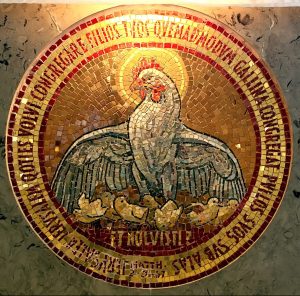
Image by Anton 17 – Own work, CC BY-SA 3.0.
The Greek Iēsous is “only” a proper name but one with great importance. The following quote by John Ellington (in The Bible Translator 1993, p. 401ff. ) illustrates this:
“In Matthew’s account of the birth of Jesus Christ, Joseph is told that when Mary gives birth to a son ‘you will name him Jesus, because he will save his people from their sins’ (1:21). This name is a Greek transliteration of the Hebrew name [Yeshua (יֵשׁוּעַ) which is a short form of a name meaning] ‘the Lord [Yahweh] saves.’ The name is very significant and is in itself especially dear to Christians around the world. (…) Unquestionably great importance is attached to the name of Jesus by Christians of all persuasions and backgrounds.”
While Iēsous (pronounced: /i.ɛː.suːs/) is transliterated as “Jesus” (pronounced /ˈdʒiːzəs/) in English (but was translated as “Hælend” [the “healing one”] in Old English — see Swain 2019) it is transliterated and pronounced in a large variety of other ways as well, following the different rules of different languages’ orthographies, writing systems and rules of pronunciation. The following is a (partial) list of forms of Jesus in Latin characters: aYeso, Azezi, Cecoc, Chesús, Chi̍i̍sū, Chisɔsi, Ciisahs, Ciise, Ciisusu, Djesu, Ɛisa, Ƹisa, Eyesu, Gesù, Gesû, Gesü, Ġesù, Ghjesù, Giêsu, ꞌGiê‑ꞌsu, Giê-xu, Gyisɛse, Hesu, Hesús, Hisus, Hisuw, Ià-sŭ, Iesen, Ié:sos, Iesu, Iesui, Iesusɨn, Iesusiva, Ié:sos, Ihu, Iisus, Iisussa, Ijeesu, iJisọsị, Iji̍sɔ̄ɔsi, Iosa, Íosa, Ìosa, İsa, I’sa, Isiso, Isõs, Ísu, Isus, Isusa, Iisussa, Isuthi, Itota, Îtu, Isuva, Izesu, Izesuq, Jasus, Jeeju, Jeesus, Jeesuse, Jeezas, Jehu, Jeisu, Jeju, Jejus, Jeso, Jesoe, Jesosa, Jesoshi, Jesosy, Jesu, Jesû, Jesua, Jesuh, Jesuhs, Jesuo, Jesús, Jésus, Jesúsu, Jethu, Jezed, Jezi, Jézi, Ježiš, Jezu, Jezus, Jézus, Jėzus, Jēzus, Jezusi, Jėzus, Jezuz, Jiijajju, Jíísas, Jiisusi, Jiizas, Jíìzọ̀s, Jisas, Jisase, Jisasi, Jisasɨ, Jisaso, Jisesi, Jisɛ̀, Jisos, Jisọs, Jisɔs, Jisu, Jiszs, Jizọs, Jizɔs, Jizọsi, Jizọsu, Jòso, Jusu, Jweesus, Ketsutsi, Njises, Sesi, Sisa, Sísa, Sisas, Sīsū, Sizi, Txesusu, uJesu, Ujísɔ̄si, ŵaYesu, Xesosi, ´Xesús, Xesús, Yasu, Ya:su, Ɣaysa, Yecu, Yeeb Sub, Yeeh Suh, Yeesey, Yeeso, Yeesso, Yēēsu, Yehsu, Yëësu, Yeisu, Yeisuw, Yeshu, Yeso, Yesò, Yëso, Yɛso, ye-su, Yésu, Yêsu, Yẹ́sụ̃, Yésʉs, Yeswa, Yet Sut, Yetut, Yexus, Yezo, Yezu, Yiesu, Yiisa, Yiisu, Yiitju, Yis, Yisɔs, Yisufa, Yitati, Yusu, ‑Yusu, :Yusu’, Zeezi, Zezi, Zezì, Zezwii, Ziizɛ, Zisas, Zîsɛ, Zjezus, Zozi, Zozii, and this (much more incomplete) list with other writings systems: ᔩᓱᓯ, ᒋᓴᔅ, Հիսուս, ᏥᏌ, ኢየሱስ, ያሱስ, ܝܫܘܥ, Ісус, Їисъ, 耶稣, იესო, ईसा, イエス, イイスス, イエスス, 예수, येशू, येशो, ਈਸਾ, ພຣະເຢຊູ, ජේසුස්, যীশু, ଯୀଶୁ, ཡེ་ཤུ་, ‘ঈছা, இயேசு, ಯೇಸು, ພຣະເຢຊູ, ယေရှု, ઇસુ, जेजू, येसु, เยซู, យេស៊ូ, ᱡᱤᱥᱩ, ယေသှု, యేసు, ᤕᤧᤛᤢ᤺ᤴ, އީސާގެފާނު, ਯਿਸੂ, ꕉꖷ ꔤꕢ ꕞ, ⵏ⵿ⵗⵢⵙⴰ, ଜୀସୁ, يَسُوعَ,ㄧㄝㄙㄨ, YE-SU, ꓬꓰ꓿ꓢꓴ, 𖽃𖽡𖾐𖼺𖽹𖾏𖼽𖽔𖾏, ꑳꌠ, ᠶᠡᠰᠦᠰ (note that some of these might not display correctly if your device does not have the correct fonts installed).
In some languages the different confessions have selected different transliterations, such as in Belarusian with Isus (Ісус) by the Orthodox and Protestant churches and Yezus (Езус) by the Catholic church, Bulgarian with Iisus (Иисус) by the Orthodox and Isus (Исус) by the Protestant church, Japanese with Iesu (イエス) (Protestant and Catholic) and Iisusu (イイスス) (Orthodox), or Lingala with Yesu (Protestant) or Yezu (Catholic). These differences have come to the forefront especially during the work on interconfessional translations such as one in Lingala where “many hours were spent on a single letter difference” (source: Ellington, p. 401).
The proper name of God in the Old Testament, Yahweh (YHWH), is rendered in most Chinese Bible translations as Yēhéhuá 耶和華 — Jehovah. According to Chinese naming conventions, Yēhéhuá could be interpreted as Yē Héhuá, in which Yē would be the family name and Héhuá — “harmonic and radiant” — the given name. In the same manner, Yē 耶 would be the family name of Jesus and Sū 稣 would be his given name. Because in China the children inherit the family name from the father, the sonship of Jesus to God the Father, Jehovah, would be illustrated through this. Though this line of argumentation sounds theologically unsound, it is indeed used effectively in the Chinese church (see Wright 1953, p. 298).
Moreover, the “given name” of Sū 稣 carries the meaning ‘to revive, to rise again’ and seems to point to the resurrected Jesus. (Source: J. Zetzsche in Malek 2002, p. 141ff., see also tetragrammaton (YHWH))
Following are languages and language groups that use a form of Isa include the following (note that this list is not complete):
In German the name Jesus (pronounced: /ˈjeːzʊs/) is distinguished by its grammatical forms. Into the 20th century the grammatical rules prescribed a unique Greek-Latin declination: Jesus (nominative), Jesu (genitive, dative, vocative), Jesum (accusative), from which today only the genitive case “Jesu” is still in active use. Likewise, in Seediq (Taroko), the morphological treatment of “Jesus” also occupies a special category by not falling under the normal rule of experiencing a vowel reduction when the object-specific suffix an is added “since it was felt that the readers might resent that the name has been changed that drastically.” (Compare Msian for “Moses” (Mosi) as an object, but Yisuan for “Jesus” (Yisu).) (Source: Covell 1998. p. 249)
In Lamba the name ŵaYesu consists of a transliteration Yesu and the prefix ŵa, a plural form for “proper names when addressing and referring to persons in any position of seniority or honor.” While this was avoided in early translations to avoid possible misunderstandings of more than one Jesus, once the church was established it was felt that it was both “safe” and respectful to use the honorific (pl.) prefix. (Source C. M. Doke in The Bible Translator 1958, p. 57ff. )
In virtually all sign languages, “Jesus” is signed with the middle finger of each hand pointing to the palm (or wrist) of the other in succession (signing the nails of the cross). In the context of Bible translation this has been pointed out as theologically problematic since the “semantic connections of the original name Jesus do point towards ‘salvation,’ they do not naturally lead to crucifixion.” (Source: Phil King in Journal of Translation 1 (2020), p. 33ff.)
“Jesus” in German Sign Language (source )
Following is the oldest remaining Ethiopian Orthodox icon of Jesus from the 14th or possibly 13th century (found in the Church of the Saviour of the World in Gurji, Ethiopia). As in many Orthodox icons, Jesus’ right hand forms the Greek letters I-C-X-C for IHCOYC XPICTOC or “Jesus Christ.” Another interpretation of the right hand is that it shows three fingers pointing to the Trinity, while the two other fingers point to Jesus’ two natures.

Orthodox icons are not drawings or creations of imagination. They are in fact writings of things not of this world. Icons can represent our Lord Jesus Christ, the Virgin Mary, and the Saints. They can also represent the Holy Trinity, Angels, the Heavenly hosts, and even events. Orthodox icons, unlike Western pictures, change the perspective and form of the image so that it is not naturalistic. This is done so that we can look beyond appearances of the world, and instead look to the spiritual truth of the holy person or event. (Source )
The following is the so-called “Wales Window for Alabama.” It is a stained-glass window by the artist John Petts from Carmarthenshire, Wales, created in response to the 16th Street Baptist Church bombing which took place in 1963:

Stained glass is not just highly decorative, it’s a medium which has been used to express important religious messages for centuries. Literacy was not widespread in the medieval and Renaissance periods and the Church used stained glass and other artworks to teach the central beliefs of Christianity. In Gothic churches, the windows were filled with extensive narrative scenes in stained glass — like huge and colorful picture storybooks — in which worshipers could ‘read’ the stories of Christ and the saints and learn what was required for their religious salvation. (Source: Victoria and Albert Museum )
The style of the following drawing of Jesus by Annie Vallotton is described by the artist as this: “By using few lines the readers fill in the outlines with their imagination and freedom. That is when the drawings begin to communicate.” (see here )

Illustration by Annie Vallotton, copyright by Donald and Patricia Griggs of Griggs Educational Service.
Other visual representation of Jesus in TIPs include several non-Western styles of art: traditional Korean art, traditional Chinese art, modern Chinese abstract art, northern and central Thailand’s popular art, Indian Hamzanama style, traditional Vietnamese art, or Japanese prints.
See also this devotion on YouVersion .
The German Good News Bible (Die Bibel im heutigen Deutsch) (1st edition: 1968, latest edition: 2018) says this about the translation of the Greek expressions that in English are often translated as “kingdom of God” or “kingdom of heaven” respectively:
“An example for how a term evolved is the rendering of ‘heavenly kingdom’ or ‘kingdom of God.’ A verbatim translation will be misunderstood by most readers today: as if it talks about a kingdom that is located in heaven, when in reality it refers in the Bible to God being the ruler, to that area in which that rule has been realized and everything that human beings can expect because of that. Dependent on the context, the term is therefore translated differently in this present version: When it focuses on the presence of God’s kingdom it is rendered as ‘God establishes his rule’ (Gott richtet seine Herrschaft auf), when the focus is on the future it is translated as ‘Once God finalizes his creation (or ‘work’) . . . ‘ (Wenn Gott sein Werk vollendet . . .), and when the focus is on that finished creation it is ‘God’s new world’ (Gottes neue Welt).” (p. 299 — for a longer exposition, see Rudolf Kassühlke in The Bible Translator 1974, p. 236ff. )
The respective translation choice in that German translation:
Likewise in the Gurung translation the term was also, depending on context, rendered in four different ways:
(Source: Warren Glover in The Bible Translator 1978, p. 231ff. — here you can also find a comprehensive list of examples where which translation was applied.)
Following is a list of (back-) translations from other languages:
In Mairasi, a language “where people would rather say something in a new way than in an old way,” there are a number of translations, including “Great Above One’s (=God) rule,” “His power,” “His control,” or “His place of authority/power.” (Source: Enggavoter 2004)
In Q’anjob’al, the translators stumbled on an additional difficulty. Newberry and Kittie Cox (in The Bible Translator 1950, p. 91ff. ) explain: “‘The kingdom of God’ may be translated ‘where God supervises’ (or literally ‘guards’). However, in Mark 10:15 and Luke 18:17 it is not possible to speak of ‘receiving the kingdom of God,’ for this would imply that one simply takes over the responsibility for guarding God’s country while He rests. Accordingly, the translation is adapted to meet the cultural and linguistic requirements of the language by the form ‘receive God as king.’
In British Sign Language it is translation with a sign that combines the signs for “God” and “rule.” (Source: Anna Smith)
“Kingdom of God” in British Sign Language (source: Christian BSL, used with permission)
The artist Willy Wiedmann envisioned Jesus foretelling the kingdom of God like this:
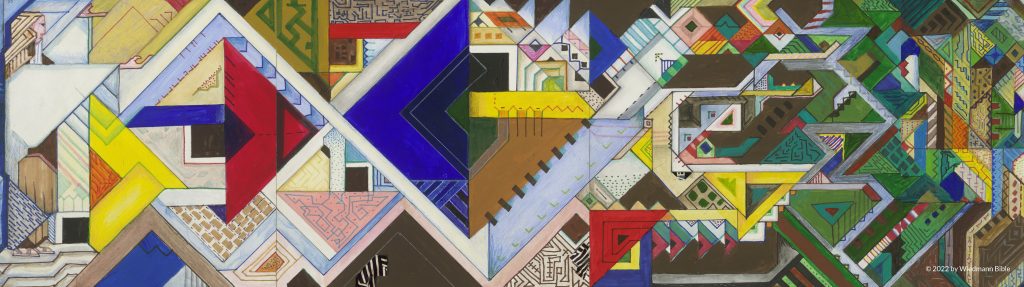
Click here to see the image in higher resolution. Image taken from the Wiedmann Bible. For more information about the images and ways to adopt them, see here . For other images of Willy Wiedmann paintings in TIPs, see here.
See also your kingdom come and kingdom of God (Japanese honorifics).
Learn more on Bible Odyssey: Kingdom of God, Kingdom of Heaven .
The Greek that is translated as “Let anyone with ears to hear listen” or similar in English was translated in Costa Rican Sign Language as “If you want to understand, understand!” (See also Mark 4:1-9 in Mexican Sign Language and Mark 4:1-9 in Russian Sign Language.)
Elsa Tamez (in The Bible Translator 2008, p. 59ff. ) explains: “A literal translation of this verse: ‘Let anyone with ears to hear listen!’ (Luke 8:8) is not appropriate for the Deaf community; it is difficult to understand and it can easily be misunderstood. Deaf people have ‘ears to hear’ but they cannot hear.”
In Tzotzil it is translated as “You all who with one heart want to learn, think about what I said,” in San Mateo Del Mar Huave as “Every one of you have heard this story. Now put it in your hearts,” in Gwichʼin as “He that will hear me, let him pay attention to me” (source: B. Moore / G. Turner in Notes on Translation 1967, p. 1ff.), and in the German New Testament translation by Berger / Nord (publ. 1999) as Denkt gut darüber nach or “Think about it carefully.”
Willy Wiedmann rendered this phrase artistically in the following way:

Click here to see the image in higher resolution.
Image taken from the Wiedmann Bible. For more information about the images and ways to adopt them, see here .
For other images of Willy Wiedmann paintings in TIPs, see here.
The Greek and Hebrew term that is translated into English as “yoke,” the Afar translation uses koyta (poles of camel pack) which refers to two poles in front of the hump and two behind; elsewhere in agricultural Ethiopia the yoke is only in front of the hump.
In Chol it is translated with tajbal, a term for “headband” (for carrying) (source: Ronald D. Olson in Notes on Translation January, 1968, p. 15ff.). Likewise, in Kele, it is translated with njɛmbɛ, “a carrying strap worn around the head and across the chest or shoulders to support a burden of firewood, garden produce or even a child carried by this on the back or hip” (source: William Ford in The Bible Translator 1957, p. 203ff. ).
In Matumbi it is translated as “rope” and “yoke is easy” is translated as “rope is slack/soft.” (Source: Pioneer Bible Translators, project-specific notes in Paratext)
In Kwasio it is translated with a term that refers to a “bulky piece of wood attached to the neck of a goat, preventing it from roaming freely in the brushy undergrowth.”
Joshua Ham explains: “When checking this verse in Kwasio, I was surprised to find that the Kwasio had a word for yoke. You see, none of the language groups we have worked with have a tradition of using animals to pull carts or plows. Since yokes don’t exist in the culture, there’s no need for a word for that concept in these languages.
“When I asked the Kwasio team about their word for yoke, they said that they don’t use yokes to help animals pull plows; rather, their word for yoke refers to a bulky piece of wood attached to the neck of a goat, preventing it from roaming freely in the brushy undergrowth. So while the exact use of a Kwasio yoke is not the same as a biblical yoke, there are a lot of similarities: in both cases, it’s a piece of wood around an animal’s neck that serves to keep the animal under control. While the overlap isn’t perfect, it’s pretty good — and almost certainly better than trying to squeeze in a distracting explanation of how yokes function in the biblical cultures.”
Adam Boyd (in The PNG Experience ) tells this story about finding the right term in Enga: “Jesus’s words in Matthew 11:29-30 are some of the most difficult to translate into the Enga language. From the time that I became a Christian, I was taught that a yoke is a wooden crosspiece that is fastened over the neck of two animals and attached to a plough or cart that they are to pull. This is an easy enough concept to understand for people who come from societies that make use of beasts of burden, but in Papua New Guinea, there are no beasts of burden. Consequently the concept of a yoke placed on animals is completely foreign. Thus, we have struggled greatly in our attempt to translate Matthew 11:29-30.
“Recently, however, I came to learn that a yoke can also refer to a wooden frame that a person places on his neck or shoulders to make it easier to carry a heavy load. Indeed, the Bible often makes figurative use of the word ‘yoke’ as it refers to people and not to beasts of burden (see 1 Kings 12:4-14). As I was pondering that idea, I began to notice that when Engan men carry heavy logs on one shoulder, they often balance the load by supporting it with a small stick placed across the other shoulder. A few weeks ago, it clicked in my mind that the small stick they use to make it easier to carry a heavy log is like a yoke.
“Excited by this realization, I quickly asked my friend Benjamin if the stick that men use to make it easier to carry a heavy log has a name in Enga. Sure enough it does. It is called a pyakende. With great anticipation, I asked the translation team if we could use the word pyakende to translate the word ‘yoke’. After wrestling with the phrasing for a little while, we came up with the following translation: ‘In order to remove the heaviness from your shoulders, take my pyakende. When you have taken it, you will receive rest. As my pyakende helps you, what I give you to carry is not heavy and you will carry it without struggling.’”
“Yoke” is illustrated for use in Bible translations in East Africa by Pioneer Bible Translators like this:

Image owned by PBT and Jonathan McDaniel and licensed with the Creative Commons Attribution 3.0 Unported License.


