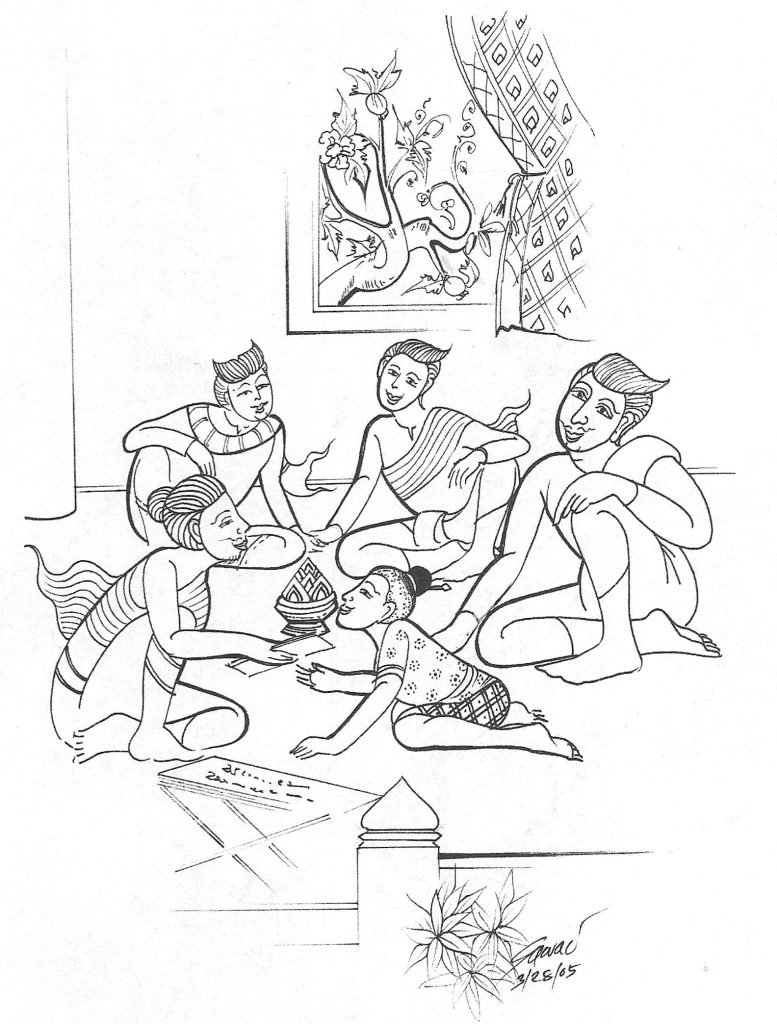
As a youth he had wisdom that surpassed that of his elders (image)

“The elders are both religious and political as indicated by their clothing. Thai scripture is written on folded palm leaf manuscripts and raised on small tables. The object in the bowl is used for ceremonial purposes. The boy’s hair will be cut at age twelve when, according to Thai tradition, he becomes a complete person. This makes his young wisdom all the more amazing.”

Drawing by Sawai Chinnawong who employs northern and central Thailand’s popular distinctive artistic style originally used to depict Buddhist moral principles and other religious themes; explanation by Paul DeNeui. From That Man Who Came to Save Us by Sawai Chinnawong and Paul H. DeNeui, William Carey Library, 2010.

For more images by Sawai Chinnawong in TIPs see here.

Saved from first danger he developed in body and spirit - pleasing to God and people (image)

“The shaded area under the second floor of the house is where the activities of home take place. Here, the young child and his mother are modeling clay water buffalo.”

Drawing by Sawai Chinnawong who employs northern and central Thailand’s popular distinctive artistic style originally used to depict Buddhist moral principles and other religious themes; explanation by Paul DeNeui. From That Man Who Came to Save Us by Sawai Chinnawong and Paul H. DeNeui, William Carey Library, 2010.

For more images by Sawai Chinnawong in TIPs see here.

From his birth there were those who wanted to kill him (image)

“People of high status would ride horses or elephants when they travel. Joseph and Mary are not rich so they walk to escape danger. They must travel through wild countryside where no one is around to help them.”

Drawing by Sawai Chinnawong who employs northern and central Thailand’s popular distinctive artistic style originally used to depict Buddhist moral principles and other religious themes; explanation by Paul DeNeui. From That Man Who Came to Save Us by Sawai Chinnawong and Paul H. DeNeui, William Carey Library, 2010.

For more images by Sawai Chinnawong in TIPs see here.

His birth brought joy to people of low status (image)

“The low social status of these men is indicated by the fact that they are wearing only one piece of cloth, all that they own. They are men of different ages working out in the fields raising animals. No one usually visits them.”

Drawing by Sawai Chinnawong who employs northern and central Thailand’s popular distinctive artistic style originally used to depict Buddhist moral principles and other religious themes; explanation by Paul DeNeui. From That Man Who Came to Save Us by Sawai Chinnawong and Paul H. DeNeui, William Carey Library, 2010.

For more images by Sawai Chinnawong in TIPs see here.

Abimelech's downfall (image)

Hand colored stencil print on momigami by Sadao Watanabe (1972).

Image taken with permission from the SadaoHanga Catalogue where you can find many more images and information about Sadao Watanabe.

For other images of Sadao Watanabe art works in TIPs, see here.

Willingly he identified with sinful people even though he himself had no sin (image)

“The man (John) is pouring water from the conch shell to anoint Jesus for a special task. The use of anointing shells originally came from Hinduism but is now used for special ceremonies in Thailand and surrounding countries. Jesus shows his willingness to identify with this tradition by raising his hands in a wai position indicating surrender.”

Drawing by Sawai Chinnawong who employs northern and central Thailand’s popular distinctive artistic style originally used to depict Buddhist moral principles and other religious themes; explanation by Paul DeNeui. From That Man Who Came to Save Us by Sawai Chinnawong and Paul H. DeNeui, William Carey Library, 2010.

For more images by Sawai Chinnawong in TIPs see here.

ark of the covenant

The Hebrew, Greek, and Latin that is sometimes translated as “ark of the covenant” in English (other English options: “pact chest” [translation by John Goldingay, 2018] or “Coffer of the Covenant” [translation by Everett Fox, 1995]) is translated in various ways:

  • Mairasi: Anasi Farjora or “Covenant Place” (source: Enggavoter 2004)
  • Uma: “Promise Box” (source: Uma Back Translation)
  • Yakan: “Covenant Chest” (source: Yakan Back Translation)
  • Kankanaey: “Chest of the Agreement” (source: Kankanaey Back Translation)
  • Tagbanwa: “Chest of the Initiated-agreement” (source: Tagbanwa Back Translation)
  • Bariai: “law box” (source: Bariai Back Translation)
  • Mairasi: “Covenant Place” (source: Enggavoter 2004)
  • Danish Bibelen 2020: kisten med den hellige aftale or “chest with the holy agreement” (source: Ehrensvärd in HIPHIL Novum 8/2023, p. 81ff. )

Following is reverse applique stitching (“mola”) by an unknown Guna artist depicting the ark:

Source: Sacred Art Pilgrim website .

In American Sign Language it is translated with a sign that combines “box” and the wings of the cherubim on top of the ark (see Exod 25:18 and following). (Source: Ruth Anna Spooner, Ron Lawer)


“Ark of the covenant” in American Sign Language, source: Deaf Harbor

See also covenant (tablets), cherub and tabernacle (noun).