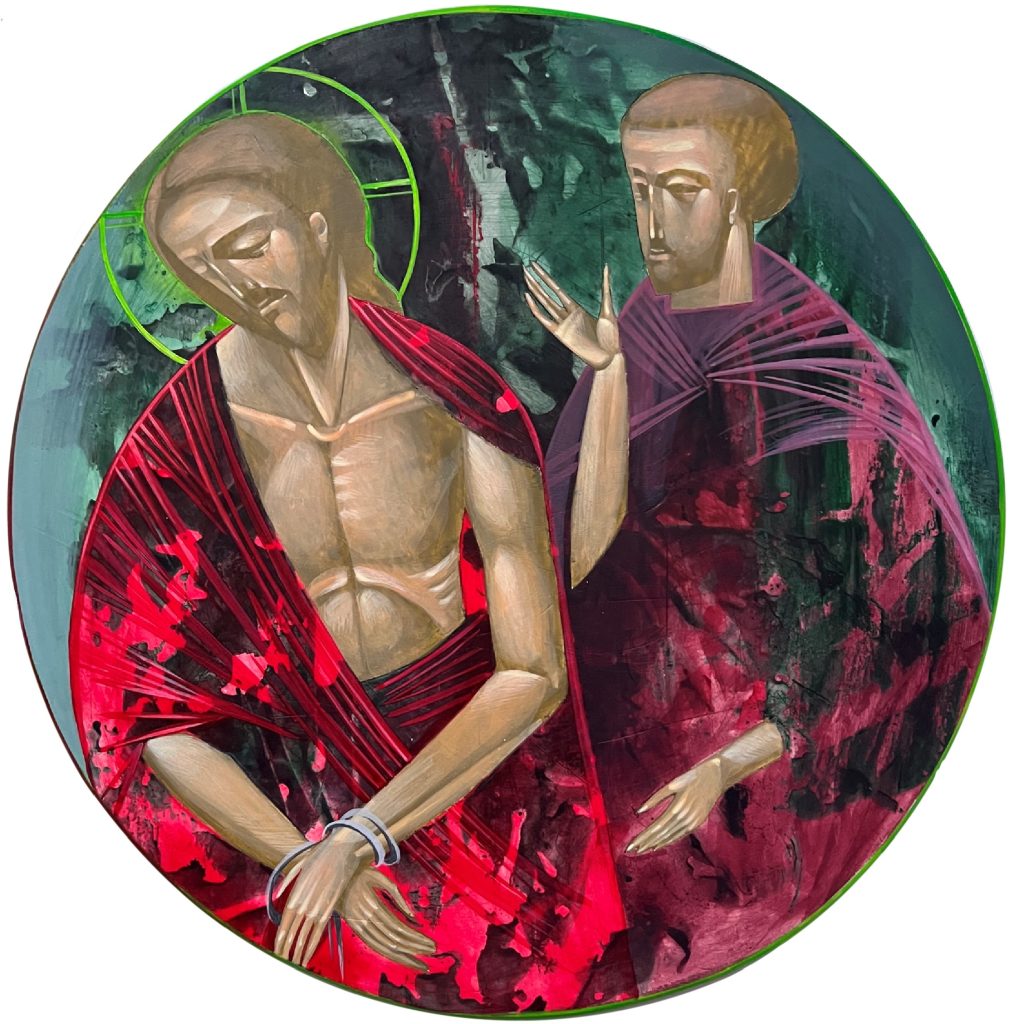
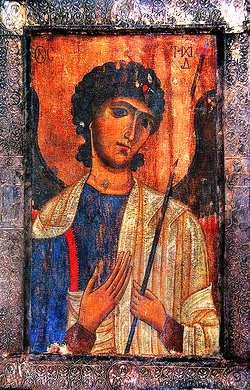
Orthodox Icons are not drawings or creations of imagination. They are in fact writings of things not of this world. Icons can represent our Lord Jesus Christ, the Virgin Mary, and the Saints. They can also represent the Holy Trinity, Angels, the Heavenly hosts, and even events. Orthodox icons, unlike Western pictures, change the perspective and form of the image so that it is not naturalistic. This is done so that we can look beyond appearances of the world, and instead look to the spiritual truth of the holy person or event. (Source )
For purchasing artworks by Kateryna Shadrina go to IconArt Gallery .
Orthodox Icons are not drawings or creations of imagination. They are in fact writings of things not of this world. Icons can represent our Lord Jesus Christ, the Virgin Mary, and the Saints. They can also represent the Holy Trinity, Angels, the Heavenly hosts, and even events. Orthodox icons, unlike Western pictures, change the perspective and form of the image so that it is not naturalistic. This is done so that we can look beyond appearances of the world, and instead look to the spiritual truth of the holy person or event. (Source )
The Hebrew and Latin that is transliterated as “Amos” in English is translated in Spanish Sign Language with the sign for “renovate / renew,” particularly referring to Amos 9:11. (Source: Steve Parkhurst)
In Swiss-German Sign Language it is translated with the sign that depicts Amos’ move from the Southern Kingdom of Judah into the Northern Kingdom of Israel to prophesy against it.
Following is a Russian Orthodox icon of Amos from the 18th century (found in the Transfiguration Church, Kizhi Monastery, Karelia, Russia). The words on the scroll are extracted from Isaiah 13:6: “For the day of the Lord is near; it will come like destruction from the Almighty!”
Orthodox Icons are not drawings or creations of imagination. They are in fact writings of things not of this world. Icons can represent our Lord Jesus Christ, the Virgin Mary, and the Saints. They can also represent the Holy Trinity, Angels, the Heavenly hosts, and even events. Orthodox icons, unlike Western pictures, change the perspective and form of the image so that it is not naturalistic. This is done so that we can look beyond appearances of the world, and instead look to the spiritual truth of the holy person or event. (Source )
Orthodox Icons are not drawings or creations of imagination. They are in fact writings of things not of this world. Icons can represent our Lord Jesus Christ, the Virgin Mary, and the Saints. They can also represent the Holy Trinity, Angels, the Heavenly hosts, and even events. Orthodox icons, unlike Western pictures, change the perspective and form of the image so that it is not naturalistic. This is done so that we can look beyond appearances of the world, and instead look to the spiritual truth of the holy person or event. (Source )
The Ancient Greek Septuagint translation of the Hebrew Bible used the word pantokrator (παντοκράτωρ) or “Ruler of All” as a translation of the second part of the Hebrew term YHWH Tz’vaót (יְהוָ֨ה צְבָא֜וֹת) or “Lord of hosts” (see here) and occasionally ʼĒl Šadạy (אֵל שַׁדַּי), translated in English commonly as “God Almighty.” In the deuterocanonical/apocryphal books, pantokrator might have also been used in the original writing. The New Testament uses it one time in the writings of Paul (2 Cor. 6:18) and several times in the book of Revelation (see esp. Rev. 1:8).
One of the most influential icon styles of the Orthodox church has developed from this concept: Christ Pantocrator. In this icon style, Christ is looking straight at the viewer, his right hand is typically spelling a short form of “Jesus Christ” (see the bottom of the entry on Jesus and icons for an explanation), and his left hand holds a New Testament. His head is often surrounded by a halo.
The earliest preserved icon is found in the Greek Orthodox Saint Catherine’s Monastery on Mount Sinai from the 6th century:
In order to express the two natures of Christ, the two sides of the face are not symmetrical. The right side might represent the qualities of his divinity, while his left side represents human nature. (Source )
Orthodox icons are not drawings or creations of imagination. They are in fact writings of things not of this world. Icons can represent our Lord Jesus Christ, the Virgin Mary, and the Saints. They can also represent the Holy Trinity, Angels, the Heavenly hosts, and even events. Orthodox icons, unlike Western pictures, change the perspective and form of the image so that it is not naturalistic. This is done so that we can look beyond appearances of the world, and instead look to the spiritual truth of the holy person or event. (Source )
“Almighty” is translated in Newari as “the strongest of all” (source: Newari Back Translation) and in the English Job translation by E.L. Greenstein (2019) as name: “Shaddai.”
Orthodox Icons are not drawings or creations of imagination. They are in fact writings of things not of this world. Icons can represent our Lord Jesus Christ, the Virgin Mary, and the Saints. They can also represent the Holy Trinity, Angels, the Heavenly hosts, and even events. Orthodox icons, unlike Western pictures, change the perspective and form of the image so that it is not naturalistic. This is done so that we can look beyond appearances of the world, and instead look to the spiritual truth of the holy person or event. (Source )
Orthodox Icons are not drawings or creations of imagination. They are in fact writings of things not of this world. Icons can represent our Lord Jesus Christ, the Virgin Mary, and the Saints. They can also represent the Holy Trinity, Angels, the Heavenly hosts, and even events. Orthodox icons, unlike Western pictures, change the perspective and form of the image so that it is not naturalistic. This is done so that we can look beyond appearances of the world, and instead look to the spiritual truth of the holy person or event. (Source )
The name that is transliterated as “Isaiah” in English is translated in Finnish Sign Language with the signs signifying “save + prophet” (referring to Genesis 2:21). (Source: Tarja Sandholm)
Following is a Russian Orthodox icon of Isaiah from the 18th century (found in the Transfiguration Church, Kizhi Monastery, Karelia, Russia). The text in the scrollis from Isaiah 2:2: “In the last days […] shall be established.”
Orthodox Icons are not drawings or creations of imagination. They are in fact writings of things not of this world. Icons can represent our Lord Jesus Christ, the Virgin Mary, and the Saints. They can also represent the Holy Trinity, Angels, the Heavenly hosts, and even events. Orthodox icons, unlike Western pictures, change the perspective and form of the image so that it is not naturalistic. This is done so that we can look beyond appearances of the world, and instead look to the spiritual truth of the holy person or event. (Source )





.jpg)


