The Greek that is translated into English as “crucify” is translated in various ways:
Naro: xgàu or “to stretch” (as is done with a skin after slaughtering in order to dry it. The word is also widely accepted in the churches.) (Source: Gerrit van Steenbergen)
Yatzachi Zapotec: “fasten him to the cross” (source for this and two above: M. Larson / B. Moore in Notes on Translation February 1970, p. 1-125)
Noongar: “kill on a tree” (source: Warda-Kwabba Luke-Ang)
Apali: “nail to a tree piece put cross-wise, lift up to stand upright (for the crucified person) to die (and in some contexts: “to die and rise again”)” (source: Martha Wade)
In British Sign Language it is signed with a sign that signifies “nails hammered into hands” and “arms stretched out.” (Source: Anna Smith)
“Crucify” or “crucifixion” in British Sign Language (source: Christian BSL, used with permission)
Following is a painting by Wang Suda 王肅達 (1910-1963):
Housed by Société des Auxiliaires des Missions Collection – Whitworth University
(click image to enlarge)
Image taken from Chinese Christian Posters . For more information on the “Ars Sacra Pekinensis” school of art, see this article , for other artworks of that school in TIPs, see here.
Click or tap here to see a short video clip showing how crucifixion was done in biblical times (source: Bible Lands 2012)
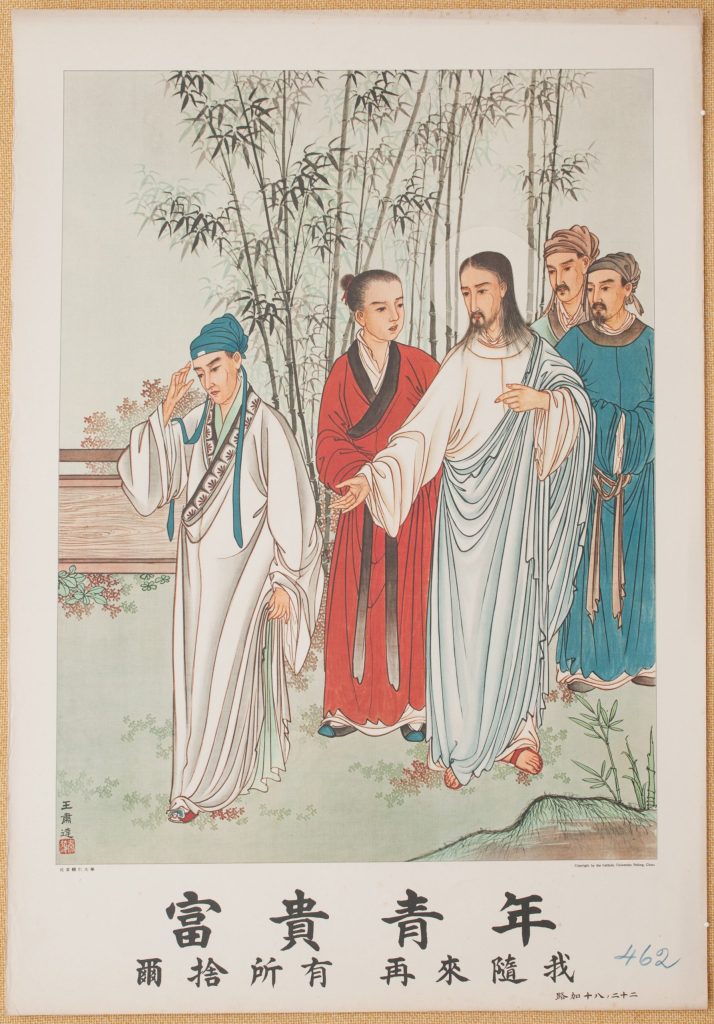
Painting by Wang Suda 王肅達 (1910-1963),
Copyright by the Catholic University Peking, China
Text under painting translated from Literary Chinese into English:
A Wealthy Youth
Abandon all that you have. Come and follow me
Image taken from Chinese Christian Posters . For more information on the “Ars Sacra Pekinensis” school of art, see this article , for other artworks of that school in TIPs, see here.
Painting by Wang Suda 王肅達 (1910-1963),
Copyright by the Catholic University Peking, China
Text under painting translated from Literary Chinese into English:
Establishing the Church
You are the rock, on this I will establish my Church
Image taken from Chinese Christian Posters . For more information on the “Ars Sacra Pekinensis” school of art, see this article , for other artworks of that school in TIPs, see here.
Painting by Wang Suda 王肅達 (1910-1963),
Copyright by the Catholic University Peking, China
Text under painting translated from Literary Chinese into English:
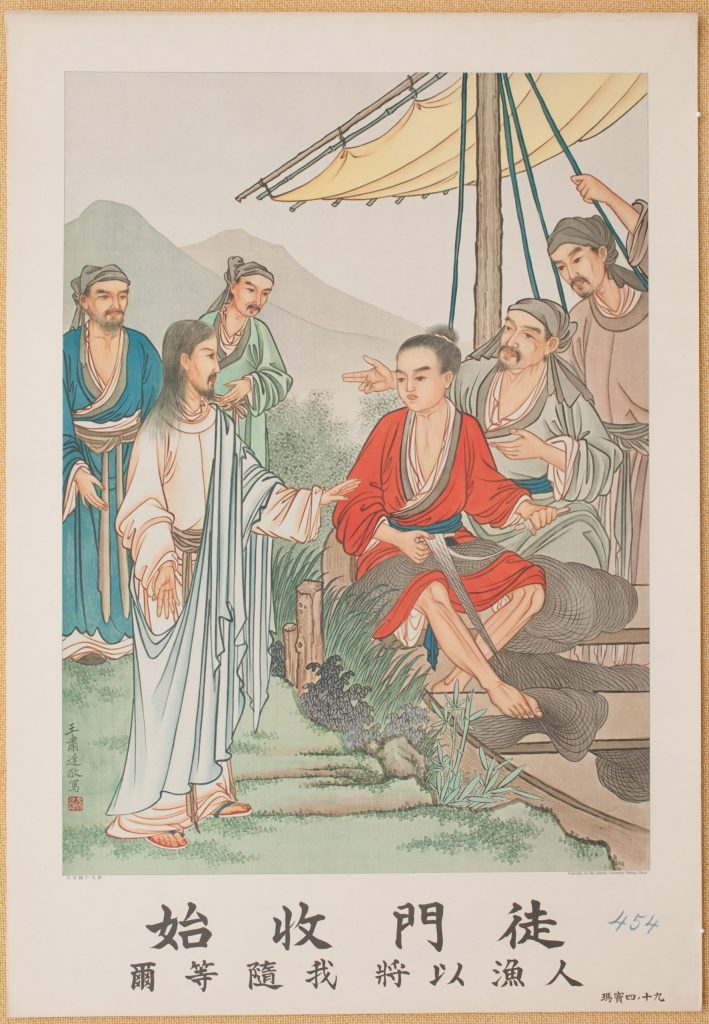
Calling of the Disciples
Come, follow me, and I will make you fishers of men
Image taken from Chinese Christian Posters . For more information on the “Ars Sacra Pekinensis” school of art, see this article , for other artworks of that school in TIPs, see here.
Painting by Wang Suda 王肅達 (1910-1963),
Copyright by the Catholic University Peking, China
Text under painting translated from Literary Chinese into English:
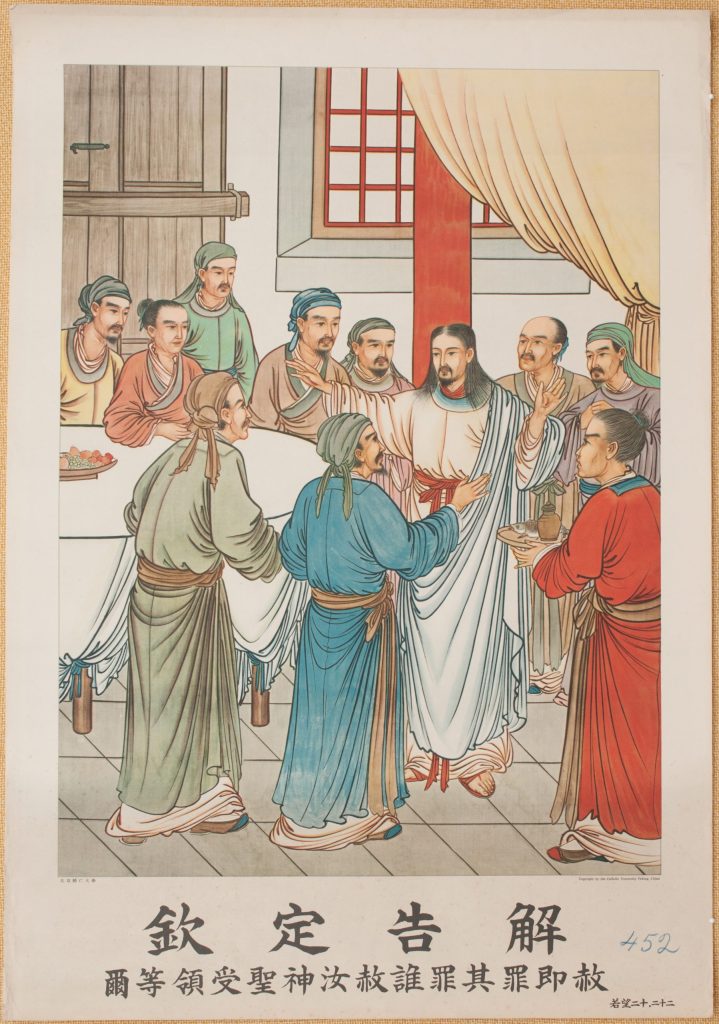
Authorized Confession
Receive the Holy Spirit. If you forgive anyone their sins, they are forgiven.
Image taken from Chinese Christian Posters . For more information on the “Ars Sacra Pekinensis” school of art, see this article , for other artworks of that school in TIPs, see here.
Painting by Wang Suda 王肅達 (1910-1963),
Copyright by the Catholic University Peking, China
Text under painting translated from Literary Chinese into English:
Healing the Paralytic
The Lord said to him, “Rise! Walk!”
Image taken from Chinese Christian Posters . For more information on the “Ars Sacra Pekinensis” school of art, see this article , for other artworks of that school in TIPs, see here.
Painting by Wang Suda 王肅達 (1910-1963),
Copyright by the Catholic University Peking, China
Text under painting translated from Literary Chinese into English: Jesus Ascended to Heaven
The Lord returned to Heaven and was seated at the right hand of Father
Image taken from Chinese Christian Posters . For more information on the “Ars Sacra Pekinensis” school of art, see this article , for other artworks of that school in TIPs, see here.
Following is a painting (“Ascension”) by Kim Ki-chang (1913-2001):
Kim Ki-chang (pen name: Unbo) had been deaf and partially mute since the age of 7. He painted a series of 30 paintings for the “Life of Christ” cycle in 1952 during the Korean War. Kim portrayed Jesus as a seonbi / 선비, or a Joseon Period (1392-1910) gentleman scholar, wearing a gat / 갓 (hat) and dopo / 도포 (robe). For other images of Kim Ki-chang art works in TIPs, see here.
The following is a church window based on an of Annie Vallotton. This is installed in a church of the Union des Églises Baptistes du Cameroun in Mowo (Mokong), Cameroon.
Photo and the following description by Ken Hollingsworth
“The windows are open with no screens or glass. The pictures were fabricated by projecting the picture using an overhead projector on a piece of plywood. They were drawn on the plywood with charcoal. Then the fabricator cut pieces of iron rebar to make the picture. Then the iron pieces were welded together. Later, when the pictures were installed, they were painted with different colors to help the people ‘see’ the picture.”
Painting by Wang Suda 王肅達 (1910-1963),
Housed in the Société des Auxiliaires des Missions Collection – Whitworth University
Image taken from Chinese Christian Posters . For more information on the “Ars Sacra Pekinensis” school of art, see this article , for other artworks of that school in TIPs, see here.