The name of the father of John the Baptist that is transliterated as “Zechariah” in English is translated in Spanish Sign Language as “beard (the sign for a patriarch)” + “mute.” (Source: John Elwode in The Bible Translator 2008, p. 78ff. )
The following is a stained glass window depicting Mary’s visitation to Elizabeth. It was created by Ateliers Maréchal de Metz between 1848 and 1860 for the Cathédrale Notre-Dame de Luxembourg. Zechariah is shown on the right:
Photo by Marcin Szala, hosted by Wikimedia Commons under a Creative Commons Attribution-Share Alike 3.0 Unported license
Stained glass is not just highly decorative, it’s a medium which has been used to express important religious messages for centuries. Literacy was not widespread in the medieval and Renaissance periods and the Church used stained glass and other artworks to teach the central beliefs of Christianity. In Gothic churches, the windows were filled with extensive narrative scenes in stained glass — like huge and colorful picture storybooks — in which worshipers could ‘read’ the stories of Christ and the saints and learn what was required for their religious salvation. (Source: Victoria and Albert Museum )
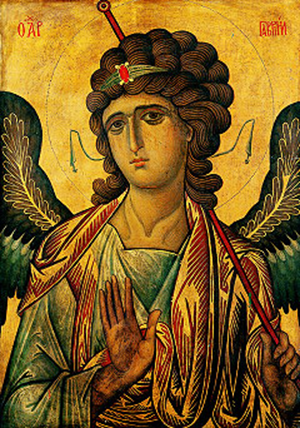
Orthodox Icons are not drawings or creations of imagination. They are in fact writings of things not of this world. Icons can represent our Lord Jesus Christ, the Virgin Mary, and the Saints. They can also represent the Holy Trinity, Angels, the Heavenly hosts, and even events. Orthodox icons, unlike Western pictures, change the perspective and form of the image so that it is not naturalistic. This is done so that we can look beyond appearances of the world, and instead look to the spiritual truth of the holy person or event. (Source )
“John the Baptist” in Mexican Sign Language (source: BSLM )
In German Sign Language (Catholic) it is translated with the sign for the letter J and the sign signifying a Catholic baptism by sprinkling on the head.
In American Sign Language it is translated with the sign for the letter J and the sign signifying “shout,” referring to John 1:23. (Source: Ruth Anna Spooner, Ron Lawer)
“John” in American Sign Language, source: Deaf Harbor
In Vietnamese (Hanoi) Sign Language it is translated with the sign for leaping in the womb (see Luke 1:41) and baptism. (Source: The Vietnamese Sign Language translation team, VSLBT)
A question of cultural assumptions arose in Tuvan. The instinctive way to translate this name denotatively would be “John the Dipper,” but this would carry the highly misleading connotation that he drowned people. It was therefore decided that his label should focus on the other major aspect of his work, that is, proclaiming that the Messiah would soon succeed him. (Compare his title in Russian Orthodox translation “Иоанн Предтеча” — “John the Forerunner.”) So he became “John the Announcer,” which fortunately did not seem to give rise to any confusion with radio newsreaders! (Source: David Clark in The Bible Translator 2015, p. 117ff. )
In Noongar it is translated as John-Kakaloorniny or “John Washing” (source: Warda-Kwabba Luke-Ang).
A new oral translation into Yao / Ciyawo, spoken in Mozambique, uses John the one who ceremoniously washes/pours water, using a term (kusingula) that “indicates a ceremonial washing or pouring of water on a person in the Yawo’s expression of Islam which can be used for an act done in repentance of sin.” (Source: Houston 2025, p. 236)
In American Sign Language it is translated with the sign for “government/governor” plus the sign for “P” with a circular movement. The reference to government indicates Pilate’s position of authority in the Roman Empire. (Source: Ruth Anna Spooner, Ron Lawer)
“Pilate” in American Sign Language, source: Deaf Harbor
“In a number of languages, including Yanesha’ of Peru, there is an obligatory morpheme that must be suffixed to the name of any person referred to after his death. An interesting problem arises in the transfiguration account as to whether or not Moses’ name should have the ‘dead’ suffix. The translators have decided to leave the suffix off the name of Moses in the transfiguration story, since his obvious physical presence would be contradictory to the reference to his death. They are using it with the names of the characters of the Old Testament when they are mentioned in the New in other contexts and with the names of characters of the New Testament only if they have reason to believe that the person was dead when the record was written.” (Source: Larson 1998, p. 46)
In Yatzachi Zapotec the translators encountered the same grammatical requirement but decided differently. Otis Leal (in The Bible Translator 1951, p. 164ff. ) explains: “Zapotecs never refer to a person who has died without indicating this fact. Thus the sentence. In Mark 9:4 Moses and Elijah spoke with Christ. Moses was obviously dead and was so designated in the translation. The question arose regarding Elijah. The informant was positive that he also should be referred to as dead since he no longer inhabited this mortal world. Should that be conceded, however, it would seem that Christ would also have to be referred to as dead at any time after the ascension. Thus Paul would be represented as beginning Romans, ‘Paul, a servant of the dead Jesus Christ.’ But because of the resurrection of Jesus, He is always spoken of as alive.”
The Greek and Hebrew that is usually translated in English as “atonement” is translated in Luchazi with minina mata: “to swallow another’s spittle.” “The human bite [is traditionally thought of] as being the most poisonous and dangerous and the poison lies in the saliva. So in swallowing another’s spittle, one takes into oneself all the poison or evil of the other and thus actually ‘becomes sin’ on behalf of the other. The substitute then proceeds to deal with the case as though he were the guilty one.” (Source: E. Pearson in The Bible Translator 1954, p. 160ff. )