yoke

The Greek and Hebrew term that is translated into English as “yoke,” the Afar translation uses koyta (poles of camel pack) which refers to two poles in front of the hump and two behind; elsewhere in agricultural Ethiopia the yoke is only in front of the hump.

In Chol it is translated with tajbal, a term for “headband” (for carrying) (source: Ronald D. Olson in Notes on Translation January, 1968, p. 15ff.). Likewise, in Kele, it is translated with njɛmbɛ, “a carrying strap worn around the head and across the chest or shoulders to support a burden of firewood, garden produce or even a child carried by this on the back or hip” (source: William Ford in The Bible Translator 1957, p. 203ff. ).

In Matumbi it is translated as “rope” and “yoke is easy” is translated as “rope is slack/soft.” (Source: Pioneer Bible Translators, project-specific notes in Paratext)

In Kwasio it is translated with a term that refers to a “bulky piece of wood attached to the neck of a goat, preventing it from roaming freely in the brushy undergrowth.”

Joshua Ham explains: “When checking this verse in Kwasio, I was surprised to find that the Kwasio had a word for yoke. You see, none of the language groups we have worked with have a tradition of using animals to pull carts or plows. Since yokes don’t exist in the culture, there’s no need for a word for that concept in these languages.

“When I asked the Kwasio team about their word for yoke, they said that they don’t use yokes to help animals pull plows; rather, their word for yoke refers to a bulky piece of wood attached to the neck of a goat, preventing it from roaming freely in the brushy undergrowth. So while the exact use of a Kwasio yoke is not the same as a biblical yoke, there are a lot of similarities: in both cases, it’s a piece of wood around an animal’s neck that serves to keep the animal under control. While the overlap isn’t perfect, it’s pretty good — and almost certainly better than trying to squeeze in a distracting explanation of how yokes function in the biblical cultures.”

Adam Boyd (in The PNG Experience ) tells this story about finding the right term in Enga: “Jesus’s words in Matthew 11:29-30 are some of the most difficult to translate into the Enga language. From the time that I became a Christian, I was taught that a yoke is a wooden crosspiece that is fastened over the neck of two animals and attached to a plough or cart that they are to pull. This is an easy enough concept to understand for people who come from societies that make use of beasts of burden, but in Papua New Guinea, there are no beasts of burden. Consequently the concept of a yoke placed on animals is completely foreign. Thus, we have struggled greatly in our attempt to translate Matthew 11:29-30.

“Recently, however, I came to learn that a yoke can also refer to a wooden frame that a person places on his neck or shoulders to make it easier to carry a heavy load. Indeed, the Bible often makes figurative use of the word ‘yoke’ as it refers to people and not to beasts of burden (see 1 Kings 12:4-14). As I was pondering that idea, I began to notice that when Engan men carry heavy logs on one shoulder, they often balance the load by supporting it with a small stick placed across the other shoulder. A few weeks ago, it clicked in my mind that the small stick they use to make it easier to carry a heavy log is like a yoke.

“Excited by this realization, I quickly asked my friend Benjamin if the stick that men use to make it easier to carry a heavy log has a name in Enga. Sure enough it does. It is called a pyakende. With great anticipation, I asked the translation team if we could use the word pyakende to translate the word ‘yoke’. After wrestling with the phrasing for a little while, we came up with the following translation: ‘In order to remove the heaviness from your shoulders, take my pyakende. When you have taken it, you will receive rest. As my pyakende helps you, what I give you to carry is not heavy and you will carry it without struggling.’”

“Yoke” is illustrated for use in Bible translations in East Africa by Pioneer Bible Translators like this:

Image owned by PBT and Jonathan McDaniel and licensed with the Creative Commons Attribution 3.0 Unported License.
Click or tap here to see a short video clip showing how yokes were used in biblical times (source: Bible Lands 2012)

myrrh

The Greek and Hebrew that is translated as “myrrh” in English is translated as “bitter medicine” in Michoacán Nahuatl and as “myrrh perfume” in Tzotzil (source: Ronald D. Olson in Notes on Translation January, 1968, p. 15ff.).

In Mark 15:23, Usila Chinantec translates it as “the herb myrrh which is useful so that one not feel pain in his body.” (Source: B. Moore / G. Turner in Notes on Translation 1967, p. 1ff.)


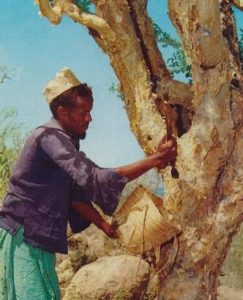
Myrrh is probably the most precious spice in the Bible. It was worth more than its weight in gold. Our experts agree that the Hebrew word mor refers to the resin of one of the Commiphora genus, either myrrha, abyssinica or schimperi, all of which grew in what is now Yemen, Ethiopia, Somalia, and Madagascar. Other kinds of myrrh may have come from India (Commiphora erythraea, Commiphora opobalsamum). A more difficult question is the meaning of the word deror in Exodus 30:23. In the other places where it occurs it means “freedom” or “liberty.” This is the basis for the word “liquid” in some versions, but there is no certainty that “free” means “liquid.” The fact that myrrh was sometimes mixed with wine may suggest that deror means “liquid” here, but on the other hand, the weight of the myrrh is given in dry measure rather than liquid measure, which argues against it.

The myrrh plant is a bush or shrub with thick thorny branches that project and bend at odd angles. The leaves come in sets of three. The fruit is oval like a plum. The wood and bark have a pleasant smell. The gum oozes naturally from the branches, though some harvesters incise the branches to increase the flow. The sap or gum is clear or yellowish brown when it comes out, but gets darker as it dries. The taste of the gum is bitter (note the similarity of mor to the Hebrew word mar meaning “bitter”). In markets the gum is often found mixed with that of the kataf bush (bisabol).

God prescribed myrrh as an ingredient of the holy anointing oil (Exodus 30:23), and it is used as perfume in Esther, Psalms, Proverbs, and eight times in Song of Songs. It was brought as an expensive gift by the Magi to the new King (Matthew 2:11). As Jesus was dying on the cross, sympathetic bystanders may have offered it to him mixed with wine (Mark 15:23; see the parallel account in Matthew 27:34). Joseph of Arimathea and Nicodemus brought a mixture of myrrh and aloes to prepare Jesus’ body for burial (John 19:39). In ancient Egypt myrrh was burned on the altars of the sun god, and in Persia it was attached to the crowns of kings when they appeared in public. Romans burned myrrh at funerals and cremations, which helps to explain its inclusion in the list of spices in Revelation 18:13. Today it is used in perfumes, lotions, and even in toothpaste.

Varieties of myrrh grow in the Horn of Africa and Madagascar, so people from those areas should have no difficulty finding words for it. As to whether the myrrh in Exodus 30:23 was liquid or solid, there seems to be no consensus, and the translator may be forgiven for simply ignoring the Hebrew word deror . Possible transliterations are Hebrew mor, Arabic mar, French mireh, and Spanish/Portuguese mirra.

Harvesting myrrh, Wikimedia Commons

Source: Each According to its Kind: Plants and Trees in the Bible (UBS Helps for Translators)

See also mixture of myrrh with aloes.

stocks

The Greek in Acts 16:24 that is typically translated as “stocks” in English is translated in Isthmus Mixe as “notched boards” (source: Ronald D. Olson in Notes on Translation January, 1968, p. 15ff.).

In Lalana Chinantec it is translated as “where planks have holes in them and where peoples’ feet are tight,” in Chichimeca-Jonaz as “bit their feet with wood,” and in Morelos Nahuatl as “stuck between two boards.” (Source: Viola Waterhouse in Notes on Translation August 1966, p. 86ff.)

“Stocks” is illustrated for use in Bible translations in East Africa by Pioneer Bible Translators like this:

Image owned by PBT and Jonathan McDaniel and licensed with the Creative Commons Attribution 3.0 Unported License.

leaven

The Greek and Hebrew that is translated as “leaven” (or “yeast”) in English is translated in Tzotzil as “the thing that swells the stomach of bread” and in Mairasi “bread cooking ingredient” (source: Enggavoter 2004)

In the occurrences in Mark 8:15 it is translated in Wantoat as “salt.” (Source: Ronald D. Olson in Notes on Translation January, 1968, p. 15ff.)

See also leaven (1Cor 5:6).

gnashing of teeth

Th Greek that is translated as “gnashing of teeth” or similar in English is translated as “gnashing their teeth in pain” in Estado de México Otomi for clarity purposes (source: Ronald D. Olson in Notes on Translation January, 1968, p. 15ff.).

See also gnash / grind teeth.

right hand of

The Greek and Hebrew that is typically translated as “(to the) right hand of” is often translated much more descriptively in other languages:

  • Yakan: “at the right side, here in the greatest/most important/most honored place/seat”
  • Mezquital Otomi: “the right hand, at the place of honor”
  • Chuj: “exalted at the right hand”
  • Chichimeca-Jonaz: “in a high place there at the right”
  • Lalana Chinantec: “make great”
  • Isthmus Mixe: “given great authority”
  • Morelos Nahuatl: “placed big” or “heart-strengthens me”
  • Isthmus Mixe: “stays with me” (source for this and above: Viola Waterhouse in Notes on Translation August, 1966, p. 86ff)
  • Teutila Cuicatec: “in all authority at the right side” (source: Ronald D. Olson in Notes on Translation January, 1968, p. 15ff.).

In Lamnso’, the seat on the right-hand side signifies that the person seated there would have a higher position than the one to his left (vs. just being a seat of honor). To circumvent any misunderstanding of the biblical text, the translation here refers to the “highest seat next to God.” (Source: Karl Grebe in Holzhausen 1991, p. 52)

(Note that in Elhomwe the idiom “I see you through the left hand” stands for “useless.” [Source: project-specific translation notes in Paratext])

For Old Testament examples of blessing and power associated with God’s right hand, see Gen 48:14, 48:17, Exodus 15:6, 15:12, Psalm 48:10, 80:15, 80:17, 89:13.

angel

The Greek, Hebrew and Aramaic that is translated as “angel” in English versions is translated in many ways:

  • Pintupi-Luritja: ngaṉka ngurrara: “one who belongs in the sky” (source: Ken Hansen quoted in Steven 1984a, p. 116.)
  • Tetela, Kpelle, Balinese, and Mandarin Chinese: “heavenly messenger”
  • Shilluk / Igede: “spirit messenger”
  • Mashco Piro: “messenger of God”
  • Batak Toba: “envoy, messenger”
  • Navajo (Dinė): “holy servant” (source for this and above: Bratcher / Nida 1961; Igede: Andy Warren-Rothlin)
  • Central Mazahua: “God’s worker” (source: Ronald D. Olson in Notes on Translation January, 1968, p. 15ff.)
  • Saramaccan: basia u Masa Gaangadu köndë or “messenger from God’s country” (source: Jabini 2015, p. 86)
  • Mairasi: atatnyev nyaa or “sent-one” (source: Enggavoter 2004)
  • Shipibo-Conibo: “word bringer” (source: James Lauriault in The Bible Translator 1951, p. 32ff. )
  • Apali: “God’s one with talk from the head” (“basically God’s messenger since head refers to any leader’s talk”) (source: Martha Wade)
  • Michoacán Nahuatl: “clean helper of God” (source: B. Moore / G. Turner in Notes on Translation 1967, p. 1ff.)
  • Noongar: Hdjin-djin-kwabba or “spirit good” (source: Warda-Kwabba Luke-Ang)
  • Wè Northern (Wɛɛ): Kea ‘a “sooa or “the Lord’s soldier” (also: “God’s soldier” or “his soldier”) (source: Drew Maust)
  • Iwaidja: “a man sent with a message” (Sam Freney explains the genesis of this term [in this article ): “For example, in Darwin last year, as we were working on a new translation of Luke 2:6–12 in Iwaidja, a Northern Territory language, the translators had written ‘angel’ as ‘a man with eagle wings’. Even before getting to the question of whether this was an accurate term (or one that imported some other information in), the word for ‘eagle’ started getting discussed. One of the translators had her teenage granddaughter with her, and this word didn’t mean anything to her at all. She’d never heard of it, as it was an archaic term that younger people didn’t use anymore. They ended up changing the translation of ‘angel’ to something like ‘a man sent with a message’, which is both more accurate and clear.”)

Like a number of other East Asian languages, Japanese uses a complex system of honorifics, i.e. a system where a number of different levels of politeness are expressed in language via words, word forms or grammatical constructs. These can range from addressing someone or referring to someone with contempt (very informal) to expressing the highest level of reference (as used in addressing or referring to God) or any number of levels in-between. One way to do this is through the usage (or a lack) of an honorific prefix as shown here in the widely-used Japanese Shinkaiyaku (新改訳) Bible of 2017. When the referent is God, the “divine” honorific prefix mi- (御 or み) is used as in mi-tsukai (御使い) or “messenger (of God).” (Source: S. E. Doi, see also S. E. Doi in Journal of Translation, 18/2022, p. 37ff. )

See also angel (Acts 12:15) and this devotion on YouVersion .

circumcise, circumcision

The Hebrew and Greek terms that are translated as “circumcise” or “circumcision” in English (originally meaning of English term: “to cut around”) are (back-) translated in various ways:

  • Chimborazo Highland Quichua: “cut the flesh”
  • San Miguel El Grande Mixtec, Navajo (Dinė): “cut around”
  • Javanese: “clip-away”
  • Uab Meto: “pinch and cut” (usually shortened to “cut”)
  • North Alaskan Inupiatun, Western Highland Purepecha: “put the mark”
  • Tetelcingo Nahuatl: “put the mark in the body showing that they belong to God” (or: “that they have a covenant with God”)
  • Indonesian: disunat — “undergo sunat” (sunat is derived from Arabic “sunnah (سنة)” — “(religious) way (of life)”)
  • Ekari: “cut the end of the member for which one fears shame” (in Gen. 17:10) (but typically: “the cutting custom”) (source for this and above: Reiling / Swellengrebel)
  • Hiri Motu: “cut the skin” (source: Deibler / Taylor 1977, p. 1079)
  • Garifuna: “cut off part of that which covers where one urinates”
  • Bribri: “cut the soft” (source for this and the one above: Ronald Ross)
  • Amele: deweg cagu qoc — “cut the body” (source: John Roberts)
  • Eastern Highland Otomi: “cut the flesh of the sons like Moses taught” (source: Ronald D. Olson in Notes on Translation January, 1968, p. 15ff.)
  • Newari: “put the sign in one’s body” (Source: Newari Back Translation)
  • Central Mazahua: “sign in his flesh”
  • Hopi: “being cut in a circle in his body” (source for this and above: Waterhouse / Parrott in Notes on Translation October 1967, p. 1ff.)
  • Mandarin Chinese: gēlǐ (割礼 / 割禮) or “rite of cutting” (Protestant); gēsǔn (割损 / 割損) or “cut + loss” (Catholic) (Source: Zetzsche)
  • Tibetan: mdun lpags gcod (མདུན་​ལྤགས་​གཅོད།), lit. “fore + skin + cut” (source: gSungrab website )
  • Kutu: “enter the cloth (=undergarments)” (source: Pioneer Bible Translators, project-specific translation notes in Paratext)

Learn more on Bible Odyssey: Circumcision .