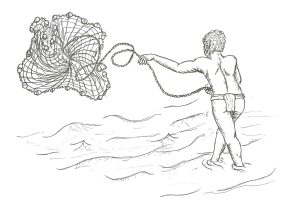
The Greek that is translated as “casting a net” in English has an immediate equivalent in Muna with buani: “to cast a (circular) net.” René van den Berg: “In this instance the Muna translation is possibly more graphic than the English, which leaves the nature of the net rather vague.”
This is illustrated for use in Bible translations in East Africa by Pioneer Bible Translators like this:
Image owned by PBT and Jonathan McDaniel and licensed with the Creative Commons Attribution 3.0 Unported License.
Low German translation by Johannes Jessen, publ. 1933, republ. 2006: “steppe”
Yakan: “the lonely place” (source: Yakan Back Translation)
Western Bukidnon Manobo: “a land where no people lived” (source: Western Bukidnon Manobo Back Translation)
Kankanaey: “the place with no inhabitants” (source: Kankanaey Back Translation)
Matumbi uses various term: lubele (desert, sandy place without water) — used in John 11:54, lupu’ngu’ti (a place where no people live, can be a scrub land, a forest, or a savanna) — used in Mark 1:3 et al.), and mwitu (a forest, a place where wild animals live) — used in Mark 1:13 et al.) (Source: Pioneer Bible Translators, project-specific notes in Paratext)
Chichewa Contemporary translation (2002/2016): chipululu: a place uninhabited by people with thick forest and bush (source: Mawu a Mulungu mu Chichewa Chalero Back Translation)
Note that in Luke 15:4, usually a term is used that denotes pastoral land, such as “eating/grazing-place” in Tagbanwa (source: Tagbanwa Back Translation).
The Greek that is typically translated as “eternity,” “forever,” or “forever and ever” in English are translated in Mairasi as “mashed out infinitely.” Lloyd Peckham explains: “Bark cloth required pounding. It got longer and wider as it got pounded. Similarly, life gets pounded or mashed to lengthen it into infinity. Tubers also get mashed into the standard way of serving the staple food, like the fufu of Uganda, or like poi of Hawaii. It spreads out into infinity.” (Source: Lloyd Peckham)
In Lisu the phrase “forever and ever” is translated as ꓕꓲꓽ ꓞꓲꓼ ꓕꓲ ꓑ — thi tsi thi pa, verbatim translated as “one – lifetime – one – world.” This construction follows a traditional four-couplet construct in oral Lisu poetry that is usually in the form ABAC or ABCB. (Source: Arrington 2020, p. 57f.)
In Makonde it is often translated as navyaka or “years and years.” (Source: Pioneer Bible Translators, project-specific notes in Paratext)
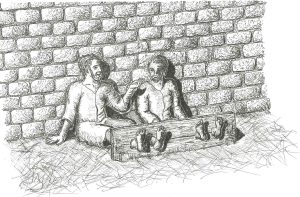
The Greek in Acts 16:24 that is typically translated as “stocks” in English is translated in Isthmus Mixe as “notched boards” (source: Ronald D. Olson in Notes on Translation January, 1968, p. 15ff.).
In Lalana Chinantec it is translated as “where planks have holes in them and where peoples’ feet are tight,” in Chichimeca-Jonaz as “bit their feet with wood,” and in Morelos Nahuatl as “stuck between two boards.” (Source: Viola Waterhouse in Notes on Translation August 1966, p. 86ff.)
“Stocks” is illustrated for use in Bible translations in East Africa by Pioneer Bible Translators like this:
Image owned by PBT and Jonathan McDaniel and licensed with the Creative Commons Attribution 3.0 Unported License.
The Hebrew that is translated in English as “livestock” (or “cattle”) is translated in Newari as “living beings brought up in a house” or “living beings cared for in a house” (source: Newari Back Translation). Specifically “cattle” is “cows and oxen.”
In Kwere it is “animals that are being kept.” (Source: Pioneer Bible Translators, project-specific translation notes in Paratext)
The Greek and Hebrew that is translated in English as “grain” (or: “corn”) is translated in Kui as “(unthreshed) rice.” Helen Evans (in The Bible Translator 1954, p. 40ff. ) explains: “Padddy [unthreshed rice] is the main crop of the country and rice the staple diet of the people, besides which [grain] is unknown and there is no word for it, and it seemed to us that paddy and rice in the mind of the Kui people stood for all that corn meant to the Jews.” “Paddy” is also the translation in Pa’o Karen (source: Gordon Luce in The Bible Translator 1950, p. 153f. ).
Other translations include: “wheat” (Teutila Cuicatec), “corn” (Lalana Chinantec), “things to eat” (Morelos Nahuatl), “grass corn” (wheat) (Chichimeca-Jonaz) (source: Viola Waterhouse in Notes on Translation August 1966, p. 86ff.), “millet” (Lambya) (source: project-specific notes in Paratext), “food” (Nyamwezi) (source: Pioneer Bible Translators, project-specific notes in Paratext)or ntimumma lujia / “seeds for food” (Lokạạ — “since Lokạạ does not have specific terms for maize and rice that can be described as grains”) (source: J.A. Naudé, C.L. Miller Naudé, J.O. Obono in Acta Theologica 43/2, 2023, p. 129ff. )
The Hebrew, Latin and Greek that is translated in English as “reptiles” or “creeping things” or similar is translated as “those which crawl along upon their stomach” in San Mateo del Mar Huave, “those that crawl the way they travel” in Chichimeca-Jonaz, and “animals that crawl on the ground” in Lalana Chinantec. (Source: Viola Waterhouse in Notes on Translation August 1966, p. 86ff.)
In Nyamwezi it is translated as as vitundwa vya ku’yu’mba or “creatures that move.” (Source: Pioneer Bible Translators, project-specific translation notes in Paratext)
The Hebrew words zachal and remes literally mean “creeping [things]” or “crawling [things]”, which is the Hebrew way of referring to small unclean creatures, reptiles in particular. The Greek word herpeton is also a general word for reptile; it includes snakes and lizards. All of the Hebrew, Greek, and Latin words usually exclude fish.
The Hebrew words carry the connotation of uncleanness.
In languages which have a word meaning “reptile”, this will fit most contexts. In languages which do not, phrases such as “snakes and lizards”, “wriggling things”, and so forth could be used.
The Hebrew in 1 Samuel 2:9 that is translated as “feet of his faithful ones” or similar in English is translated in Vidunda, Kwere and Kutu as “faithful people” because a translation involving “feet” did not communicate the correct meaning. (Source: Pioneer Bible Translators, project-specific translation notes in Paratext)