
The Hebrew in Proverbs 16:9 that is translated as “(the Lord) directs the steps” in English is translated in Aguacateco with the saying “… takes hold of our foot and leads us.” This is for instance used when “a man is taking a pig to market. He ties a rope to its back leg in order to guide it along the way that he wants it to go.” (Source: Harry McArthur in Notes on Translation 1984, p. 11ff.)
fig tree in leaf
The Greek in Mark 11:13 that is translated as “fig tree in leaf” or similar in English is translated in Mamaindé as “a tree, a stick like a cashew-stick, a fig-called stick, a leafy stick.” In Mamaindé, “when new information is introduced in the nominal phrase, and the information is somewhat complex, but revolves around a single central theme, appositional nominal phrases are used to build up a total concept, rather as the cycles are used to build up a whole discourse using cyclic repetition.” (Source: Peter K. E. Kingston in Notes on Translation 1973, p. 13ff.)
See also fig tree.
How often have I desired to gather your children together as a hen gathers her brood under her wings and you were not willing!
The Greek that is translated as “How often have I desired to gather your children together as a hen gathers her brood under her wings, and you were not willing!” or similar in English is translated in Ankave as “As a chicken extracts its young and gathers them under her breast, although all the time I tried to do the same to you, why did it not please you (to allow me to do so)?” (Source: Richard Speece in Notes on Translation 1988. p. 47ff.)
This is also depicted as a mosaic in Dominus Flevit, a Roman Catholic church on the Mount of Olives:
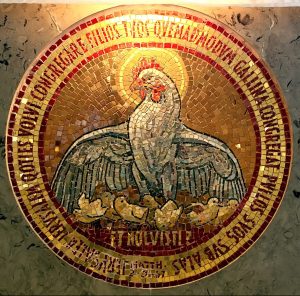
Image by Anton 17 – Own work, CC BY-SA 3.0.
he who believes in him
The Greek in Romans 9:33 that is translated as “he who believes in him” in English is translated as “the person who trusts in the one who is compared to a rock” in Yatzachi Zapotec. (Source: Waterhouse / Parrott in Notes on Translation October 1967, p. 1ff.)
not submit to God's righteousness
The Greek in Romans 10:3 that is translated as “do not submit to God’s righteousness” is translated as “are not willing that God should make them good the way he wants” in Isthmus Zapotec, as “do not desire that only God should make them right doing” in Central Tarahumara, and as “don’t give their hearts to have them made straight by God” in Tzeltal. (Source: Waterhouse / Parrott in Notes on Translation October 1967, p. 1ff.)
See also submit to God.
chosen by grace
The Greek in Romans 11:5 that is translated as “chosen by grace” or similar in English is translated as “God had mercy on and chose” in Isthmus Zapotec, as “picked out to worship him because he loves them” in Yatzachi Zapotec, and “God loving very much chose” in Central Tarahumara. (Source: Waterhouse / Parrott in Notes on Translation October 1967, p. 1ff.)
full inclusion
The Greek in Romans 11:12 that is translated in English as “full inclusion” or similar is translated as “return to their place” in Isthmus Zapotec, as “be called back by God” in Tzeltal, as “when they believe well” in Central Tarahumara, as “when God reinstates them” in Yatzachi Zapotec, and as “when they again become many who believe” in Chicahuaxtla Triqui. (Source: Waterhouse / Parrott in Notes on Translation October 1967, p. 1ff.)
contrary to nature
The Greek in Romans 11:24 that is translated as “contrary to nature” or similar in English is translated as “where you didn’t spring up” in Isthmus Zapotec, as “contrary to what you belong to” in Highland Totonac, and as “which is contrary to your normal way in that you are not the good branches of the good tree” in North Alaskan Inupiatun. (Source: Waterhouse / Parrott in Notes on Translation October 1967, p. 1ff.)