
The Greek in James 5:2 that is translated as “your riches have rotted” or similar in English is translated in Guhu-Samane as “your riches stink” (source: Ellis Deibler in Notes on Translation July, 1967, p. 5ff.).
slow to speak
The Greek in James 1:19 that is translated as “slow to speak” in English is translated as “speak without thinking” in Yatzachi Zapotec.
(Source: Ellis Deibler in Notes on Translation July, 1967, p. 5ff.)
myrrh
The Greek and Hebrew that is translated as “myrrh” in English is translated as “bitter medicine” in Michoacán Nahuatl and as “myrrh perfume” in Tzotzil (source: Ronald D. Olson in Notes on Translation January, 1968, p. 15ff.).
In Mark 15:23, Usila Chinantec translates it as “the herb myrrh which is useful so that one not feel pain in his body.” (Source: B. Moore / G. Turner in Notes on Translation 1967, p. 1ff.)
Myrrh is probably the most precious spice in the Bible. It was worth more than its weight in gold. Our experts agree that the Hebrew word mor refers to the resin of one of the Commiphora genus, either myrrha, abyssinica or schimperi, all of which grew in what is now Yemen, Ethiopia, Somalia, and Madagascar. Other kinds of myrrh may have come from India (Commiphora erythraea, Commiphora opobalsamum). A more difficult question is the meaning of the word deror in Exodus 30:23. In the other places where it occurs it means “freedom” or “liberty.” This is the basis for the word “liquid” in some versions, but there is no certainty that “free” means “liquid.” The fact that myrrh was sometimes mixed with wine may suggest that deror means “liquid” here, but on the other hand, the weight of the myrrh is given in dry measure rather than liquid measure, which argues against it.
The myrrh plant is a bush or shrub with thick thorny branches that project and bend at odd angles. The leaves come in sets of three. The fruit is oval like a plum. The wood and bark have a pleasant smell. The gum oozes naturally from the branches, though some harvesters incise the branches to increase the flow. The sap or gum is clear or yellowish brown when it comes out, but gets darker as it dries. The taste of the gum is bitter (note the similarity of mor to the Hebrew word mar meaning “bitter”). In markets the gum is often found mixed with that of the kataf bush (bisabol).
God prescribed myrrh as an ingredient of the holy anointing oil (Exodus 30:23), and it is used as perfume in Esther, Psalms, Proverbs, and eight times in Song of Songs. It was brought as an expensive gift by the Magi to the new King (Matthew 2:11). As Jesus was dying on the cross, sympathetic bystanders may have offered it to him mixed with wine (Mark 15:23; see the parallel account in Matthew 27:34). Joseph of Arimathea and Nicodemus brought a mixture of myrrh and aloes to prepare Jesus’ body for burial (John 19:39). In ancient Egypt myrrh was burned on the altars of the sun god, and in Persia it was attached to the crowns of kings when they appeared in public. Romans burned myrrh at funerals and cremations, which helps to explain its inclusion in the list of spices in Revelation 18:13. Today it is used in perfumes, lotions, and even in toothpaste.
Varieties of myrrh grow in the Horn of Africa and Madagascar, so people from those areas should have no difficulty finding words for it. As to whether the myrrh in Exodus 30:23 was liquid or solid, there seems to be no consensus, and the translator may be forgiven for simply ignoring the Hebrew word deror . Possible transliterations are Hebrew mor, Arabic mar, French mireh, and Spanish/Portuguese mirra.
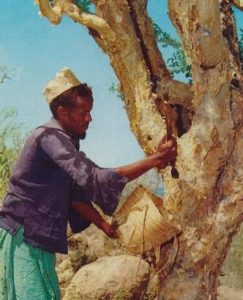

Source: Each According to its Kind: Plants and Trees in the Bible (UBS Helps for Translators)
See also mixture of myrrh with aloes.
stocks
The Greek in Acts 16:24 that is typically translated as “stocks” in English is translated in Isthmus Mixe as “notched boards” (source: Ronald D. Olson in Notes on Translation January, 1968, p. 15ff.).
In Lalana Chinantec it is translated as “where planks have holes in them and where peoples’ feet are tight,” in Chichimeca-Jonaz as “bit their feet with wood,” and in Morelos Nahuatl as “stuck between two boards.” (Source: Viola Waterhouse in Notes on Translation August 1966, p. 86ff.)
“Stocks” is illustrated for use in Bible translations in East Africa by Pioneer Bible Translators like this:
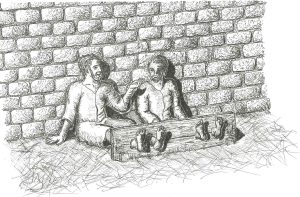
Image owned by PBT and Jonathan McDaniel and licensed with the Creative Commons Attribution 3.0 Unported License.
leaven
The Greek and Hebrew that is translated as “leaven” (or “yeast”) in English is translated in Tzotzil as “the thing that swells the stomach of bread” and in Mairasi “bread cooking ingredient” (source: Enggavoter 2004)
In the occurrences in Mark 8:15 it is translated in Wantoat as “salt.” (Source: Ronald D. Olson in Notes on Translation January, 1968, p. 15ff.)
See also leaven (1Cor 5:6).
gnashing of teeth
Th Greek that is translated as “gnashing of teeth” or similar in English is translated as “gnashing their teeth in pain” in Estado de México Otomi for clarity purposes (source: Ronald D. Olson in Notes on Translation January, 1968, p. 15ff.).
See also gnash / grind teeth.
shake off the dust from your feet
The Greek in Matthew 10:14 that is translated as “shake off the dust from your feet” in English is translated in this occurrence in Matt. 10:14 as “shake off the dust from your feet to show renunciation” in Estado de México Otomi for clarification. In the other passages in Mark, Luke and Acts the Greek text gives a clarification as well. (Source: John Beekman in Notes on Translation, March 1965, p. 2ff.)
See also shake the dust off your feet.
right hand of
The Greek and Hebrew that is typically translated as “(to the) right hand of” is often translated much more descriptively in other languages:
- Yakan: “at the right side, here in the greatest/most important/most honored place/seat”
- Mezquital Otomi: “the right hand, at the place of honor”
- Chuj: “exalted at the right hand”
- Chichimeca-Jonaz: “in a high place there at the right”
- Lalana Chinantec: “make great”
- Isthmus Mixe: “given great authority”
- Morelos Nahuatl: “placed big” or “heart-strengthens me”
- Isthmus Mixe: “stays with me” (source for this and above: Viola Waterhouse in Notes on Translation August, 1966, p. 86ff)
- Teutila Cuicatec: “in all authority at the right side” (source: Ronald D. Olson in Notes on Translation January, 1968, p. 15ff.).
In Lamnso’, the seat on the right-hand side signifies that the person seated there would have a higher position than the one to his left (vs. just being a seat of honor). To circumvent any misunderstanding of the biblical text, the translation here refers to the “highest seat next to God.” (Source: Karl Grebe in Holzhausen 1991, p. 52)
(Note that in Elhomwe the idiom “I see you through the left hand” stands for “useless.” [Source: project-specific translation notes in Paratext])
For Old Testament examples of blessing and power associated with God’s right hand, see Gen 48:14, 48:17, Exodus 15:6, 15:12, Psalm 48:10, 80:15, 80:17, 89:13.