He gave sight to the physically and spiritually blind (image)

“In the religious cultures of Asia, it is often believed that people are blind because of their past karma. The blind often resort to begging in order to survive. Here the blind man stretches out his arms in a polite way to receive a donation but instead he connects with a healing touch. The onlookers are shocked to see Jesus making physical connection with a lowly beggar with bad karma.”

Drawing by Sawai Chinnawong who employs northern and central Thailand’s popular distinctive artistic style originally used to depict Buddhist moral principles and other religious themes; explanation by Paul DeNeui. From That Man Who Came to Save Us by Sawai Chinnawong and Paul H. DeNeui, William Carey Library, 2010.

For more images by Sawai Chinnawong in TIPs see here.

Learn more on Bible Odyssey: Divine Power in Mark 8 .

When they were afraid he calmed their stormy hearts (image)

“Fishermen relied upon their folk knowledge in order to survive. It is strange that they did not know what to do in the midst of a storm but Jesus did.”

Drawing by Sawai Chinnawong who employs northern and central Thailand’s popular distinctive artistic style originally used to depict Buddhist moral principles and other religious themes; explanation by Paul DeNeui. From That Man Who Came to Save Us by Sawai Chinnawong and Paul H. DeNeui, William Carey Library, 2010.

For more images by Sawai Chinnawong in TIPs see here.

As the word about him spread people brought friends to him because they knew he cared (image)

“Successful Thai gatherings are always crowded. Four people carrying a wooden bed is a symbol of death to Thai people. Here Jesus symbolizes resurrection by raising the man from the sick bed back to health in body and soul.”

Drawing by Sawai Chinnawong who employs northern and central Thailand’s popular distinctive artistic style originally used to depict Buddhist moral principles and other religious themes; explanation by Paul DeNeui. From That Man Who Came to Save Us by Sawai Chinnawong and Paul H. DeNeui, William Carey Library, 2010.

For more images by Sawai Chinnawong in TIPs see here.

Even the least significant members of society he embraced (image)

“Adult activities are only for adults and the activities of child are only for children. Usually only very elderly Thai adults will spend time with children, but here we see Jesus doing it. The shaved hairstyles are different for the different boys and girls. Those with two pony tails are actually boys with two crowns of hair indicative of either great intelligence or belligerence.”

Drawing by Sawai Chinnawong who employs northern and central Thailand’s popular distinctive artistic style originally used to depict Buddhist moral principles and other religious themes; explanation by Paul DeNeui. From That Man Who Came to Save Us by Sawai Chinnawong and Paul H. DeNeui, William Carey Library, 2010.

For more images by Sawai Chinnawong in TIPs see here.

He allowed people of bad reputation to touch him (image)

“Usually, Thai men spend their free time with other men. Women only enter to serve them food, but here a woman has entered into the male social space in a counter-cultural way Not only is she female, she is a lowly prostitute. Although a Thai woman may sometimes wash her husband’s feet, she will never use her hair to dry them The men observing her are shocked at it all.”

Drawing by Sawai Chinnawong who employs northern and central Thailand’s popular distinctive artistic style originally used to depict Buddhist moral principles and other religious themes; explanation by Paul DeNeui. From That Man Who Came to Save Us by Sawai Chinnawong and Paul H. DeNeui, William Carey Library, 2010.

For more images by Sawai Chinnawong in TIPs see here.

People from his home town rejected him because they could not accept who he claimed to be (image)

“Only qualified, trained leaders know the dharma (truth) yet Jesus made claims that threatened the establishment. He is being chased out of the temple because his people thought him merely a carpenter. They intended to throw him down the cliff but he just passed by.”

Drawing by Sawai Chinnawong who employs northern and central Thailand’s popular distinctive artistic style originally used to depict Buddhist moral principles and other religious themes; explanation by Paul DeNeui. From That Man Who Came to Save Us by Sawai Chinnawong and Paul H. DeNeui, William Carey Library, 2010.

For more images by Sawai Chinnawong in TIPs see here.

When he grew up he worked as a carpenter until the age of thirty (image)

“Carpenters are considered skilled craftsman who do detailed work. Here, Jesus is making a wooden spindle on which his mother will spin silk thread.”

Drawing by Sawai Chinnawong who employs northern and central Thailand’s popular distinctive artistic style originally used to depict Buddhist moral principles and other religious themes; explanation by Paul DeNeui. From That Man Who Came to Save Us by Sawai Chinnawong and Paul H. DeNeui, William Carey Library, 2010.

For more images by Sawai Chinnawong in TIPs see here.

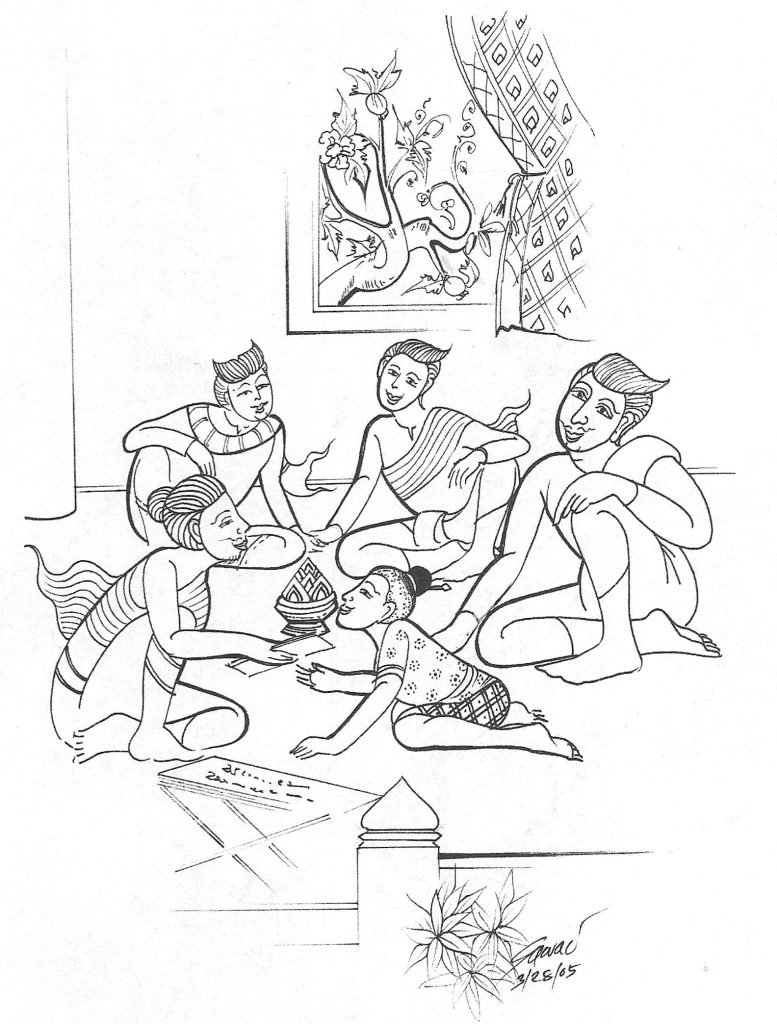
As a youth he had wisdom that surpassed that of his elders (image)

“The elders are both religious and political as indicated by their clothing. Thai scripture is written on folded palm leaf manuscripts and raised on small tables. The object in the bowl is used for ceremonial purposes. The boy’s hair will be cut at age twelve when, according to Thai tradition, he becomes a complete person. This makes his young wisdom all the more amazing.”

Drawing by Sawai Chinnawong who employs northern and central Thailand’s popular distinctive artistic style originally used to depict Buddhist moral principles and other religious themes; explanation by Paul DeNeui. From That Man Who Came to Save Us by Sawai Chinnawong and Paul H. DeNeui, William Carey Library, 2010.

For more images by Sawai Chinnawong in TIPs see here.