The Greek and Latin that is translated as “Son of God” in English is translated in Shipibo-Conibo as “God’s Child” and in Garifuna as “God’s offspring.” (Source: M. Larson / B. Moore in Notes on Translation February 1970, p. 1-125.)
Nida (1984, p. 113) remarks on this “It was a common expression in Hebrew to say that someone was the ‘Son of…’ something to express that they shared characteristics with that thing etc. E.g. ‘son of peace’ ‘son of thunder.’ Therefore ‘Son of God’ meant that Jesus shared characteristics with God. This wasn’t carried over into Greek and was interpreted more biologically.”
In San Mateo Del Mar Huave it is translated as “Son of Father God,” where “Father” is a term of respect. (Source: B. Moore / G. Turner in Notes on Translation 1967, p. 1ff.)
Like a number of other East Asian languages, Japanese uses a complex system of honorifics, i.e. a system where a number of different levels of politeness are expressed in language via words, word forms or grammatical constructs. These can range from addressing someone or referring to someone with contempt (very informal) to expressing the highest level of reference (as used in addressing or referring to God) or any number of levels in-between. One way to do this is through the usage (or a lack) of an honorific prefix as shown here in the widely-used Japanese Shinkaiyaku (新改訳) Bible of 2017. When the referent is God, the “divine” honorific prefix mi- (御) is used as in mi-ko (御子) or “son (of God)” in the referenced verses. (Source: S. E. Doi, see also S. E. Doi in Journal of Translation, 18/2022, p. 37ff. )
The Greek in John 19:9 that is translated as “Jesus gave no answer” is translated as “Jesus didn’t answer, but he wasn’t angry” in Central Pame. “In Pame culture, refusal to answer normally indicates anger, so an addition was necessary in order to avoid this wrong meaning.”
(Source: M. Larson / B. Moore in Notes on Translation February 1970, p. 1-125.)
The Greek in John 19:13 that is typically translated in English as “(the) Stone Pavement” is translated as “The smooth place of stone” in Tenango Otomi and “cemented place” in Huehuetla Tepehua.
(Source: M. Larson / B. Moore in Notes on Translation February 1970, p. 1-125.)
The Greek in John 19:23 that is translated as “seamless” in many English translation is translated in Aguaruna as “not sewn when they made it,” in Chol as “not stitched,” in Navajo (Dinė) as “woven in one piece from the top down,” and in Lalana Chinantec as “no joint in it at all.”
(Source: M. Larson / B. Moore in Notes on Translation February 1970, p. 1-125.)
The Greek in John 21:15 that is translated as “feed my lambs” in English is translated as “teach my people my words, as if to say you will feed my little sheep” in Ojitlán Chinantec, “teach my word to the men who are like lambs” in Huehuetla Tepehua, “help those who believe in me” in Xicotepec De Juárez Totonac, “teach the people who have just begun to trust in me” in Yatzachi Zapotec and “now do like a shepherd does. Take care of the people who believe in me” in Tenango Otomi.
(Source: M. Larson / B. Moore in Notes on Translation February 1970, p. 1-125.)
The Greek in John 21:16 that is translated as “tend my sheep” or similar in English is translated in Xicotepec De Juárez Totonac as “take care of the ones who believe in me just as a shepherd carefully cares for his sheep,” in Ojitlán Chinantec as “take care of my people, as if to say, you will take care of my sheep,” in Huehuetla Tepehua as “take care of the people who are like my sheep,” and in Yatzachi Zapotec as “care for the people who trust in me.”
(Source: M. Larson / B. Moore in Notes on Translation February 1970, p. 1-125.)
The Greek that is translated as “Follow me” in English is translated as “Be my disciple” in Ojitlán Chinantec and “Don’t forsake me” in Tenango Otomi (the latter is used in John 21). (Source: M. Larson / B. Moore in Notes on Translation February 1970, p. 1-125.)
In Kaingang it is translated as “run with me and do as I do.” (Source Ursula Wiesemann in Holzhausen / Riderer 2010, p. 65).
The Greek and Hebrew that is translated as “myrrh” in English is translated as “bitter medicine” in Michoacán Nahuatl and as “myrrh perfume” in Tzotzil (source: Ronald D. Olson in Notes on Translation January, 1968, p. 15ff.).
In Mark 15:23, Usila Chinantec translates it as “the herb myrrh which is useful so that one not feel pain in his body.” (Source: B. Moore / G. Turner in Notes on Translation 1967, p. 1ff.)
Myrrh is probably the most precious spice in the Bible. It was worth more than its weight in gold. Our experts agree that the Hebrew word mor refers to the resin of one of the Commiphora genus, either myrrha, abyssinica or schimperi, all of which grew in what is now Yemen, Ethiopia, Somalia, and Madagascar. Other kinds of myrrh may have come from India (Commiphora erythraea, Commiphora opobalsamum). A more difficult question is the meaning of the word deror in Exodus 30:23. In the other places where it occurs it means “freedom” or “liberty.” This is the basis for the word “liquid” in some versions, but there is no certainty that “free” means “liquid.” The fact that myrrh was sometimes mixed with wine may suggest that deror means “liquid” here, but on the other hand, the weight of the myrrh is given in dry measure rather than liquid measure, which argues against it.
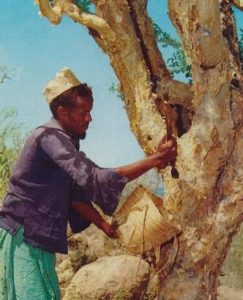
The myrrh plant is a bush or shrub with thick thorny branches that project and bend at odd angles. The leaves come in sets of three. The fruit is oval like a plum. The wood and bark have a pleasant smell. The gum oozes naturally from the branches, though some harvesters incise the branches to increase the flow. The sap or gum is clear or yellowish brown when it comes out, but gets darker as it dries. The taste of the gum is bitter (note the similarity of mor to the Hebrew word mar meaning “bitter”). In markets the gum is often found mixed with that of the kataf bush (bisabol).
God prescribed myrrh as an ingredient of the holy anointing oil (Exodus 30:23), and it is used as perfume in Esther, Psalms, Proverbs, and eight times in Song of Songs. It was brought as an expensive gift by the Magi to the new King (Matthew 2:11). As Jesus was dying on the cross, sympathetic bystanders may have offered it to him mixed with wine (Mark 15:23; see the parallel account in Matthew 27:34). Joseph of Arimathea and Nicodemus brought a mixture of myrrh and aloes to prepare Jesus’ body for burial (John 19:39). In ancient Egypt myrrh was burned on the altars of the sun god, and in Persia it was attached to the crowns of kings when they appeared in public. Romans burned myrrh at funerals and cremations, which helps to explain its inclusion in the list of spices in Revelation 18:13. Today it is used in perfumes, lotions, and even in toothpaste.
Varieties of myrrh grow in the Horn of Africa and Madagascar, so people from those areas should have no difficulty finding words for it. As to whether the myrrh in Exodus 30:23 was liquid or solid, there seems to be no consensus, and the translator may be forgiven for simply ignoring the Hebrew word deror . Possible transliterations are Hebrew mor, Arabic mar, French mireh, and Spanish/Portuguese mirra.