The Hebrew and Greek that is transliterated as “Naphtali” in English is translated in Spanish Sign Language with the sign for “deer,” referring to Genesis 49:21. (Source: Steve Parkhurst)
The Hebrew and Greek that is transliterated as “Issachar” in English is translated in Spanish Sign Language with a sign that signifies “donkey” referring to Genesis 49:14. (Source: Steve Parkhurst)
The name that is transliterated as “Adam” in English is translated in Finnish Sign Language with the sign signifying “rib” (referring to Genesis 2:21). (Source: Tarja Sandholm)
The Hebrew, Latin, and Greek that is transliterated as “Jacob” in English is translated in Spanish Sign Language with a sign that signifies “lentil,” referring to the soup he gave his brother in exchange for his birthright (see Genesis 25:34). Note that another Spanish Sign Language sign for Jacob also users the sign for Jewish. (Source: Steve Parkhurst)
In Finnish Sign Language it is translated with the signs signifying “smooth arm” (referring to the story starting at Genesis 27:11). (Source: Tarja Sandholm)
The term that is transliterated as “Ishmael” in English is translated in American Sign Language with the sign for the letter I and the sign signifying “stubborn” (also similar to “donkey”), referring to Genesis 16:12. (Source: Ruth Anna Spooner, Ron Lawer)
“Ishmael” in American Sign Language, source: Deaf Harbor
In Spanish Sign Language it is translated with a sign that depicts shooting bow and arrow, referring to the fact that Ishmael was skilled with his bow (see Genesis 21:20). (Source: Steve Parkhurst)
The Hebrew, Latin and Greek that is transliterated as “Noah” in English is translated in Spanish Sign Language with a sign that combines the letter N + “boat.” (Source: Steve Parkhurst)
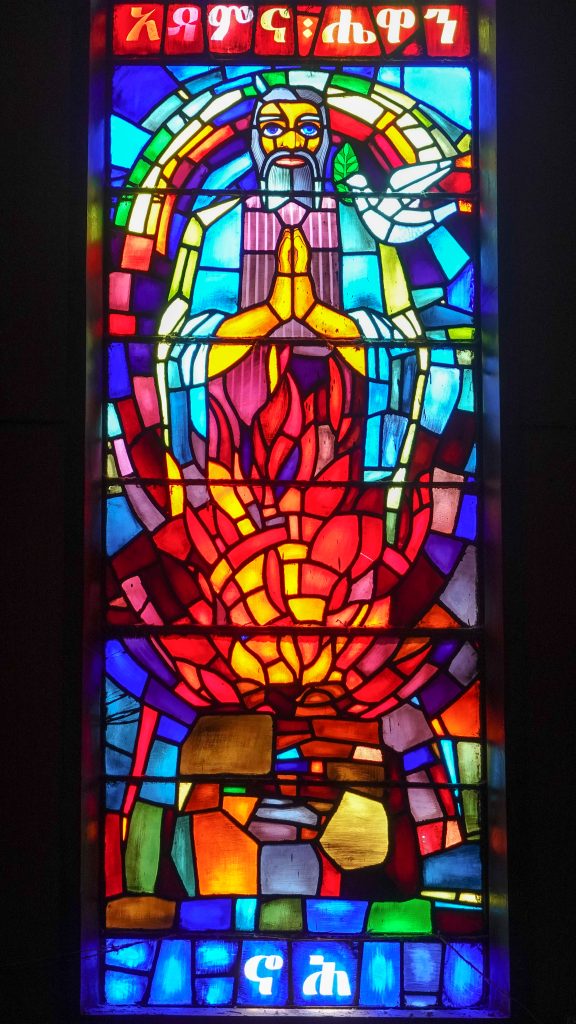
The following is a stained glass window depicting Noah by Endre Odon Hevezi and Gyula Bajo from 1965 for the Debre Libanos Monastery, Oromia, Ethiopia:
Photo by Timothy A. Gonsalves, hosted by Wikimedia Commons under a Creative Commons Attribution-Share Alike 4.0 International license
Stained glass is not just highly decorative, it’s a medium which has been used to express important religious messages for centuries. Literacy was not widespread in the medieval and Renaissance periods and the Church used stained glass and other artworks to teach the central beliefs of Christianity. In Gothic churches, the windows were filled with extensive narrative scenes in stained glass — like huge and colorful picture storybooks — in which worshipers could ‘read’ the stories of Christ and the saints and learn what was required for their religious salvation. (Source: Victoria and Albert Museum )
The Hebrew and Greek that is transliterated as “Ephraim” in English is translated in Spanish Sign Language with the sign for “palm tree” referring to the palm of Deborah in the land of Ephraim (see Judges 4:5. (Source: Steve Parkhurst)
The Hebrew and Greek that is transliterated as “Gideon” in English is translated in Spanish Sign Language with the sign for “wring out cloth” referring to Judges 6:38. (Source: Steve Parkhurst)