The Greek in Acts 3:7 that is translated as “ankle(s)” in English is translated as “the round bone of feet” in Tepeuxila Cuicatec or “necks of his feet” in Ayutla Mixtec. (Source: Viola Waterhouse in Notes on Translation August 1966, p. 86ff.)
“Feet and ankles” are translated in Matumbi as “legs.” “Foot” and “leg” are covered by just one term in this and some other Bantu languages. (Source: Pioneer Bible Translators, project-specific notes in Paratext)
Chichimeca-Jonaz: “who believed that message” (Source: Viola Waterhouse in Notes on Translation August 1966, p. 86ff.)
Elhomwe: “those who lived according to the Way of the Lord” (source: project-specific translation notes in Paratext)
German New Testament translation by Berger / Nord (publ. 1999): “Christian(ity)”
In the Mandarin ChineseUnion Version, the most commonly used Protestant Chinese Bible, it is translated as zhèdào (这道) or “this way.” Note that dào (道) or “way” is the same word that is also used for Logos (usually “Word” in English) in John 1:1 and elsewhere (see Word / Logos).
The Greek in Romans 10:2 that is translated as “not based on knowledge” or similar in English is translated as “don’t understand how God likes it” in Huehuetla Tepehua, as “not in the correct way” in Highland Totonac, as “don’t know what God wants” in Yatzachi Zapotec (source: Waterhouse / Parrott in Notes on Translation October 1967, p. 1ff.), and in Elhomwe as “real knowledge.” (Source: project-specific translation notes in Paratext)
The Greek that is translated as “treat with contempt,” “treat with scorn,” “ridicule,” or “abuse” is translated in Gullah as suck dey teet or “suck their teeth.” (Source: David Frank)
In Elhomwe “mock” is translated as “belittle.” (Source: project-specific translation notes in Paratext)
The Hebrew that is translated as “(he is) our body” in English is translated in Bura-Pabir with the existing idiom as “(he is) our blood.” (Source: Andy Warren-Rothlin)
In Elhomwe it is translated with the idiomatic mbalaaka, literally “of my knee.” (Source: project-specific translation notes in Paratext)
The Greek that is translated as “put his arms around him and kissed him” or similar in English is translated in the Pfälzisch translation by Walter Sauer (publ. 2012) as is em um de Hals gfalle un hot en abgekisst or “he flung his arms around his neck and smothered him with kisses.” (Source: Zetzsche)
In Elhomwe it is translated as “greeted him by hugging.” (Source: project-specific translation notes in Paratext)
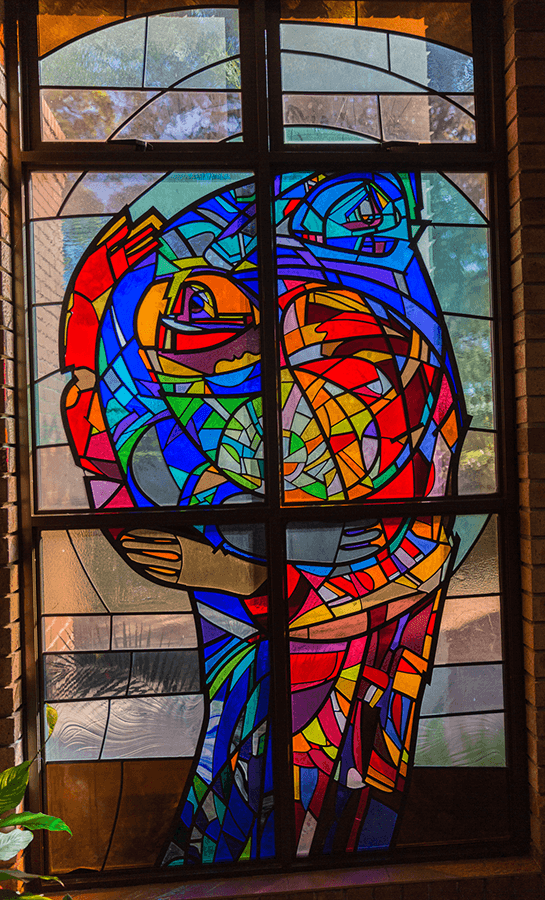
The following is a contemporary stained glass window depicting the father hugging his son in the Catholic Church of the Resurrection in Bryanston, New Zealand:
The Window of Reconciliation: The Father ran to his son and clasped him in his arms (Luke 15:21). This window portrays the reconciliation of God and ourselves: His grace (shown as brilliant light at the centre of united figures) transforms our hearts. The reconciliation we strive for in our country and our world is also portrayed — and there is no easy road to achieving peace on earth and goodwill to all (Luke 2:14). The modern window shows reconciling figures against a desert-like background that symbolises the death and desolation that threaten us. As the great 20th century poet WH Auden wrote: ‘We must love one another or die.’ (Source: Catholic Church of the Resurrection in Bryanston )
Stained glass is not just highly decorative, it’s a medium which has been used to express important religious messages for centuries. Literacy was not widespread in the medieval and Renaissance periods and the Church used stained glass and other artworks to teach the central beliefs of Christianity. In Gothic churches, the windows were filled with extensive narrative scenes in stained glass — like huge and colorful picture storybooks — in which worshipers could ‘read’ the stories of Christ and the saints and learn what was required for their religious salvation. (Source: Victoria and Albert Museum )
The Hebrew that is translated as “thistles” in English is translated in Elhomwe as epullathi or “bitter fruit” (which cannot be eaten). (Source: project-specific translation notes in Paratext)
The Hebrew in Genesis 4:11 that is translated as “opened its mouth to receive (your brother’s) blood” or similar in English is translated in Elhomwe as “the soil drank (your brother’s) blood.” “The soil drinking blood” was a common expression during the wartime in neighboring Mozambique . (Source: project-specific translation notes in Paratext)