Step into the multitudes of languages of the Bible and join the worldwide conversation!
Language: Indonesian
Standard Indonesian (ind) is a(n) Austronesian language of Indonesia, Netherlands, Philippines, Saudi Arabia, Singapore, United States, marked as not endangered
The Hebrew in Genesis 26:35 that is translated as “made life bitter” or similar in English is translated in Indonesian as “made heart bitter” (Alkitab Terjemahan Baru translation) (source: Daniel Arichea in The Bible Translator 1983, p. 209ff. )
In Nyamwezi, nnandyo is used, a term that communicates that “they brought sorrow/bitterness into their lives (from this point forward).” (Source: Pioneer Bible Translators, project-specific notes in Paratext)
The Hebrew in Deuteronomy 34:9 that is translated as “full of the spirit of wisdom” or similar in English is translated in Indonesian as “filled to overflowing with wisdom” (Common Language Translation) (source: Daniel Arichea in The Bible Translator 1983, p. 209ff. )
The Hebrew in Num 27:18 that is translated as “a man in whom is the spirit” or similar in English is translated in Indonesian as “an intelligent man” (Common Language Translation) (source: Daniel Arichea in The Bible Translator 1983, p. 209ff. )
The Hebrew that is translated often very carefully in English as “You son of a rebellious woman” or the like is translated is some common language translations from around the world much more directly. IndonesianBahasa Indonesia Masa Kini: Anak haram jadah! or “You bastard!”, GermanGute Nachricht Bibel: Du Bastard! or “You bastard!”, or Mandarin ChineseToday’s Chinese Version: Nǐ zhè chùshēng (你這畜生!) or “You beast!” (this is also used in Yue Chinese (Cantonese)). (See also Translation commentary on 1 Samuel 20:30)
The phrase in 1 Peter 3:4 that is translated in some English versions with “gentle and quiet in spirit” was translated into Kahua with the idiom that verbatim says “be beautiful in your belly.” (Source: Daniel Clark)
Genealogies play an important role among many of Indonesian language groups and it’s important to follow the right format to make them recognizable as such. Daniel Arichea explains (in The Bible Translator 1986. p. 232ff. ):
“In translating the genealogies, we need to pay attention to the standard form of genealogical lists in the language of translation. Among the Bataks, it was discovered after some research that the genealogies are recorded in the form of a list of ancestors. Furthermore, this list almost always starts from the ancestor and goes down to the descendants. This seems to be true also for many other Indonesian groups, although there are some variations. For the genealogies to have meaning among the Bataks and other groups of similar cultures, these genealogies must be in a form which is appropriate.
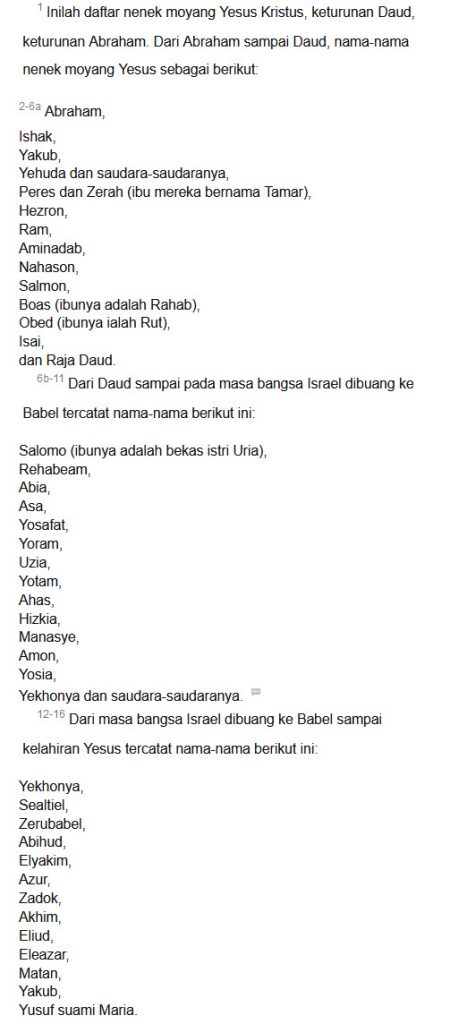
“In Matthew 1:2-16, the biblical form is strange to many Indonesians. (…) The second edition of the Common Language Indonesian New Testament (Alkitab dalam Bahasa Indonesia Masa Kini) discarded the biblical form and came out with a series of ancestral lists. (…) When this was tested, however, many Indonesians did not recognize these lists as genealogical lists, but saw them simply as a list of names. In the light of such reactions, the new edition which is included in the recently published common language Bible has printed these lists as genealogical lists moving downward from the ancestors to the descendants. Thus, verse 2 reads: “From Abraham until David, the names of the ancestors of Jesus are as follows” [which is then followed by a list].”
You can see this in the following screen capture (available right here ):
Similarly to that, Joanne Shetler (1992) describes the impact of the genealogy in the Balangao language of the Philippines:
“Then one day Ama [the co-translator and Christian leader] casually picked up an English New Testament from my shipping-crate desk. He opened it to the first page, Matthew 1, which is a list of names. He stood frozen, staring at it. Incredulous, he asked me, ‘You mean this has a genealogy in it?’
“I said, ‘Yeah, but just skip over that so you can get to the good part.’
“‘You mean this is true?’ he asked. Eyes riveted to the page, he struggled through the list of names.
“Something’s going on here! I got some shelf paper and made a genealogy from Adam to Jesus, from the ceiling clear down to the floor. Ama took it all over the village. He carefully explained, ‘We always thought it was the rock and the banana plant that gave birth to people. But we don’t have their names written down. Look, here are ALL the names—written down!’
“Balangaos had their own creation story, passed down from generation to generation through oral tradition. Ama told me their story:
“Long ago, when there were no people yet on the earth, the rock and the banana plant argued as to which of them would give birth to people and populate the earth. In the course of events, it was the frail banana plant from whom all the people of the earth descended. After producing fruit, the banana plant dies and new shoots spring up for succeeding generations. People have inherited all the frailty of the banana plant and are susceptible to all kinds of dangers and inevitably, death.
“Although their story accounted for man’s frailty, it didn’t have their ancestors’ names written down. A genealogy written was powerful. Balangaos loved that genealogy from the Gospel of Matthew. It proved the Bible was true: for the first time they had the actual names from the beginning of the world — written down.
In the Kölsch translation (publ. 2017), the genealogy is summarized: “From Abraham to David there were fourteen generations. There were another fourteen generations from David until the Jews were deported to Babylon and from Babylon to Jesus there were yet another fourteen generations. This shows that Joseph (Jupp), Mary’s husband, was a descendant of Abraham and David.” (Translation: Jost Zetzsche)