
Following is an Albanian Orthodox icon of the circumcision of Christ of ca. 1760-1780 by Athanasios of Korcë (located in the Church of the Annunciation to the Virgin, Tirane).
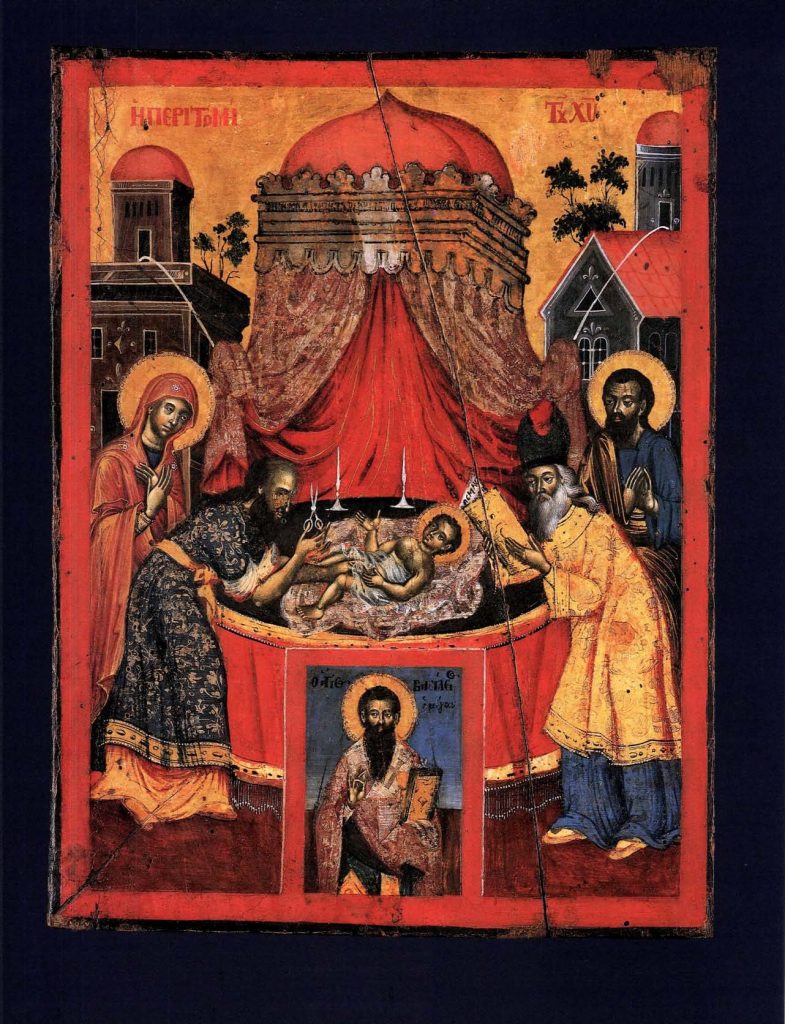
“The Circumcision of Christ is not depicted very often in Byzantine and Post-Byzantine painting, and is not included amongst the Twelve Great Feasts. According to the Gospel of Saint Luke (2:21), Joseph and Mary took Jesus to the temple when he was eight months old to have him circumcised and named. In the Orthodox Church, the Circumcision is celebrated on 1 January together with the memory of Basil the Great, which accounts for the depiction in the present icon of Saint Basil, who often accompanies the Circumcision in both earlier and later works. In the icon from the church of the Annunciation at Tirane, the painter followed a westernizing model presumably derived from an engraving, as in the other works in the same church. The representation is dominated by the ciborium with its rich curtain and decoration, and also by the round altar with its gold-embroidered cover, on which Christ lies, enveloped in a lacy fabric. The luxurious garments worn by the priests contrast with the plain appearance of Joseph and Mary, who are standing nearby.
“The predominant color in the representation is red, contrasting with the gold-yellow used for the background, clothes and halos.
“Equally impressive are the meticulous workmanship in the luxurious garments and diaphanous fabrics, and the naturalistic rendering of objects such as the scissors in the hands of the priest.” (Source: Tourta 2006, p. 164ff.)
The person depicted in the foreground is Basil of Caesarea .
Orthodox Icons are not drawings or creations of imagination. They are in fact writings of things not of this world. Icons can represent our Lord Jesus Christ, the Virgin Mary, and the Saints. They can also represent the Holy Trinity, Angels, the Heavenly hosts, and even events. Orthodox icons, unlike Western pictures, change the perspective and form of the image so that it is not naturalistic. This is done so that we can look beyond appearances of the world, and instead look to the spiritual truth of the holy person or event. (Source )