The Hebrew, Latin, and Greek that is transliterated as “Hosea” in English is translated in Spanish Sign Language with the sign for “repent,” particularly referring to Hosea 6:1 – Hosea 6:3. (Source: Steve Parkhurst)
In Swiss-German Sign Language it is translated with a sign that depicts going away and returning, referring to Hosea going away and finding the prostitute Gomer to marry and then returning home with her (see Hosea 1:2 and Hosea 1:3).
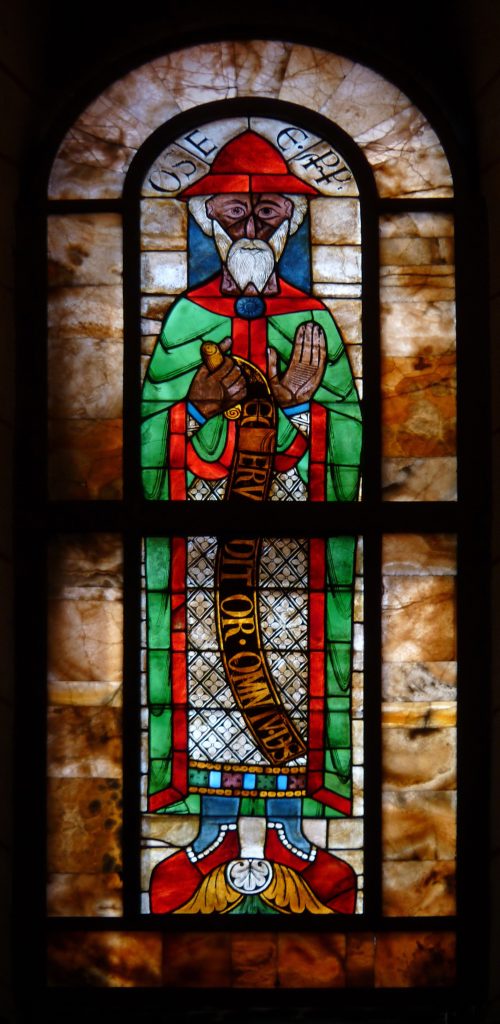
The following is a stained glass window of Hosea in the Augsburg Cathedral in Germany. It is part of the “Prophet windows of Augsburg ” from the 12th century which is assumed to be the oldest remaining set of church windows:
Photo by Hans Bernhard, hosted by Wikimedia Common under the GFDL-CC-BY-SA-all license
Stained glass is not just highly decorative, it’s a medium which has been used to express important religious messages for centuries. Literacy was not widespread in the medieval and Renaissance periods and the Church used stained glass and other artworks to teach the central beliefs of Christianity. In Gothic churches, the windows were filled with extensive narrative scenes in stained glass — like huge and colorful picture storybooks — in which worshipers could ‘read’ the stories of Christ and the saints and learn what was required for their religious salvation. (Source: Victoria and Albert Museum )
The Hebrew, Latin and Greek that is transliterated as “Noah” in English is translated in Spanish Sign Language with a sign that combines the letter N + “boat.” (Source: Steve Parkhurst)
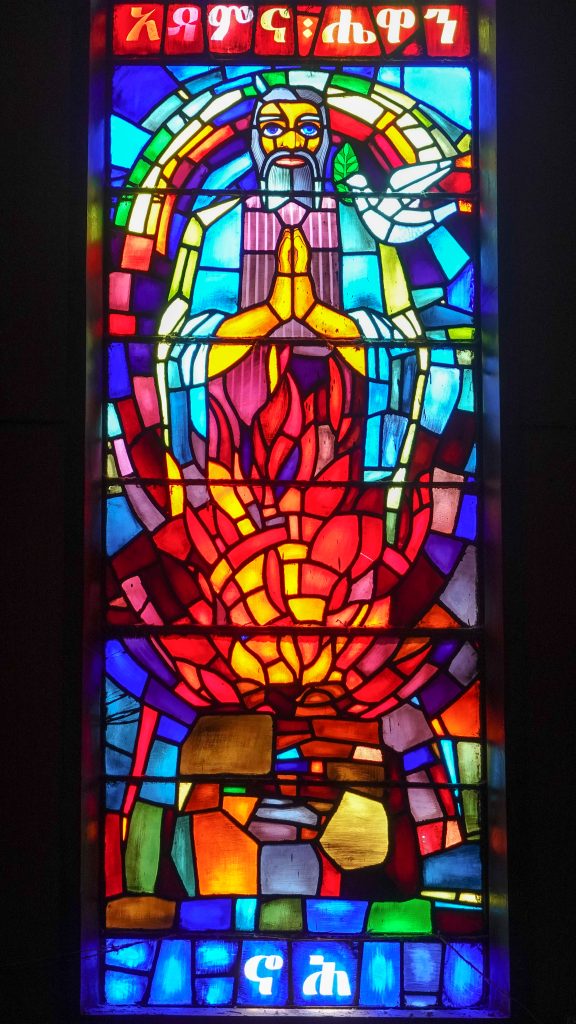
The following is a stained glass window depicting Noah by Endre Odon Hevezi and Gyula Bajo from 1965 for the Debre Libanos Monastery, Oromia, Ethiopia:
Photo by Timothy A. Gonsalves, hosted by Wikimedia Commons under a Creative Commons Attribution-Share Alike 4.0 International license
Stained glass is not just highly decorative, it’s a medium which has been used to express important religious messages for centuries. Literacy was not widespread in the medieval and Renaissance periods and the Church used stained glass and other artworks to teach the central beliefs of Christianity. In Gothic churches, the windows were filled with extensive narrative scenes in stained glass — like huge and colorful picture storybooks — in which worshipers could ‘read’ the stories of Christ and the saints and learn what was required for their religious salvation. (Source: Victoria and Albert Museum )
The Greek that is translated as “put his arms around him and kissed him” or similar in English is translated in the Pfälzisch translation by Walter Sauer (publ. 2012) as is em um de Hals gfalle un hot en abgekisst or “he flung his arms around his neck and smothered him with kisses.” (Source: Zetzsche)
In Elhomwe it is translated as “greeted him by hugging.” (Source: project-specific translation notes in Paratext)
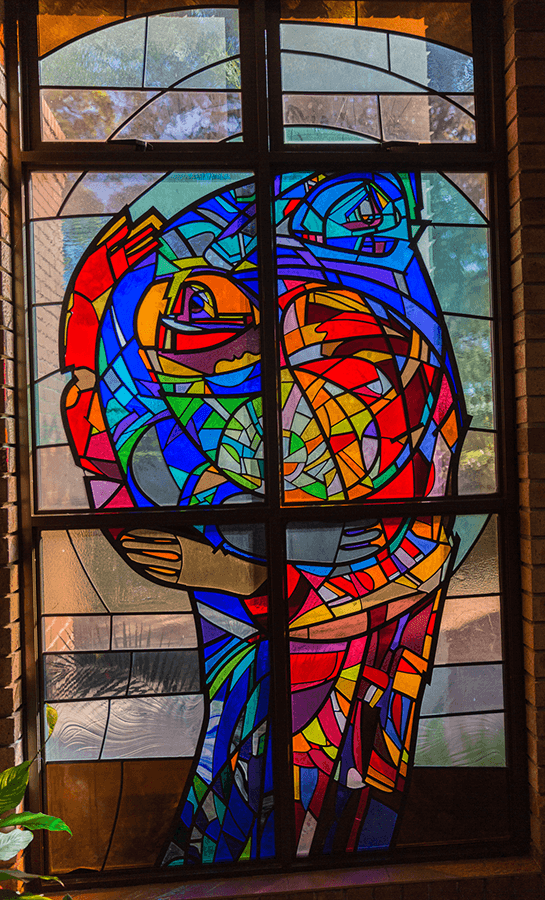
The following is a contemporary stained glass window depicting the father hugging his son in the Catholic Church of the Resurrection in Bryanston, New Zealand:
The Window of Reconciliation: The Father ran to his son and clasped him in his arms (Luke 15:21). This window portrays the reconciliation of God and ourselves: His grace (shown as brilliant light at the centre of united figures) transforms our hearts. The reconciliation we strive for in our country and our world is also portrayed — and there is no easy road to achieving peace on earth and goodwill to all (Luke 2:14). The modern window shows reconciling figures against a desert-like background that symbolises the death and desolation that threaten us. As the great 20th century poet WH Auden wrote: ‘We must love one another or die.’ (Source: Catholic Church of the Resurrection in Bryanston )
Stained glass is not just highly decorative, it’s a medium which has been used to express important religious messages for centuries. Literacy was not widespread in the medieval and Renaissance periods and the Church used stained glass and other artworks to teach the central beliefs of Christianity. In Gothic churches, the windows were filled with extensive narrative scenes in stained glass — like huge and colorful picture storybooks — in which worshipers could ‘read’ the stories of Christ and the saints and learn what was required for their religious salvation. (Source: Victoria and Albert Museum )
Kim Ki-chang (pen name: Unbo) (1913-2001) had been deaf and partially mute since the age of 7. He painted a series of 30 paintings for the “Life of Christ” cycle in 1952 during the Korean War. Kim portrayed Jesus as a seonbi / 선비, or a Joseon Period (1392-1910) gentleman scholar, wearing a gat / 갓 (hat) and dopo / 도포 (robe).
For other images of Kim Ki-chang art works in TIPs, see here.
Painting by Chen Yuandu 陳緣督 (1902-1967)
Housed in the Société des Auxiliaires des Missions Collection – Whitworth University
Image taken from Chinese Christian Posters . For more information on the “Ars Sacra Pekinensis” school of art, see this article , for other artworks of that school in TIPs, see here.
Painting by Wang Suda 王肅達 (1910-1963),
Copyright by the Catholic University Peking, China
Text under painting translated from Literary Chinese into English: The Seventh Commandment
The holy woman washes the Lord, a wicked disciple chastises her
Image taken from Chinese Christian Posters . For more information on the “Ars Sacra Pekinensis” school of art, see this article , for other artworks of that school in TIPs, see here.