Article in Christian Century: What do we mean when we say something is “in the Bible”?

A new database of more than 900 biblical translations presents a prism of cultures, languages, and meanings.

Antoine de Saint-Exupéry’s classic novella The Little Prince has been translated into more than 600 languages and dialects, more than any other nonreligious work in history. Translation of this magnitude is truly a mind-blowing feat, a powerful and ever-growing monument to this beloved story of friendship, love, and seeing with the heart.

My own experience with Bible translation makes me wonder whether the English readers of The Little Prince, the Basque readers of the Printze txikia, and the Zulu readers of the Inkosana Encane are all reading the book in the same manner. Do they approach this book as an original book in their own language, or do they recognize its universal themes packaged into a World War II French pilot’s semi-autobiographical tale that was then successfully translated into their language? In other words, how do we view this text as we read it?

There are seven different translations of Le Petit Prince into English, but of course most readers are not going to go back and compare their favorite translation with the French original in detail. We just don’t read most literature like that. Instead, readers love the story and yearn for its message: deeper relationships that allow us to see things that are “invisible to the eyes.”

But with the Bible, the stakes go up. When we say that something is “in the Bible,” what do we mean? Is it the exact translated text? Or the original Greek, Hebrew, or Aramaic text that we assume is well represented in the translated text? Or maybe it’s no specific text at all but more of an idea of “the message of the Bible”?

You find the rest of this article right here .
Reading Plan on YouVersion: Holy Week Through the Eyes of the Languages of the World

“This devotion that is intended to accompany you from Palm Sunday through Easter Sunday presents Jesus as he approaches his death and is glorified in his resurrection in a way you might not have encountered him: Through the words of languages from around the world. Find out how other cultural norms and concepts find their expression in Bible translation and how that can have a deep impact on your own appreciation and understanding of God’s love for you.”

Subscribe to the 7-day reading plan on YouVersion right here.

The Language of Faith: Bible translation throughout the centuries (article in MultiLingual magazine)

As a working translator, I knew that a “perfect” translation is neither a goal nor a possible reality. I knew that complete and linear transfer of form and meaning between two languages is not achievable, no matter how closely languages might be related. Like all translators, I knew that there is always something “lost in translation” (the favorite trope of journalists writing about anything related to translation). But I also knew that successful translation is still possible because so much can be gained in translation as well.

It’s in the balance between the two that a translation is successful. Since linear and complete transfer from one language to another is unattainable and therefore not a desirable goal, translators try to generate a text that becomes equivalent in its expressive force and meaning by transformation, by inevitably adding changed and new elements.

What if, I imagined, I could build a database to document those changed and new elements that have made their way into some, and maybe eventually all, of the 3,000+ languages into which the Bible has been translated? What if I could collect a listing of those fascinating terms, phrases, and constructs, and then go a step further to associate each with an explanation or a story or a back-translation into English so that they were actually accessible?

See the rest of this article in MultiLingual magazine right here.

Article in Christianity Today: Sign Language Bible Translations Have Something to Say to Hearing Christians

A visitor coming to Bible Gateway to look up John 3:16 has 63 options of English translations. For Christians, reading the same verse with an unfamiliar word or changed-up syntax—or in a more contemporary or lyrical version—can illuminate a biblical principle in a fresh way or strengthen the resonance of the passage.

Jost Zetzsche noticed this effect—but to an even stronger degree—when he began watching sign language translations. Zetzsche, a linguist, is the curator of United Bible Societies’ free Translation Insights & Perspectives (TIPs), an online tool that gathers insights from Bible translations in nearly 1,000 languages, including many sign languages. Zetzsche initially believed that adding these languages was just another part of his TIPs assignment.

“But as I began studying the recorded sign language translations,” he said, “I was astonished at how much I as a hearing person could learn from those languages that I had never experienced in others.”

He recently spoke with Ruth Anna Spooner, the lead translator on the American Sign Language Chronological Bible Translation team since 2019 and a trainer for Deaf-translation teams worldwide, to discuss the power of watching these sign language translations as a hearing person.

Read the rest of this article in Christianity Today right here .

The article is also available in

Spanish: https://es.christianitytoday.com/2025/01/lenguaje-senas-biblia-traduccion-mateo-15-marcos-2-es/

French: https://fr.christianitytoday.com/2025/02/tips-ubs-traduction-langues-signes-fr/

Portuguese: https://pt.christianitytoday.com/2025/03/lingua-sinais-traducao-biblia-mateus-15-marcos-2-pt/

Russian: https://ru.christianitytoday.com/2025/02/zhestovy-yazyk-biblia-perevod-surdoperevod-matfey-15-mark-2-ru/

Ukrainian: https://ua.christianitytoday.com/2025/02/zhestova-mova-bibliya-pereklad-surdopereklad-matviya-15-marka-2-ua/

German: https://de.wycliffe.ch/uebersetzungen-der-bibel-in-gebaerdensprachen-haben-auch-hoerenden-christen-etwas-zu-bieten/

Article on Bible Gateway: The Gift of the Prince of Peace

As we approach Christmas and look back at this long year, “peace” may not be the first word most of us will associate with the last twelve months. Still, I — and I suspect many who read these words — long for exactly that: peace.

The Many Meanings of Peace

If we take time to ponder this longed-for “peace,” we quickly realize its very broad range of meanings.

There is the absence or cessation of strife or war. There’s the inner peace that, similar to the first meaning, is also the absence or cessation of struggles, but within a single person. Google surprisingly offers the “peace greeting” used in many Christian churches as the third possible meaning of “peace.”

Read more right here .

Artículo en Christianity Today: ¿Cómo se traduce ‘lleno del Espíritu Santo’?

La escena bíblica del día de Pentecostés nos permite ver a un Dios que entiende que el idioma va más allá de la mera comunicación.

Tan solo unos días después de la muerte y resurrección de Cristo, el Espíritu Santo fue enviado, y con Él, la capacidad de los apóstoles de hablar en otras lenguas. Los visitantes presentes en ese lugar, que habían viajado de lugares tan lejanos como Irak, Libia e Italia, de pronto pudieron escuchar el mensaje del evangelio en sus lenguas maternas. Escuchar sobre Jesús de esta forma tan profundamente cercana sorprendió y maravilló a la audiencia en Jerusalén y produjo una certeza profunda sobre la veracidad de la misión que Jesús había encarnado. (El hecho de que estos visitantes probablemente pudieran entender el griego o el arameo, las lenguas predominantes en Jerusalén en ese tiempo, remarca esto).

Puede leer el resto del artículo aquí .

Integration into STEP Bible

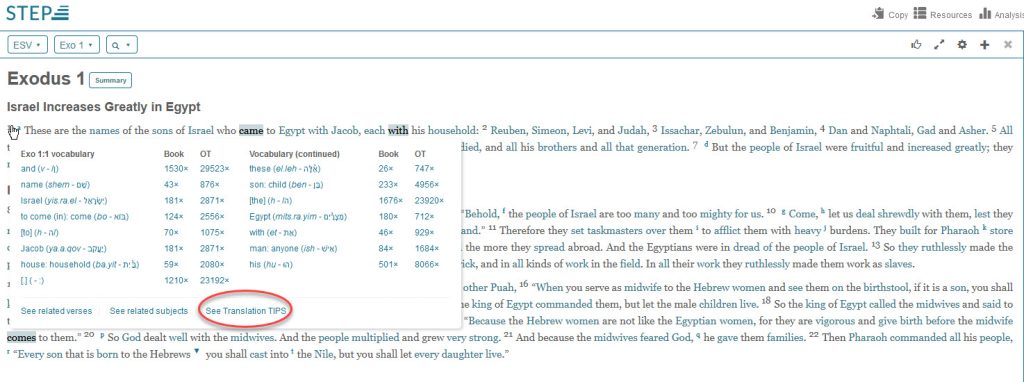
You can now find a link to the Translation Insights & Perspectives data for every verse in the Bible right from within the STEP Bible (stepbible.org) interface. Just click on the verse number and you will see “See Translation TIPS” listed in the lower right-hand corner of the resulting popup window.

Newly designed website for TIPs

We are so pleased to announce that the website for the Translation Insights & Perspectives tool (“TIPs”) has gone through a thorough redesign.

The goals of the redesign included

  • a more intuitive and informative homepage, which now includes a selection of the most popular insights within TIPs and a selection of video-based user testimonies;
  • a tie-in with local Bible societies, with prompts for TIPs users to visit the national or regional society’s website when they first visit the TIPs site; and
  • easy ways to locate data by Bible verse, keyword, or category.

With close to 50,000 individual and often very extensive records within TIPs, users from across the world are now arriving on the TIPs site via many different pages. To help orient and direct those users, the site now contains consistent messaging and guidance on every page.

TIPs came online in 2018 as a collection of translations of key biblical terms that create a clearer understanding of how those concepts are understood across languages and cultures. The target audience for TIPs was twofold: on the one hand, anyone interested in the Bible and the multilingual church; on the other hand, Bible translators who could use those examples in their important work. At its inception, it seemed far-fetched to ever have enough data for every single verse in the Bible or to get beyond the data of a couple hundred languages.

It is with a great sense of gratitude that while still pursuing those target audiences and creating the same multilingual understanding of the Bible, today there is indeed data for every verse in the Protestant, Catholic, and most Orthodox canons. The data now includes

Overall, examples of more than 900 languages have been recorded and documented.

TIPs offers a tremendous opportunity for Bible societies or other translation agencies to engage supporters by linking to tips.translation.bible or by including some of TIPs’ data in their own websites via our API. We are grateful for any suggestions and questions and are eager to help you use the ever-growing treasures in TIPs for your own purposes.